“How Can You Buy and Sell the Sky?”

Seana Mallen’s homage to George Caitlin’s 1850 painting. In 1844 Caitlin documented Mahaska’s journey to London with a group of thirteen other Ioway people.

In 1848, my great-great grandfather Martin Snider erected the first cabin in Montezuma, Mahaska County, Iowa.

The state of Iowa was named after the Ioway natives who split off from the Oneotas around 1650.  In the early 1800s, through a series of treaties, the US government evicted the Ioways from their land.  Mahaska County was named after the Indian Chief Mahaska, or White Cloud in English.

My great-great grandfather used to tell the story of an Ioway Indian who knocked on the door and asked to borrow milk.  The Ioway’s wife had died during childbirth.  My grandfather agreed but admitted he was a bit perplexed when the man went into his barn and led his cow away.  However he did not stop him.

When the baby was weaned, the Ioway brought the cow back.  Later during the “Indian uprising” my grandfather was the only settler in the area the Ioway did not attack.

European colonists viewed the Native people as either vicious barbarians or as Noble Savages.  The Noble Savage image dates back to Bartolome de Las Casa’s 1530 writings about American natives.  1987 American high school textbooks summarized this history.

“For thousands of centuries –centuries in which human races were evolving, forming communities, and building the beginnings of national civilizations in Africa, Asia and Europe-the continents we know as the Americas stood empty of mankind and its works.”  The story of Europeans in the New World “is the story of the creation of a civilization where none existed.”  – Charles C Mann, 1491

This American myth has lasted over five centuries.  In the book 1491, Charles C. Mann calls it Holmberg’s Mistake.

“The supposition that Native Americans lived in an eternal, unhistoried state – held sway in scholarly work, and from there fanned out to high school textbooks, Hollywood movies, newspaper articles, environmental campaigns, romantic adventure books and silk-screened tee-shirts.” – Charles C. Mann, 1491

Historically the North American Indian population prior to Columbus was estimated to be around 1.15 million with a total of 8.4 million throughout the Americas.  Mann outlines new evidence that points to an American population more likely between 90 to 112 million people.  New estimates suggest by the sixteenth century, 80 to 100 million Indians were wiped out by the European smallpox.

Mann also presents evidence the Indians were not just Noble Savages living off the land; rather they were active agents agriculturally shaping the land.  Mann writes the Amazon rainforest is not wild.  Rather this wet desert is the remnant of a large, managed landscape.

The Native Americans were not simply farmers or hunters.

In 1100AD, at the mouth of the Mississippi River was the port city called Cahokia.  The largest concentration of people north of the Rio Grande, hundreds of high-peaked, deeply thatched roofs like those on traditional Japanese farms were built around a four-level earthen mound bigger than the Great Pyramid of Giza.

Further south, the Mexican Olmec developed a dozen different systems of writing, established wide trade networks, tracked the orbits of planets, created a 365-day calendar more accurate than the Europeans’ and recorded its histories in books of folded bark paper.  The Mexican capital of Tenochtitlan was larger than Paris.

The South American Inka empire was bigger than the Ming Dynasty in China, Ivan the Great’s Russia, the Ottomon Empire and the Triple Alliance.

The use of zero considered “one of the greatest single accomplishments of the human race” was first whispered around 600BC when the Babylonians tallied numbers in columns.  India used a zero in the first few centuries AD.  Europeans began using it in the 12th century when the Arabs brought it to them.

The first recorded zero in the Americas was in a 357AD Mayan carving.  Before that, a calendrical system based on the existence of zeros was used.

Seana Mallen’s painting is based on Edward Curtis’ photograph. Curtis’ life work was to document the tragic decline of the Native American peoples.

“Man did not weave the web of life.  He is but one strand within it.  What we do to the web we do to ourselves.  All things are bound together.  All things connect.”  Chief Seattle.

When we read the “sage” sayings of White Cloud and Chief Seattle, it is not simply the Noble Savage’s spirituality or mythology.  Their wisdom comes from millennia of experience and reflects the “remarkable body of knowledge about how to manage and improve their environment.”

I highly recommend 1491 to open your eyes to a new perspective on history.  It is not the easiest read but it is very interesting.

Currently on display during America Week, Seana Mallen’s paintings can be seen in the Seef Mall near the Starbucks.

The Potter

‘Why is a potter second only to God?’

The boys shook their heads in unison and Iskander explained, ‘Because God created everything out of earth, air, fire and water, and these are the very same things that a potter uses to make his vessels. When a potter makes something, he acts in the image of God.’

‘Are you more important than the Sultan Padishah then?’ asked Mehmetcik, astonished.

‘Not on earth,’ replied Iskander, ‘but perhaps in Paradise.’

–          By Louis de Bernieres from Birds Without Wings

I sculpted my clay into a woman.  She dried in the air before being baked in the kiln’s fire.  Pleased she emerged intact, Michelle, my teacher and I discussed many, many options for the finishing touch – color.

Michelle guided me towards some tried and true glazes, encouraging me to keep it simple.  I choose only two colors.  I poured Fire Opal, a pinkish/blue over her headdress and powdered her face white.  Having prepared my creation the best I could, I let go.  My woman faced the fire alone.

As I walked into the studio, I was anxious to see how she managed when mixed with the other creations and put under pressure.

To summarize, she fared poorly.

Under the combination of the elements, she cracked.  My intended colors did not stick.  The vibrant pinks and blues melted away.  Their residue burnt her surface and scorched it brown.  Although she retained her original shape, she did not turn out at all like the woman I imagined.

And then I wondered, ‘If God is a potter, how disappointed does he feel when looking down at the earth? ‘

Finding Universal Oneness in a Courtyard

Majlis Gallery Courtyard Dubai

The Majlis Gallery is the oldest art gallery in Dubai.  When we ducked through its entrance, I was delighted to find myself in an interior courtyard.  Opened in 1979 in an old Bastikiya wind tower house, it was the kind of place I always imagined we would live in.

We strolled under the Christ’s thorn tree through the central courtyard.  A gallery and working studio, a man was busy framing as a woman painted.  In the main gallery Lynette Ten Krooden’s landscapes were on display.  And the owner, Alison Collins, was trying to soothe a crying baby in a pram.

“My grandson is so tired,” she said.  “I am waiting for my daughter to come back.  Please take a program.”

I admired Krooden’s paintings before crossing into another room.  A man was seated on the sofa working on a large painting.  We greeted each other.

“You are working today,” I said nodding at his paint palette.

“Actually I am on vacation but decided to come in and do some work while it is so hot outside,” he said.

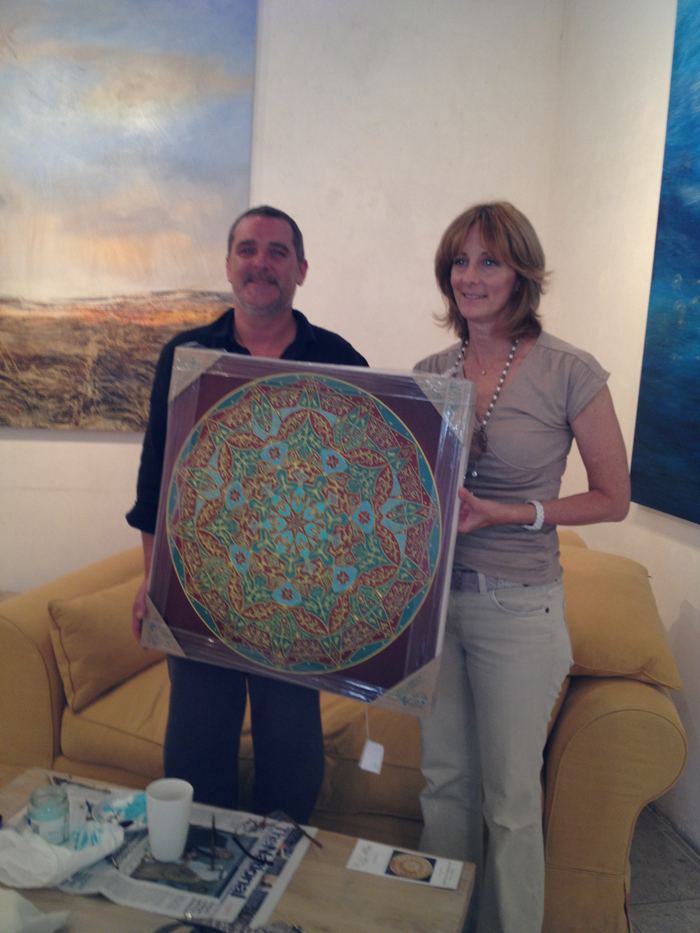
I took a step closer to see what he was working on.  It was a large maroon and green circle with intricate designs like a Tibetan mandala.

Artist Stephen E Meakin at Majlis Gallery in Dubai

He began explaining to me how Orchis 7 was created.

“Seven, you know, is the number of the days in the week corresponding to the creation of the earth, the seven colors of the rainbow and the seven heavens where the order of the angels dwell.  Seven is the universes’ dynamic wholeness. ”

He pulled out his compass and ruler and continued to explain the relationship between the circle and the triangle.

I was talking to Stephen E. Meakin the Sacred Geometer.

As Meakin described how a circle can be divided and the symbols he included in his work, I listened with wonder.   Of all the artists I could have met, I found it amazing I met the one whose work was based on Pythagoras’ sacred geometry.

The first philosopher, Pythagoras said

“All Things consist of Three.”

Sacred Geometry Triangle

α2 + β2 = γ2

Pythagoras taught everything in nature could be divided into three parts and no one could become truly wise if they did not view each problem as being diagrammatically triangular.

“Establish the triangle and the problem is two-thirds solved” Pythagoras said.

For nearly a half an hour Stephen Meakin and I discussed sacred geometry.  My sister and mother wondered in and joined our conversation.   The feeling that somehow this meeting was Divinely contrived stayed with me the whole time.  I asked him whether I could take a photo and thanked him for explaining his ideas.

“To me each painting is sacred,” Meakin said.  “But in the end it really is just art, isn’t it?”

The Majlis Gallery is open everyday except Friday.  They acknowledge parking can be difficult.  They make some suggestions on the website.

Stephen Meakin’s Desert Rose exhibit is currently at the Dubai Fairmont Hotel.

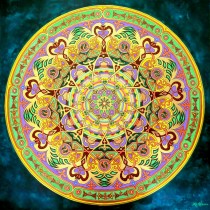
CYGNUS  – The Swan is one of the paintings.

Cygnus by Stephen E. Meakin Acrylic on Canvas

About Cygnus, Stephen Meakin writes on his website:

“The Enneagon is an extraordinary polygon with mystical connotations.  It is very seldom used in sacred architecture, even though it is the highest number that consists of one digit.

The number nine is full of symbolism.  It consists of three triads announcing the end of a cycle and the beginning of a new one. The human embryo needs nine months of growth before birth. Egyptian, Celtic and Greek myths have an ennead of nine gods and goddesses, representing the entire archetypal range of principles.  Nine is the number of perfection.”

(Stephen 11/03/2012)

Although the paintings range from 3×3 to 6×6 feet, Meakin said “like feminine energy, the twenty paintings are hidden within a very masculine structure.”

If you feel some softness as you walk along the Fairmont’s marble hallways, stop and see whether you have stumbled upon one Stephen’s inspired circles.

The Rabbit Triad – a little known bunny’s tale

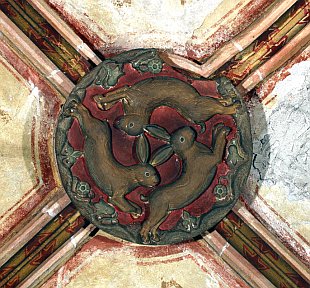
Medieval Roof Boss Wissembourg France, Three Hares Project

The secret is not great when one knows it.

But it is something to one who does it.

Turn and turn again and we will also turn,

So that we give pleasure to each of you.

And when we have turned, count our ears,

It is there, without any disguise, you will find a marvel

–   1576 Dutch engraving from a book by Jurgis Baltrušaitis

I unearthed another interesting rabbit fact while doing my research.

In 1991 archaeologist Tom Greeves wrote about the Three Hares symbol found in Dunhuang, China.  He noted a similar symbol was used in European churches.  Over the next decade, photographer Chris Chapman and art historian Sue Andrews joined Greeves on a worldwide rabbit hunt.

Map of locations where The Three Hares were found

The Three Hares were not as elusive as one might imagine.  The trio discovered a trail of the trinity rabbit along the Silk Trade Route.  The earliest Three Hare symbol found in China was encircled in a sacred lotus.

The Tao-Te Ching says

“The Tao produced one, one produced two and two produced three.”

Baseplate detail found in Trier, Germany. Three Hares Project

To the Chinese three was the perfect number representing wholeness and fulfillment.

Three, the triad, and the triangle are universally regarded as a fundamental number or even a perfect number expressing the divine order in the cosmos and mankind.

Buddhists find fulfillment in the Triple Jewel – Buddha, Dharma and Sangha.

Hindus view the threefold manifestation of the Godhead as Brahma, Vishnu and Shiva.

In the Great Work, alchemist used the three elements sulfur, mercury and salt.

Ancient Persians had a threefold motto: “Good thoughts, Good words and Good deeds.”

And the Christian trinity – Father, Son and Holy Ghost – is an example of a sacred triad.

Emmanuel Swedenborg’s angels told him,

“For love, wisdom and usefulness are three things that cannot be separated…. Nothing is complete or perfect unless it has this trinity…You can see why the number ‘three’ in the Word can be understood spiritually to mean ‘complete and total’.”

Conversations with Angels, pg. 144 and 145

A child reveals the presence of a mother and a father.  A tree trunk reveals the presence of leaves above and roots below.

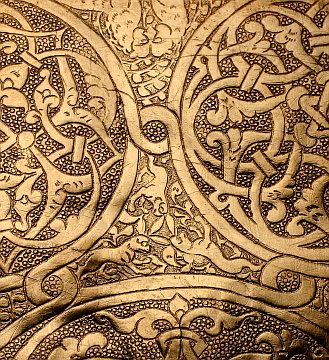
The Three Hares are both a puzzle and a perfect symbol.

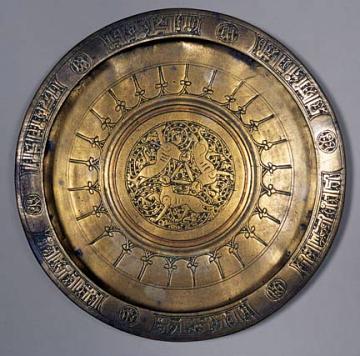
Iranian Tray, Three Hares Project

Each TWO-eared hare gets its second ear from another hare.  It is only when the THREE are gathered together as ONE that they are whole and complete.

You can join in the rabbit hunt.

When traveling the world if you find a Three Hare symbol, you can forward your photo with the details to Sue Andrews, Chris Chapman or Tom Greeves at The Three Hare Project.

The Rabbit Moon

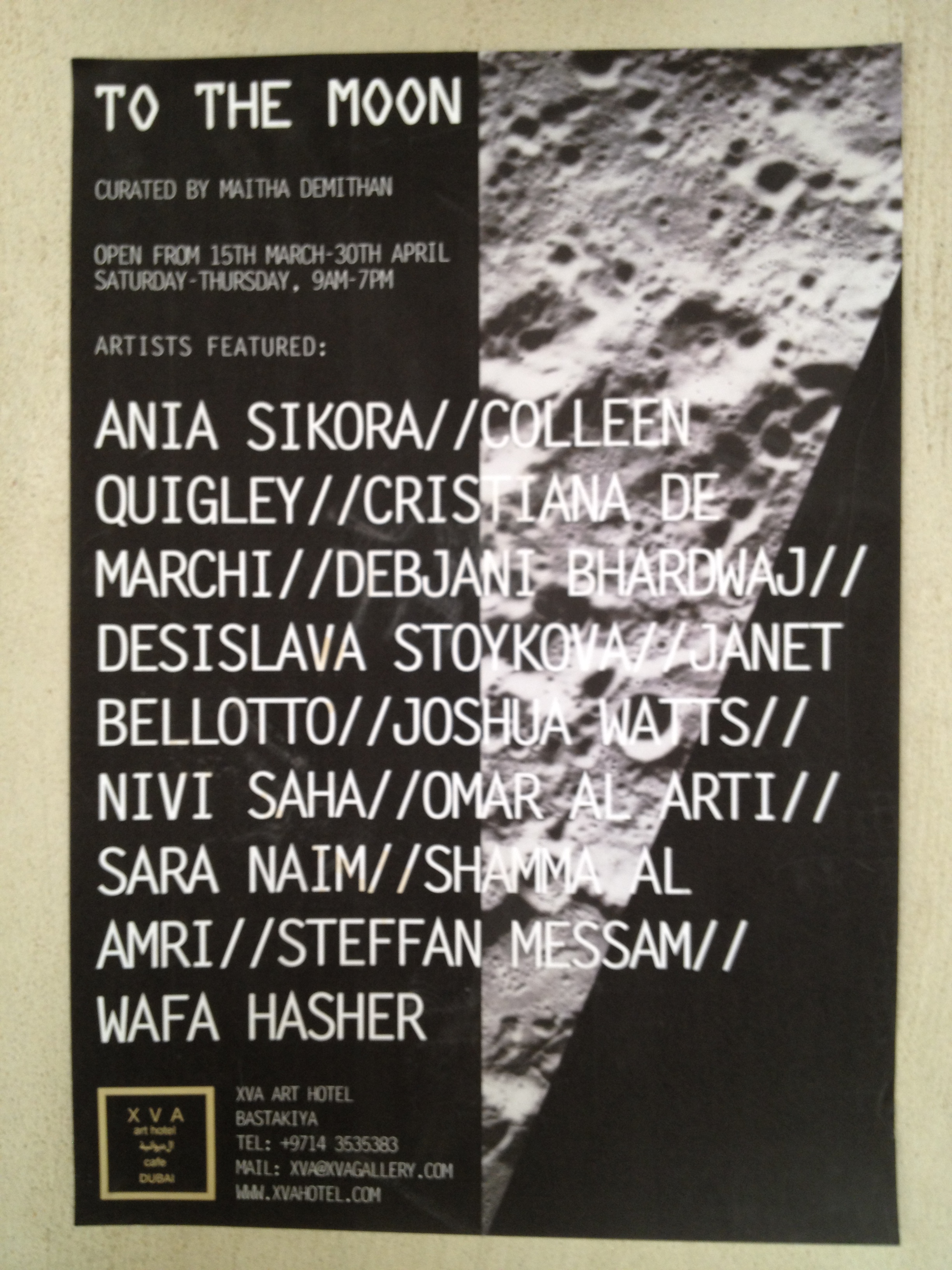
To The Moon Exhibit

While working on a rabbit sculpture for my daughter, I did a little research on rabbits and the moon.  I was reminded of an exhibit we attended in Dubai at the XVA Gallery.

Featuring fifteen artists, the exhibit TO THE MOON explores our relationship with the moon in oil and ink paintings, digital prints, metal and ceramic sculptures.

Our closest celestial body, the Moon’s twenty-eight day cycle of disappearance then reappearing holds deep archetypal meaning in all religions and traditions.  Twenty-eight was the number of days Buddha meditated under a fig tree.  Indian Brahmans teach there are twenty-eight angelical states above the human condition.  In Islam the moon is a sign of Allah’s power and its twenty-eight day cycle is the calendar for all canonical activities.

Faces of the Moon by Shamma Al Amri

Associated with the unconscious, water, dreams and the imagination, the moon is feminine and denotes fertility.  The goddesses Isis, Ishtar, Artemis, Diana, Heng-ugo, Ixchel and Hecate were associated with the moon in ancient myths, legends, folklore and poetry.

What I find amazing is that globally rabbits or hares are associated with the moon.

The Rabbit that Nibbled Soft Moon Cheese by Debjani Bhardwaj

Aztecs (Central Mexico) believed the moon was the daughter of the rain-god Tlaloc.  The moon was depicted as “crescent-shaped water receptacle with a rabbit silhouette”.

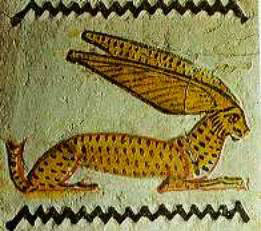
Egyptian Hare

Osiris (Ancient Egypt) was in the shape of a hare before being torn to pieces and thrown into the Nile to ensure the seasonal cycle of renewal.  The Chinese jade rabbit pounds the medicine of immortality in a mortar under a fig-tree.   The goddesses Ostara (Anglo-Saxon), Eostre (Celtic), Freya (Norse) and Kaltes (Siberia) either rode rabbits or had them as their companions.

The Algonquin, Ojibwa and Sioux Winebago Indians’ (North America) mythic ancestor Menebuch, the Great Hare, came to earth to teach humans the skills they have today.  After the Great Flood, Menebuch left the earth anew and went away.

The TO THE MOON exhibit proves the adage that everything old is new again and speaks to the moon’s influence on the collective human psyche.  The exhibit might still be hanging although a new exhibit TOY STORY was to begin April 19th.

During my research, I discovered the Endicott Studio.  Writer, artist and founder Terry Windling wrote an article on The Symbolism of Rabbits and Hares.  I also relied heavily on one of my other favorite resources, The Dictionary of Symbols.

Life as Art – ALWAN338

ALWAN338 at Bohemia

LmbK described Life as Art when the first creation provided the idea for the second making life a multi-layered experience.

Or walking around ALWAN 338 you might describe Life as Art.

ALWAN 338 was led by one of Bahrain’s preeminent arts advocates, Bayan Al Barak Kanoo.  Since 1998 she has promoted new artists and actively sought to creatively engage the community.

This year in conjunction with the Spring of Culture Festival, her gallery the Al Riwaq Art Space, with the aid of government and non-government supporters, teamed up with its neighbors in the 338 restaurant block to create a community space for art.

Last week my friend and I drove over to ALWAN338.

As the threshold for ALWAN338, Zoe’s restaurant, got a facelift.  The outside was painted a bright blue with gold, oriental-style motifs.  Mercedes Gonzalez de Garay’s graphic cut-outs of old Egyptian movie stars hung between the windows.  Across the street from Mirai, Scottish artist Alan Goulbourne created a wood sculpture on the plywood around the vacant lot.

Late as usual, we hurried over to Al Riwaq to meet a third friend.  She had already toured al mahata – the station – exhibit featuring Egyptian artist Mohamed Sharkawy.  His tarbouched-figures graphically interpreted Old Cairo.

Playing catch-up I dashed through the rooms.

Waheedah Mallulah at ALWAN338

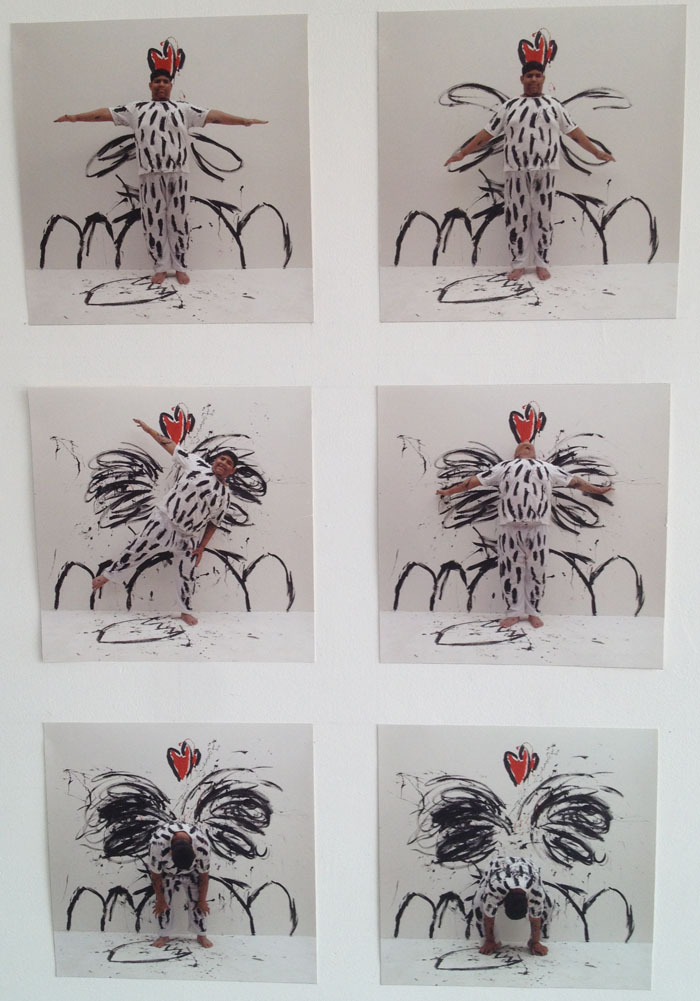
Waheedah Mallulah’s Big Rooster and the Little One, a montage of black, white and red photos of Mallulah doing yoga-for-roosters, delighted the rooster-lover in me.    The gift shop was transformed into a space for Zilia Monteiro’s videography.

Mohamed Sharkawy at ALWAN338

I climbed the curved stairwell to the second floor where Sharkawy’s Egyptians continued to go about their daily business.

Next to the colorful, but undifferentiated beings, a young man sat on the couch, his earphones around his neck, working on his laptop.  He smiled at me and asked whether or not I had seen the exhibit at Bohemia, the building encircled with flying bicycles.

I told him no, but said “we were on our way over there”.  I asked him if he was working.

He said, “I am finishing up an assignment.  I go to school at NYIT.”

“Good luck.”  We smiled at each other and said good-bye.

The renovation of the old Bohemia restaurant into a four-story exhibition for I AM THE OTHER is the crowning achievement of ALWAN338.  Visiting-artist Mo Reda connected with over 20 Bahrain-based artists to comment on

“how do we exclude the OTHER, when we ourselves are the OTHER to those around us?”

This is a critical question in a time when the EU considers whether “to let” Turkey join their union, after France and Switzerland created legislation responding to their Muslim populations, and in the USA where mainstream Americans describe the OTHER as Teacup Conservatives, uber-rich executives or illegal alien-workers.

A microcosm of global politics, Bahrain has faced its own challenges over the past year.  As the diverse community members entered into the National Dialogue, the question of Who am I?  Am I the OTHER? became particularly relevant.  ALWAN338 gave established and emerging artists an opportunity to publicly add their distinctive “voice” to the dialogue and answer the question in their unique ways.

Bahraini, Bahrain-immigrants and Arab artists of “mixed” parents presented their personal experiences as the OTHER.   Being and raising third-culture children, the exhibit felt relevant to me.

However, I found the most striking artists were Bahrain Contemporary Arts Association member Nader Abdulrahim, street-artist Huvil and architect Maysam Nassar.

Maysam Nasser at ALWAN338

The fact that they can publicly describe their perspectives regarding truth and current social issues speaks volumes on Bahrain’s openness compared to its neighbors.

But the ALWAN338 artists are not just visual artists or limited to these two venues.

DJs will be performing live at The Meat Company, an excellent place to go during this pre-summer lull in the heat.

Architect Sara Kanoo created a temporary “Park”; an outdoor stage, library and cinema screen.   In this under-utilized public space, films “Life in the Day” (April 10, 7:30pm) and “Man Without a Cellphone” (April 12, 7pm) will be shown; jazz-band 13th Note (April 13, 8pm) and Watan (April 20, 8pm) will perform; and several workshops for kids (Spray Painting, Cartoon Animation) and Adults (Photography, Mosaic, Street Art Intervention) will be held.

My friends and I left Bohemia hoping it would become a permanent gallery and walked to Coco’s for an outdoor lunch.  Coming towards us was the tall, slim man I saw earlier at Al Riwaq.

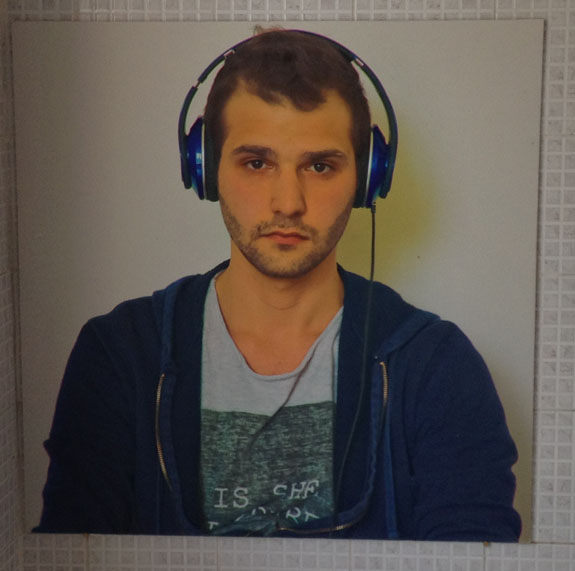
Only then I knew his name.  Ghalib Zuhair.  He was the Iraqi artist whose visage was featured on the  I AM THE OTHER cover.

Ghalib Zuhair at ALWAN338

According to his bio, he is looking for a place to call home.

“I just saw your installation in the gallery.”  Being recognized, he beamed.   “How long have you been doing photography?” I asked him.

“About twelve years.  This is my second exhibit.”

“Congratulations.  You did a great job.  It seems like Bahrain is home for you.”

“For now,” he smiled.

That, my friends, is Life as Art.

ALWAN338 continues through April 22nd from 10am-10pm.  The entire schedule is on the Al Riwaq website and exhibit programs can be found at the restaurants in Adliya where the ALWAN338 flag is displayed.   The restaurants that have given support and invite you to experience art-camaraderie, Bahraini-style include Blaze Burgers, Block 338, Café Italia, Mezzaluna, Tian and Masso at the Palace Hotel.

In case you don’t remember Bohemia (next to the Adliya Café Lilou which for some reason is not a sponsor), you can plug this address into your GPS:  Adliya, Block 338, Road 3816, Building 502.

One Breath Long – the Haiku

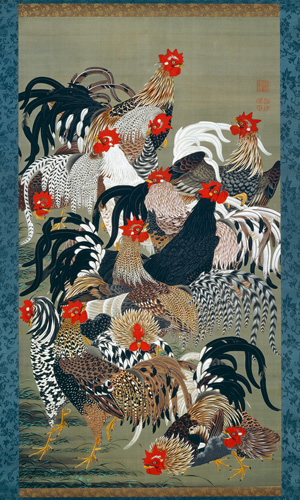
Thirteen Roosters by Ito Jaskuchu at the National Gallery of Art

A map of chicken land

noisy with red capitals,

black lakes, white highways

– by Emily from New York

While ruminating on the poet Mahmoud Darwish, the National Gallery of Art sent me an invitation to write a Japanese-inspired haiku.  As my artist-sister and her Japanese family were visiting us the timing was serendipitous.

Haikus are expressions of moments in time.  Through simple language, they invite the reader to experience nature as the writer attempts to capture it.

One breath long, haikus traditionally are three lines of 5, 7 and 5 syllable words.  In English this translates into 10 – 14 syllables or 6 – 10 words.

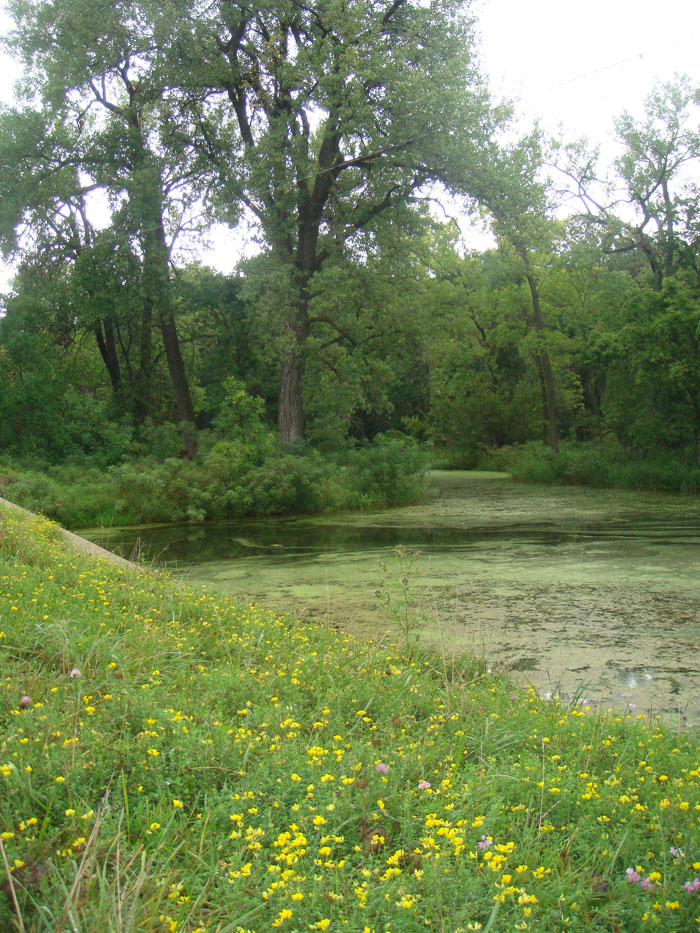
Near Lake Okoboji, Iowa

Old pond –

Frog jumps in

Sound of the water

–          Matsuo Basho, 1644-1694, Japanese poet

April is poetry month at the National Gallery of Art in Washington DC.

On exhibit is the work of the Japanese treasure Ito Jakuchu (1760-1800).  This is the first time his Colorful Realm of Living Beings has been displayed outside of Japan.  The 30-piece bird and flower painting collection is normally kept at the Shukokuji monastery in Kyoto.  Displayed in one room, the paintings signify all living beings gathered around Buddha.

An American national treasure, the National Gallery of Art is free and open to anyone visiting Washington DC.

In fact, the haiku invitation is for everyone.  It’s an opportunity to sit outside and experience a tree, spring flower or bird.  Breathe.  Then try to take that moment and express it in words.

You can read more about the exhibit, the 1,000 year-old art of haiku writing and submitting your haiku at nga.gov/jakuchu.

Previous Older Entries Next Newer Entries

Archives

Tales by Chapter