The Rabbit Triad – a little known bunny’s tale

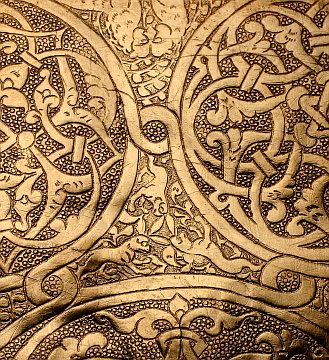
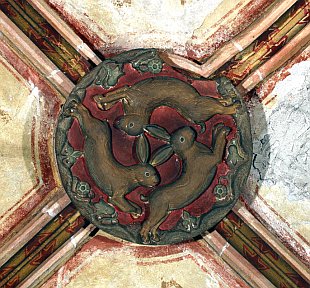
Medieval Roof Boss Wissembourg France, Three Hares Project

The secret is not great when one knows it.

But it is something to one who does it.

Turn and turn again and we will also turn,

So that we give pleasure to each of you.

And when we have turned, count our ears,

It is there, without any disguise, you will find a marvel

–   1576 Dutch engraving from a book by Jurgis Baltrušaitis

I unearthed another interesting rabbit fact while doing my research.

In 1991 archaeologist Tom Greeves wrote about the Three Hares symbol found in Dunhuang, China.  He noted a similar symbol was used in European churches.  Over the next decade, photographer Chris Chapman and art historian Sue Andrews joined Greeves on a worldwide rabbit hunt.

Map of locations where The Three Hares were found

The Three Hares were not as elusive as one might imagine.  The trio discovered a trail of the trinity rabbit along the Silk Trade Route.  The earliest Three Hare symbol found in China was encircled in a sacred lotus.

The Tao-Te Ching says

“The Tao produced one, one produced two and two produced three.”

Baseplate detail found in Trier, Germany. Three Hares Project

To the Chinese three was the perfect number representing wholeness and fulfillment.

Three, the triad, and the triangle are universally regarded as a fundamental number or even a perfect number expressing the divine order in the cosmos and mankind.

Buddhists find fulfillment in the Triple Jewel – Buddha, Dharma and Sangha.

Hindus view the threefold manifestation of the Godhead as Brahma, Vishnu and Shiva.

In the Great Work, alchemist used the three elements sulfur, mercury and salt.

Ancient Persians had a threefold motto: “Good thoughts, Good words and Good deeds.”

And the Christian trinity – Father, Son and Holy Ghost – is an example of a sacred triad.

Emmanuel Swedenborg’s angels told him,

“For love, wisdom and usefulness are three things that cannot be separated…. Nothing is complete or perfect unless it has this trinity…You can see why the number ‘three’ in the Word can be understood spiritually to mean ‘complete and total’.”

Conversations with Angels, pg. 144 and 145

A child reveals the presence of a mother and a father.  A tree trunk reveals the presence of leaves above and roots below.

The Three Hares are both a puzzle and a perfect symbol.

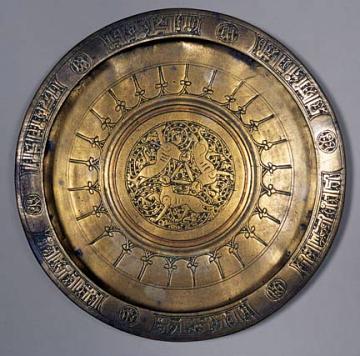
Iranian Tray, Three Hares Project

Each TWO-eared hare gets its second ear from another hare.  It is only when the THREE are gathered together as ONE that they are whole and complete.

You can join in the rabbit hunt.

When traveling the world if you find a Three Hare symbol, you can forward your photo with the details to Sue Andrews, Chris Chapman or Tom Greeves at The Three Hare Project.

The Rabbit Moon

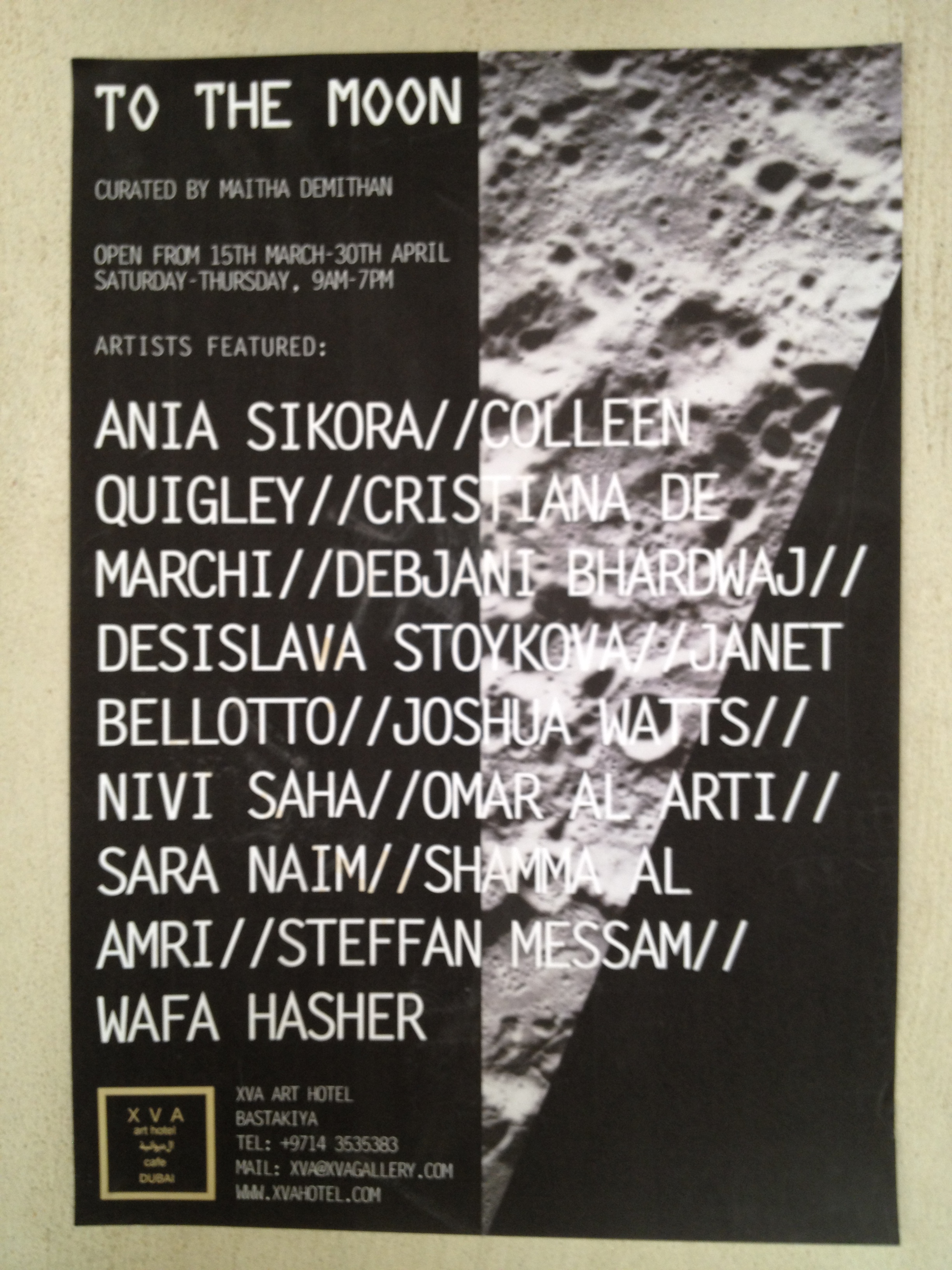
To The Moon Exhibit

While working on a rabbit sculpture for my daughter, I did a little research on rabbits and the moon.  I was reminded of an exhibit we attended in Dubai at the XVA Gallery.

Featuring fifteen artists, the exhibit TO THE MOON explores our relationship with the moon in oil and ink paintings, digital prints, metal and ceramic sculptures.

Our closest celestial body, the Moon’s twenty-eight day cycle of disappearance then reappearing holds deep archetypal meaning in all religions and traditions.  Twenty-eight was the number of days Buddha meditated under a fig tree.  Indian Brahmans teach there are twenty-eight angelical states above the human condition.  In Islam the moon is a sign of Allah’s power and its twenty-eight day cycle is the calendar for all canonical activities.

Faces of the Moon by Shamma Al Amri

Associated with the unconscious, water, dreams and the imagination, the moon is feminine and denotes fertility.  The goddesses Isis, Ishtar, Artemis, Diana, Heng-ugo, Ixchel and Hecate were associated with the moon in ancient myths, legends, folklore and poetry.

What I find amazing is that globally rabbits or hares are associated with the moon.

The Rabbit that Nibbled Soft Moon Cheese by Debjani Bhardwaj

Aztecs (Central Mexico) believed the moon was the daughter of the rain-god Tlaloc.  The moon was depicted as “crescent-shaped water receptacle with a rabbit silhouette”.

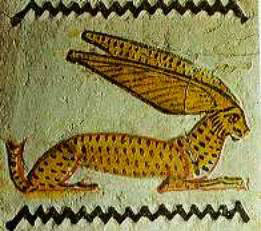
Egyptian Hare

Osiris (Ancient Egypt) was in the shape of a hare before being torn to pieces and thrown into the Nile to ensure the seasonal cycle of renewal.  The Chinese jade rabbit pounds the medicine of immortality in a mortar under a fig-tree.   The goddesses Ostara (Anglo-Saxon), Eostre (Celtic), Freya (Norse) and Kaltes (Siberia) either rode rabbits or had them as their companions.

The Algonquin, Ojibwa and Sioux Winebago Indians’ (North America) mythic ancestor Menebuch, the Great Hare, came to earth to teach humans the skills they have today.  After the Great Flood, Menebuch left the earth anew and went away.

The TO THE MOON exhibit proves the adage that everything old is new again and speaks to the moon’s influence on the collective human psyche.  The exhibit might still be hanging although a new exhibit TOY STORY was to begin April 19th.

During my research, I discovered the Endicott Studio.  Writer, artist and founder Terry Windling wrote an article on The Symbolism of Rabbits and Hares.  I also relied heavily on one of my other favorite resources, The Dictionary of Symbols.

Bird Pranayama – Breathing Lessons

“Out of the clouds I hear a faint bark, as of a faraway dog. It is strange how the world cocks its ear to that sound, wondering.   Soon it is louder: the honk of geese, invisible, but coming on.

The flock emerges from the low clouds, a tattered banner of birds, dipping and rising, blown up and blown down, blown together and blown apart, but advancing, the wind wrestling lovingly with each winnowing wing. When the flock is a blur in the far sky I hear the last honk, sounding taps for summer.

It is warm behind the driftwood now, for the wind has gone with the geese.

So would I — if I were the wind.”
― Aldo Leopold, The Sand County Almanac

We don’t have any trees in our backyard.  If the neighbors’ trees didn’t love extending their branches over the twelve foot wall to touch our house, the morning sun would beam straight into our bedroom room.  Just as we appreciate the trees’ shelter, the birds love congregating among the leaves.

This morning just as the dawn crept around the blackout curtains, a bird began his morning singing.  Despite the air conditioner’s roar, his effort pierced my sleep.

Tired, I felt like cursing him but held my thoughts and listened, waiting for him to go away.

His song was full of effort.  In my mind’s eye, I could see him deeply inhaling as if lifting his wings up into the sky then vigorously closing them, forcing the air through his entire body.  The force produced his loud chirp.  He continued at least five minutes.  It reminded me of the pranayama or breathing exercise I did just the previous evening in my yoga class.

As we lifted our arms above our heads, we inhaled.  Then quickly and with strength we pulled our arms down to our sides, releasing the breath.  It was a very vigorous exercise.

The bird slowed down and I listened, wondering whether he was finished.

But he was not.

His breathing evened out and became quieter as he inhaled deeply then let his exhale gently carry the song.  The pace reminded me of nadi shodana breathing.

After a few minutes of nadi shodana, he started his third round, the vigorous bhastrika.  For the bhastrika  or bellows breath, the inhale is rather quiet as the effort goes towards strongly contracting the abdomen, forcing the air out the nostrils.  It is considered to be an advanced breathing technique.  Unlike me, the bird was quite an expert and did several rounds without passing out.

I knew the ancient yogis used to look to nature – the plants, birds and animals – for answers to their deepest questions.  In the morning sun, the bird gathered his prana for the day.  And I wondered – was it the study of birds the led the yogis to create pranayama, a breathing exercise said to revitalize the body?

Like the Taoists, shamans and yogis of millennium past, after years of carefully observing nature’s patterns and comparing conventional wisdom against what the land showed him, Aldo Leopold too came upon an answer to his deepest question – the idea of a land ethic.

In The Sand County Almanac, he described the lessons he learned observing nature and considered how man might learn to live as a steward rather than a thief.  And although he said poets did a better job describing nature’s beauty, in the end, all the hours he spent watching geese and storks while taking copious notes turned him into a poet.

For Earth Day April 22, 2012, Green Fire the documentary about Aldo Leopold makes its television debut.  It will be shown six times on Wisconsin Public Television between April 20 – 27.

The Aldo Leopold Foundation has many outreach programs for educators and interested people.  By watching Green Fire or looking at the foundation’s website, you can learn how to teach children that eggs come from a chicken and not a grocery store.

Out of It – A Novel

Out of It by Selma Dabbagh

In 1973, Mahmoud Darwish wrote,

“Gaza has not mastered the orator’s art. Gaza does not have a throat. The pores of her skin speak in sweat, blood and fire.”  – Journal of an Ordinary Grief

In its review of the novel Out of It, the Egyptian Independent said author Selma Dabbagh’s “portrayal of Gaza is, in some ways, not so different from the gaping wound Palestinian poet Mahmoud Darwish presents.”

The wound still hasn’t healed.  In fact it has turned septic and widened as now five generations sit within its weeping gap.  But 30 years later, Gaza has found an orator.

British-Palestinian, Dabbagh is like one of the “PLO Brats” she created;  the English-speaking, Diaspora who carry Holy Land DNA in their blood.  The granddaughter of a politically active Palestinian, Dabbagh grew up outside Gaza where her story takes place; yet she carries the memories of place and of the wounds her father sustained in a 1948 Jaffa attack.  Dabbagh’s intelligent, urbane characters promise to give readers an alternative view of the Palestinian OTHER.

I haven’t gotten a copy of the book – yet.  But I am excited to see my friend, fellow bookclub member and former Bahrain resident return to the island to talk about her debut novel.

It wasn’t so long ago when conversations about our toddlers were interspersed with her laments about the difficulty of finding the creative space to finish her book.  But her acclaimed talent and perseverance prevailed against potty-training and garden birthday parties with bouncy castles.

In the land of unexpected coincidences, Selma, featured on the cover of this week’s GulfWeekly, tells of her Bahraini good luck when we met Egyptian novelist Ahdaf Soueif  at a Shaikh Ebrahim Center lecture in 2008.  In 2011, the stars finally aligned and international publisher Bloomsbury UK took on Out of It.

Selma Dabbagh was at the 2012 Dubai Literary Festival.  It was a great opportunity to meet this engaged, articulate and passionate Palestinian.

The US version will be published in August 2012 and an Arabic translation is expected in December 2012.  The WORDS bookstore and cafe has her book in stock.

To get to WORDS take the exit at the Burgerland roundabout towards Budaiya.  WORDS is located in the Palms Square shopping center located between the third roundabout and the fourth roundabout (Al Osra) on the Budaiya Highway. Phone number is 17 690 790.

Life as Art – ALWAN338

ALWAN338 at Bohemia

LmbK described Life as Art when the first creation provided the idea for the second making life a multi-layered experience.

Or walking around ALWAN 338 you might describe Life as Art.

ALWAN 338 was led by one of Bahrain’s preeminent arts advocates, Bayan Al Barak Kanoo.  Since 1998 she has promoted new artists and actively sought to creatively engage the community.

This year in conjunction with the Spring of Culture Festival, her gallery the Al Riwaq Art Space, with the aid of government and non-government supporters, teamed up with its neighbors in the 338 restaurant block to create a community space for art.

Last week my friend and I drove over to ALWAN338.

As the threshold for ALWAN338, Zoe’s restaurant, got a facelift.  The outside was painted a bright blue with gold, oriental-style motifs.  Mercedes Gonzalez de Garay’s graphic cut-outs of old Egyptian movie stars hung between the windows.  Across the street from Mirai, Scottish artist Alan Goulbourne created a wood sculpture on the plywood around the vacant lot.

Late as usual, we hurried over to Al Riwaq to meet a third friend.  She had already toured al mahata – the station – exhibit featuring Egyptian artist Mohamed Sharkawy.  His tarbouched-figures graphically interpreted Old Cairo.

Playing catch-up I dashed through the rooms.
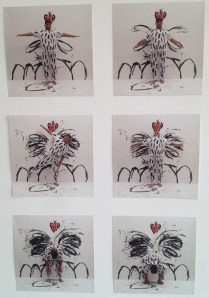
Waheedah Mallulah at ALWAN338

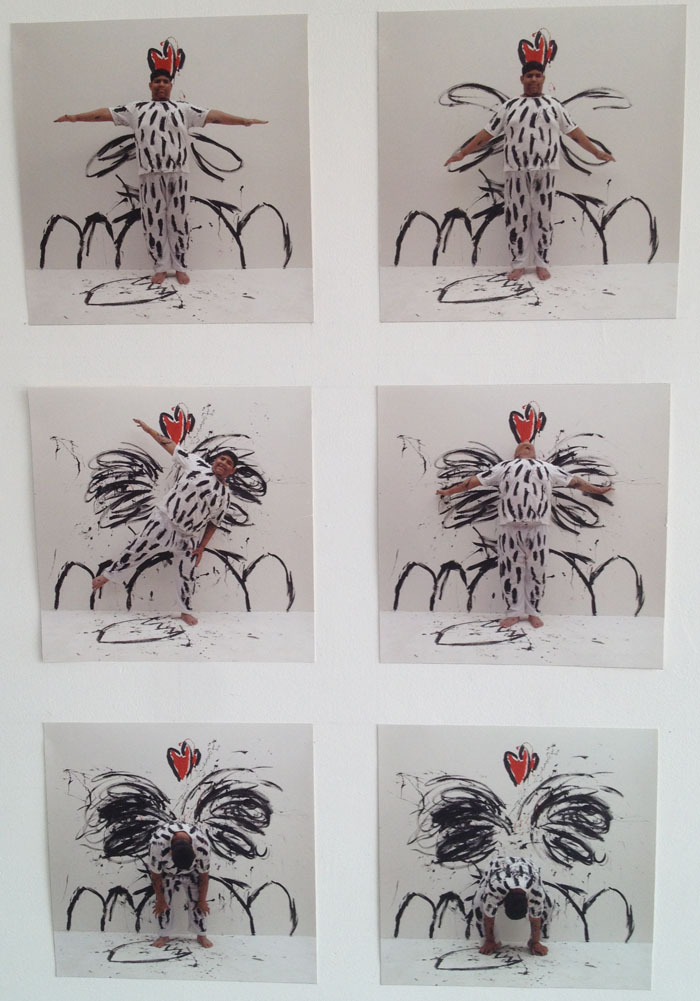
Waheedah Mallulah’s Big Rooster and the Little One, a montage of black, white and red photos of Mallulah doing yoga-for-roosters, delighted the rooster-lover in me.    The gift shop was transformed into a space for Zilia Monteiro’s videography.
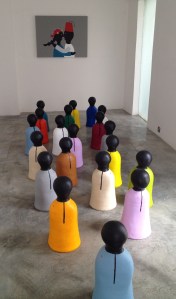
Mohamed Sharkawy at ALWAN338

I climbed the curved stairwell to the second floor where Sharkawy’s Egyptians continued to go about their daily business.

Next to the colorful, but undifferentiated beings, a young man sat on the couch, his earphones around his neck, working on his laptop.  He smiled at me and asked whether or not I had seen the exhibit at Bohemia, the building encircled with flying bicycles.

I told him no, but said “we were on our way over there”.  I asked him if he was working.

He said, “I am finishing up an assignment.  I go to school at NYIT.”

“Good luck.”  We smiled at each other and said good-bye.

The renovation of the old Bohemia restaurant into a four-story exhibition for I AM THE OTHER is the crowning achievement of ALWAN338.  Visiting-artist Mo Reda connected with over 20 Bahrain-based artists to comment on

“how do we exclude the OTHER, when we ourselves are the OTHER to those around us?”

This is a critical question in a time when the EU considers whether “to let” Turkey join their union, after France and Switzerland created legislation responding to their Muslim populations, and in the USA where mainstream Americans describe the OTHER as Teacup Conservatives, uber-rich executives or illegal alien-workers.

A microcosm of global politics, Bahrain has faced its own challenges over the past year.  As the diverse community members entered into the National Dialogue, the question of Who am I?  Am I the OTHER? became particularly relevant.  ALWAN338 gave established and emerging artists an opportunity to publicly add their distinctive “voice” to the dialogue and answer the question in their unique ways.

Bahraini, Bahrain-immigrants and Arab artists of “mixed” parents presented their personal experiences as the OTHER.   Being and raising third-culture children, the exhibit felt relevant to me.

However, I found the most striking artists were Bahrain Contemporary Arts Association member Nader Abdulrahim, street-artist Huvil and architect Maysam Nassar.
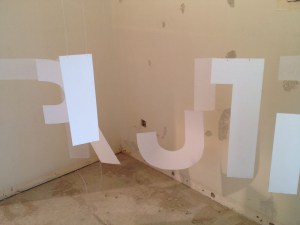
Maysam Nasser at ALWAN338

The fact that they can publicly describe their perspectives regarding truth and current social issues speaks volumes on Bahrain’s openness compared to its neighbors.

But the ALWAN338 artists are not just visual artists or limited to these two venues.

DJs will be performing live at The Meat Company, an excellent place to go during this pre-summer lull in the heat.

Architect Sara Kanoo created a temporary “Park”; an outdoor stage, library and cinema screen.   In this under-utilized public space, films “Life in the Day” (April 10, 7:30pm) and “Man Without a Cellphone” (April 12, 7pm) will be shown; jazz-band 13th Note (April 13, 8pm) and Watan (April 20, 8pm) will perform; and several workshops for kids (Spray Painting, Cartoon Animation) and Adults (Photography, Mosaic, Street Art Intervention) will be held.

My friends and I left Bohemia hoping it would become a permanent gallery and walked to Coco’s for an outdoor lunch.  Coming towards us was the tall, slim man I saw earlier at Al Riwaq.

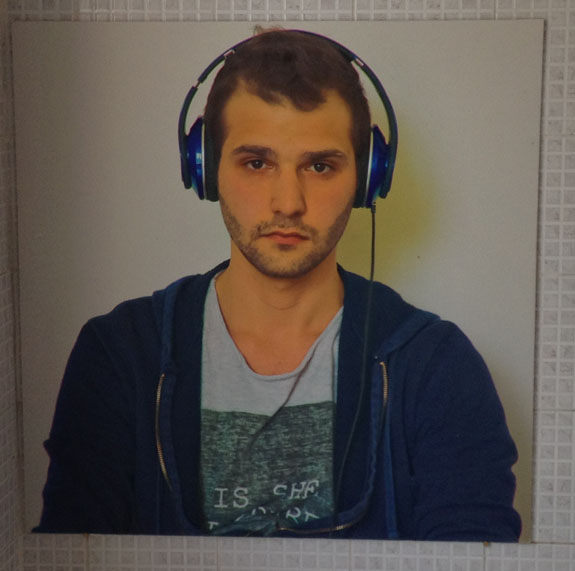
Only then I knew his name.  Ghalib Zuhair.  He was the Iraqi artist whose visage was featured on the  I AM THE OTHER cover.

Ghalib Zuhair at ALWAN338

According to his bio, he is looking for a place to call home.

“I just saw your installation in the gallery.”  Being recognized, he beamed.   “How long have you been doing photography?” I asked him.

“About twelve years.  This is my second exhibit.”

“Congratulations.  You did a great job.  It seems like Bahrain is home for you.”

“For now,” he smiled.

That, my friends, is Life as Art.

ALWAN338 continues through April 22nd from 10am-10pm.  The entire schedule is on the Al Riwaq website and exhibit programs can be found at the restaurants in Adliya where the ALWAN338 flag is displayed.   The restaurants that have given support and invite you to experience art-camaraderie, Bahraini-style include Blaze Burgers, Block 338, Café Italia, Mezzaluna, Tian and Masso at the Palace Hotel.

In case you don’t remember Bohemia (next to the Adliya Café Lilou which for some reason is not a sponsor), you can plug this address into your GPS:  Adliya, Block 338, Road 3816, Building 502.
The Snow Goose

Snow Goose in Iowa

Calm, indifferent

as if nothing’s transpired –

the goose, the willows

Haiku by Kobayashi Issa, 1762-1826, Japanese Poet

One Breath Long – the Haiku

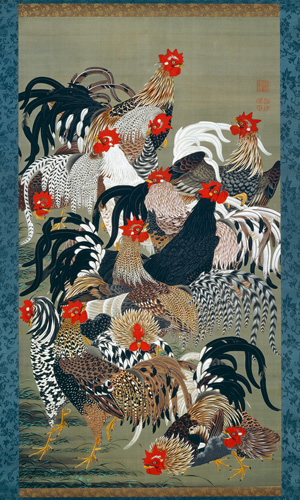
Thirteen Roosters by Ito Jaskuchu at the National Gallery of Art

A map of chicken land

noisy with red capitals,

black lakes, white highways

– by Emily from New York

While ruminating on the poet Mahmoud Darwish, the National Gallery of Art sent me an invitation to write a Japanese-inspired haiku.  As my artist-sister and her Japanese family were visiting us the timing was serendipitous.

Haikus are expressions of moments in time.  Through simple language, they invite the reader to experience nature as the writer attempts to capture it.

One breath long, haikus traditionally are three lines of 5, 7 and 5 syllable words.  In English this translates into 10 – 14 syllables or 6 – 10 words.

Near Lake Okoboji, Iowa

Old pond –

Frog jumps in

Sound of the water

–          Matsuo Basho, 1644-1694, Japanese poet

April is poetry month at the National Gallery of Art in Washington DC.

On exhibit is the work of the Japanese treasure Ito Jakuchu (1760-1800).  This is the first time his Colorful Realm of Living Beings has been displayed outside of Japan.  The 30-piece bird and flower painting collection is normally kept at the Shukokuji monastery in Kyoto.  Displayed in one room, the paintings signify all living beings gathered around Buddha.

An American national treasure, the National Gallery of Art is free and open to anyone visiting Washington DC.

In fact, the haiku invitation is for everyone.  It’s an opportunity to sit outside and experience a tree, spring flower or bird.  Breathe.  Then try to take that moment and express it in words.

You can read more about the exhibit, the 1,000 year-old art of haiku writing and submitting your haiku at nga.gov/jakuchu.

Previous Older Entries Next Newer Entries

Archives

Tales by Chapter