In the Beginning – Creation in Paradise

It is quite an ambitious project to set the Creation story from Genesis to music.  But Joseph Haydn felt he was up to the task and his masterpiece was rolled out in Vienna in 1798.

For the first time, on March 23rd, The Creation will be sung in Bahrain by the Manama Singers.

Musical Director Michael Natzke must have decided it was only fitting that the choir residing in Paradise should sing about the parting of the waters and the creation of all the animals.  Resident artist Seanna Mallen was commissioned to paint her vision of Creation for the official poster.

The Creation covers the story from the beginning – when God created the heavens and the earth (Genesis 1:1) – until Adam and Eve sing their love duet.  Although neither Genesis chapters 1 nor 2 specifically mentions any serenades, I think Haydn basically brings us up through the end of Genesis where they were naked but probably not singing.

The concert ends with the Angel Uriel vocalizing his advice for the pair to be happy with what they have and not wishing for anything more.  And again, although I really respect Angel Uriel, the only angel I could find was an unnamed cherubim.

I think Haydn wanting his oratoria to be popular committed two sins; the sin of pride – telling the story his way – and the sin of omission – telling the story but not the whole story- when he left out the part about the snake.

Still it promises to be a fabulous concert.

You can buy tickets for Friday’s concert at Al Osra, the Bookcase or at the Diplomat Radisson Hotel.

Touring Bahrain? Get Your STREETSMART Guide

You are invited to the Streetsmart Bahrain Book launch party.

Yeah!  The party I have been waiting for.

My friend, author Melissa van Maasdyk, promised she would have her Bahrain travel guide ready before the Formula One in April.  And she did it.

Sunday night was the official reception.  As we drove up to the soon-to-be opened, second wing of the Kempinski Grand and Ixir Hotel, we waited for the line of dignitaries’ cars to be valeted.

“Who are all these people?” Mojo asked.

Arab men dressed in elegant white thobes, African women in long gowns, European ambassadors in business suits, and glam women in high-heels all hurried into the lobby.

“Melissa seems to know everybody in Bahrain,” I said.  “The UN people love her book so much they asked the Director General of UNIDO to speak tonight.  Some must be with him.   And there is Debbie and Mohammed,” I said, pointing at the Bentley pulling in behind us.

Mohammed and Debbie Al Asfoor, the Arabian Sheik perfume designer/creators, are one of the thirteen Bahraini insiders featured in the MY WAY sections (pg. 89) of the guide.   With her enthusiasm for Bahrain, Melissa charmed these Bahrainis into revealing their favorite, and previously unknown to outsiders, places to shop, eat and chill.

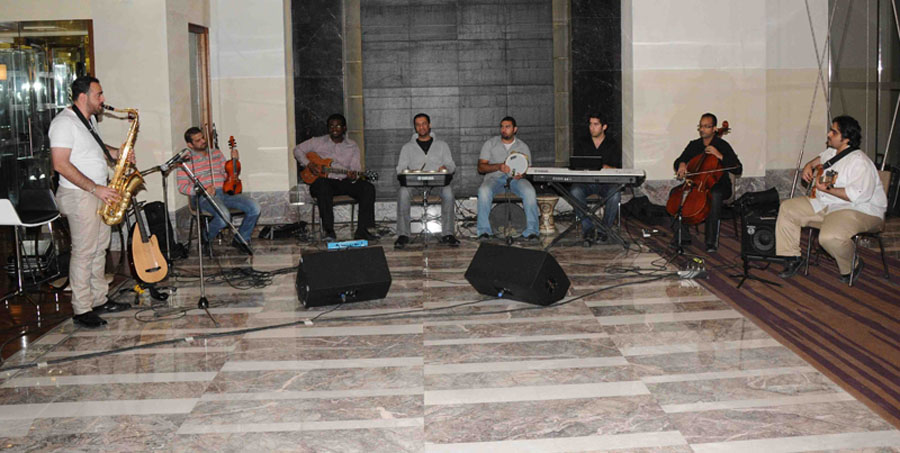
As we walked through the lobby doors waiters greeted us with shots of fresh watermelon juice as the Bahraini jazz band 13th Note played.

Melissa introduced me to interior designer Ammar Bashar who created the fabulous entry way for the amphitheater where Andrea Bocelli sang last week.

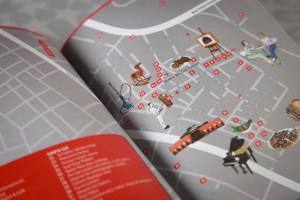
The very stylish Ammar accessorized his made-in-Bahrain suit with a Hermes scarf instead of a tie.  In Streetsmart he gives away his style secret – his shoes are custom made by a local shoemaker named Ghuloom and has his suits made in the souq at a “fraction of the cost of Seville Row”.   To find these places you need the map in the guide.
Luckily for Melissa, New York based Bahraini photographer Ghada Khunji (pg. 51) was in town for the opening.  I had not met her before.  Like me her favorite aspect of Bahrain is the warmth of the Bahraini people and its multifaceted cultures.  And one of her favorite places to exhibit her photos, eat, have a spa day and a yoga class is at La Fontaine Center for Contemporary Art (pg. 49).

I took a photo of my new friend Errin Stone the Chef and Manager of the Al Riwaq Gallery (pg. 116) getting his book signed.  Just last month Errin helped me host our book club meeting.  He came up with five fresh salads, sandwiches and of course Red Velvet Cake for us to nibble.  Afterwards the members texted me “It was the best book club meeting we’ve had in awhile.” I attributed it to the art and the gallery’s atmosphere.

On the globe Bahrain is small.  But Melissa still managed to bring together Bahrainis who had never met.

Words Bookstore owner Rana whose family has literally lived in Bahrain for centuries met the perfumer and creator of Green Bar, Reem al Khalifa (pg. 168) for the first time.  I had never heard about Green Bar’s made-in-Bahrain line of pure rose waters (pg. 171) but Rana who uses her line of plant-based skin creams said “I’m so glad to meet you.  I love your products.”

Besides these Bahraini gems, the guide includes Bahrain’s key tourist sites – Tree of Life, Barbar Temple, Bahrain Fort, Saar Settlement and the Bahrain National Museum, shopping highlights and the restaurants with the best food.

Next week when my family visits, I am going to travel “off road” and will follow Melissa’s guide deep into the souq to visit Azzam Ayurvedic “that wouldn’t be out of place in Harry Potter’s wizard’s market, Diagon Alley” and through Muharraq’s alleys to the first coffee shop founded by an out-of-work pearl diver.  My brother-in-law who keeps a photo album of his favorite dishes will love going deep in the heart of Gudaibiya to sample the BEST tikka in Bahrain.

I may or may not tell you about our adventures.  Unlike Melissa, I like to keep secrets.

If you want to tour the real Bahrain or need a detailed guide for a day trip, you can pick up Streetsmart at Words Bookstore on Budaiya Highway, Jashanmals in Al A’ali Mall, or the Virgin Mega Store in Bahrain City Center.

If you stay at the Kempinski in City Center, a copy will be in your room.

To get copies of Streetsmart Bahrain for your Formula One visitors, you can email editor@streetsmartbahrain.com.

Melissa and Jamal Shaheen Muharraq carpenter

See you at Jamal Shaheen’s carpentry shop on Road 1125 behind the unmarked wooden door on your left shortly after entering the street (pg. 69).

What Looks After You

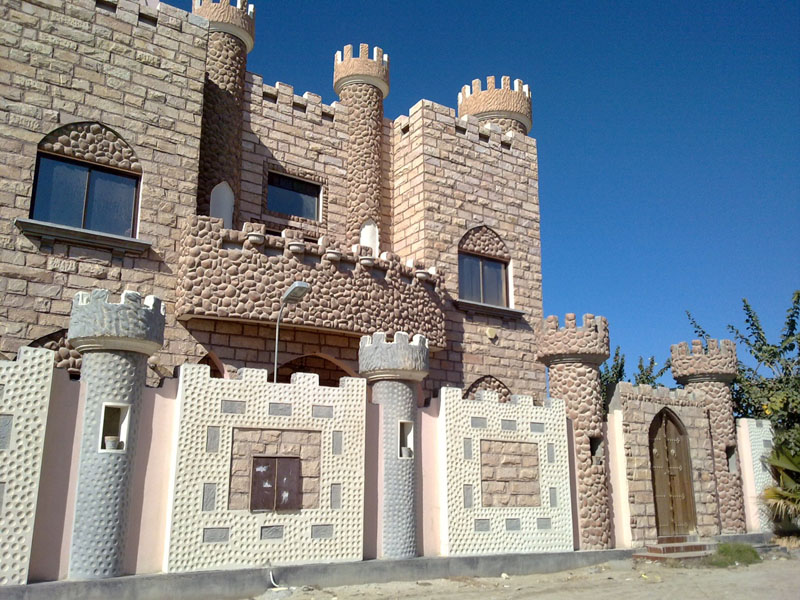
A Castle Built in our Neighborhood

Knowledge is better than wealth.  You have to look after wealth;

knowledge looks after you.

– Ali


From Indries Shah, The Way of the Sufi

Saudi Women’s Progress in the Health Sector Webinar March 14th

If you are curious about nursing in Saudi Arabia, or women’s healthcare in Saudi Arabia, this Wednesday March 14th (I know it is late notice) Dr. Elham Al Ateeq, the Dean of the Nursing College at the King Saud bin Abdulaziz University in Saudi Arabia is presenting a one-hour webinar.  A Webinar is similar to a radio show.


I think this is a great opportunity for those interested in these issues to listen to a woman based in Saudi Arabia.


Dr. Al Ateeq has a Masters in Nursing Administration from Northeastern University and a Ph. D. in Nursing from George Mason University.  She will be speaking on Saudi Women’s Progress in the Health Sector.  The interview is to include an overview of the past and present positions of Saudi women in the health sector and a comparison of their progress in the health sector versus other industries in Saudi Arabia.


This offering is through the Fielding Graduate Institute’ Worldwide Network for Gender Empowerment.  My friend Fariba Enteshari just shared this event information with me.


I don’t have any experience with this type of seminar but it appears to be open to interested parties by simply accessing the following links.


The Webinar is at 9:30am Pacific Standard Time (GMT -07:00)


For more information go to http://wnge-gendernet.ning.com/

Or try this link to WNGE – Wednesday Webinar.


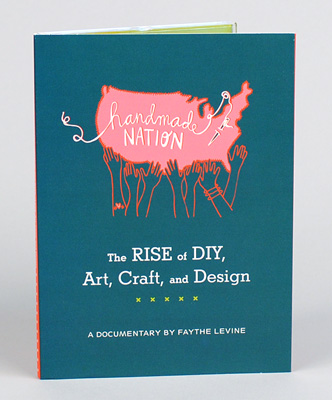
Handmade Nation

Faythe Levine created a documentary about the “new” trend in America – handmade crafts and art.

Trend is probably the appropriate word since it usually refers to what Americans are buying today.  But two generations ago Americans, like my grandmother Louisa Burns, who crafted their own food, clothes and entertainment were the norm.

Growing up in Saudi Arabia before the Rashid Mall existed, my own mother used to sew clothes for us.  Once she sewed me a bathing suit.  Granted the moment I entered the sea, I wished she had spent the $20 to buy me a suit from Sears.  The material she choose stretched, and my bikini quietly floated off my body with the same leisurely stroke as the jelly fish around me.

Although I haven’t seen this film, my guess is this is about Americans who are discovering joy and pride in making their own stuff, instead of buying cheap, mass produced goods imported from China.

Calling this trend the RISE of Do-It-Yourself Art, Craft and Design seems a bit grand.  However, if you are of Ms. Levine’s mid-30s and under generation, maybe you are unaware that it is possible to knit your own socks, can fruit and mold your own soap.

Potentially this film may highlight the fact that many Americans, including young Americans, are out of work because corporations have moved their manufacturing and service jobs outside the USA.  If Americans are not highly educated, they are having difficulty finding high-paying jobs that can support them.  And like people in developing countries who do not have the cash to buy manufactured goods, these Americans are re-learning the art and craft of handmade items.

Whatever the message it is an excuse to enjoy a short film that may inspire you.

Perhaps You Will Feast on This Banquet of Love

We are not forced to do anything. We are only chosen. To be chosen does not mean anything by itself, but the meaning of what you are chosen to do does. Once we make that choice, the Divine comes to meet us and gives us assistance that is beyond our capabilities.

Fariba Enteshari,

Jalal al Din Rumi student/scholar

I have never been a big reader of poetry but lately I seem to keep coming across small bits of Rumi’s work.  And although no one is forcing me to read it – I am not “in school” – I find that for some reason I am drawn to his work and find a relevant truth in nearly every passage.  Perhaps this is an example of the Divine meeting me and helping me glimpse Rumi’s magnificence.

My friend Fariba Enteshari has been a Rumi student since I met her nearly twenty years ago at the Immaculate Heart College Center in Los Angeles.    While I waded through Theresa of Avila, Fariba was immersed in Rumi’s six volume book of poetry, the Mathnawi.

The Mathnawi  is 25,000 lines of lyrical verse.  It is referred to as the Persian Koran.  The verse is spoken in the voice of Rumi’s beloved muse, friend, teacher, Shams al Din.  Our bookclub recently read a novel about their relationship called The Forty Rules of Love.  

Rumi, a Koranic scholar, was a popular Imam in Koya, Turkey.   Shams was “delivered” to his doorstep and began a conversation with Rumi that, according to the stories, lasted forty-days and nights.  During that intense period of interaction, Rumi’s heart was opened.  And after Sham’s death, for the first time in his life, he began writing the poetry which has guided people for 700 years.

Indries Shah the great thinker and writer on Sufism said a great part of Sufism “must be personally communicated by means of interaction between the teacher and the learner. Too much attention to the written page can be harmful.”

This Sufism truth was probably revealed by Rumi’s and Sham’s relationship.

If you are interested in entering a conversation with a Rumi scholar, this Wednesday, March 14th, Fariba Enteshari is putting aside her writing for the day to have a Banquet of Love.  She invites anyone interested in Rumi’s poetry to come to this spiritual feast.

If you are uncertain whether you are interested in poetry or are capable of understanding Rumi’s deeper meaning, you can take heart from Indries Shah who said

“Rumi, like other Sufi authors, plants his teachings within a framework which as effectively screens its inner meaning as displays it.  This technique fulfills the functions of preventing those who are incapable of using the material on a higher level from experimenting effectively with it; allowing those who want poetry to select poetry; giving entertainment to people who want stories; stimulating the intellect in those who prized such experiences.”

Indries Shah, The Way of the Sufi, 1970.

If you are near beautiful Santa Barbara, California this Wednesday, go spend the day at La Casa Maria with Fariba and other Rumi devotees and see what message Rumi’s poetry has for you.

Banquet of Love is Wednesday March 14th 9:30-3:30 at the La Casa de Maria, in Santa Barbara, California.  Donations will be taken at the door.  To make a reservation for the $14 lunch go to www.lcdm.org or call (805) 969 – 5031.

Mary Louisa Colvin Burns

My grandmother, Louisa Colvin Burns, on the right

My grandmother, Louisa Colvin Burns, on the right

100 years ago today, my grandmother Mary “Louisa” Colvin Burns was born.

In many ways I knew her well.

I knew she could balance a business man’s books, sew her own clothes and crotchet an afghan.  I knew she played the organ and occasionally sang at church.  I knew she was the Secretary for the Business and Professional Women’s Association and raised funds every year by selling bags of pecans.  I knew she put on her stockings during the week to go to work and wore her elastic-waisted jeans on the weekend to tend her garden.  I knew she loved chocolate and bread and believed having a bowl of ice cream just before going to bed ended the day on a high note.

I knew a little bit about her history, the time before I was born.  She was from Illinois and had attended business school.  Her Uncle Joe Colvin introduced her to my grandfather Ralph Burns during a summer visit to Colorado.  I knew they got married September 1, 1929.

But other than that she rarely spoke of the past.

She never mentioned that two months after they married, the stock market crashed.  It was her sister, who told me how my grandmother learned to cook dandelion soup when they ran out of cash during the Great Depression.   The 1930s, aka the Dust Bowl years, were described as the years they spent ranching in eastern Colorado.

Perhaps it was after her eldest son Earnest died during the great polio epidemic of 1946 that my grandmother quit bringing up what could not be changed.  Instead, she tried to stay in the present, stay positive and work hard at making something of herself.

Because she rarely spoke about the past and her beloved family “from Kentucky”, I knew nothing about her grand-cestors.

I never knew our earliest known English ancestor appeared to be a young apprentice named Thomas Wright who arrived in Massachusetts in 1639.

I never heard of Peter Jett who immigrated to the colonies from London in 1663.  With a bit of stealth, he obtained a 600-acre land grant from Governor Berkeley in OLD Rappahannock County, Virginia.  In the end it was an unfortunate acquisition because thirteen years later, in 1676, his wife, Mary Triplett, and three children were killed in a Susquehannock Indian raid.

I never knew her ancestors eventually sided against the English monarchy and her great-great-great-grandfathers Henry Colvin, George Mains and Edward Hamilton were all young privates in the American Revolution.

I never knew that after Daniel Boone cleared the trail into Kentucky, her family moved west to Bracken County.  Eight generations later, the Colvins, Mains, Jetts, Wrights, along with the Scot-Irish McKinneys, Forsythes  and Hamiltons still reside in the area around Pendleton County, Kentucky.

There was so much family history I was unaware of.

And in the end, maybe none of that history matters.

Maybe all that matters is that in her time I knew she loved me.  And unlike historical facts, I never have to re-search the memory of her love.  It sits within me, eternal.

Happy Birthday Grandma.

Previous Older Entries Next Newer Entries

Archives

Tales by Chapter