Finding Ourselves in Our Soul Mirror

The Forty Rules of Love by Elif Shafak

The Forty Rules of Love was chosen by my Bahraini book club.  The Bahraini women are the majority but the group includes a Mexican, a Belgium, a couple of Americans and a French woman.  We read books from an international selection of authors including Elif Shafak the female, Turkish author of this month’s choice.

The Forty Rules of Love is a multi-layered novel.  An American housewife is charged with editing a novel about the mystic Rumi and it changes her life.  Rumi was a gifted Islamic preacher and teacher who, in the book, developed into RUMI the Sufi poet after he met his soul-mirror named Shams of Tabriz.

In the novel within the novel, the dervish Shams’ forty rules are rolled out like an antique Persian carpet.

One of Shams’ rules is

“Loneliness and solitude are two different things.  When you are lonely, it is easy to delude yourself into believing that you are on the right path.  Solitude is better for us, as it means being alone without feeling lonely.  But eventually it is best to find a person, the person who will be your mirror.  Remember, only in another person’s heart can you truly see yourself and the presence of God within you.”  Pg 72.

In modern Western culture the idealized life partner is called our soul mate.  But a soul mirror is different.

Rumi and Shams’ friendship reminded me of my friend YeYeIfe.

Like Ella the female protagonist in the novel, YeYeIfe was an American housewife who after raising her children discovered her husband was not her soul mate.  They divorced.  I met her when we both became students at the Immaculate Heart College Center.

She was a kind of exotic bird: a white woman wearing a leopard print skirt, armloads of African bracelets and high heeled mules.  Shortly after meeting her, YeYeIfe became an initiate of an African spiritual practice and had to cleanse herself of her previous life.  I was shocked when, wrapped in a white smock, she cut off her hair and swore off cosmetics for one year.

As we studied theology, YeYeIfe actively transformed her body, mind and spirit.  Like Shams who taught Rumi the twirling dervish dance, YeYeIfe used dance to connect with God.

I watched YeYeIfe’s progress with awe.  After the end of her year, when her mind and her time were freed, we started talking.  In her I discovered my soul mirror.  Like Shams and Rumi, we sat by ourselves in a room and talked about everything to do with spirit, God and existence.  When we were apart we wrote to each other.

A couple years later, the distance between us literally grew when I moved to San Francisco from LA.  But that did not end our friendship.

But after I married, I quit looking at my soul.  Instead I became mesmerized by my face reflected in my babies’ eyes.  During those years the distance between me and my friend became so great that we lost contact.

Now my babies are children and as I read Elif Shafak’s book I wondered, where is my soul mirror?

A Google search found her referenced in a book.  I contacted the author.  He said after he interviewed her several years ago, she moved to South America.  I imagine her like the itinerant Shams trading healing stories for food and teaching those who are called to dance.

I describe The Forty Rules of Love as Sufi-light.  It is entertaining while explaining Sufi thought without having to read Rumi and tease out the meaning behind his poetic metaphors.  Perhaps it will inspire more people to seek out their soul mirrors who can help them see God within.

An interesting publishing note: Elif Shafak’s hardcover book can be purchased on Amazon.com but not the ebook.  For the Kindle version, you have to use Amazon.co.uk.
Dilmun Makes A Comeback in 2011

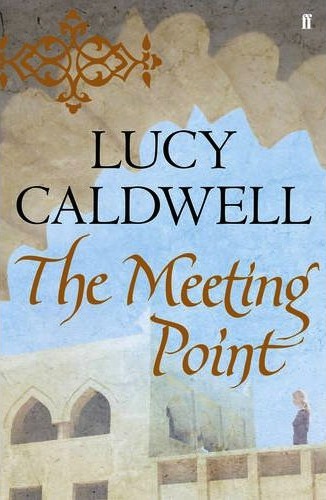
The Meeting Point by Lucy Caldwell, Dylan Thomas Award Winner

Lucy Caldwell begins her Dylan Thomas Prize winning book The Meeting Point with

The land of Dilmun is holy, the land of Dilmun is pure.

In Dilmun the raven does not croak, the lion does not kill.

No one says, “My eyes are sick, my head is sick.”

No one says, I am an old man, I am an old woman.”

Sound familiar?  If not, refer to Standing Out in Saudi Arabia.

This verse was written on a 4000 year old clay tablet held in the Bahrain National Museum.

Caldwell wrote a lyrical story of an Irish woman who follows her husband to Bahrain.  Ruth dreamed of a new life in an exotic country.  Like thousands of expat housewives before her, Ruth’s life without financial or domestic responsibilities and a husband who is completely absorbed in his new job leaves her plenty of time to wonder – what do I do all day in Paradise?

Confronted by people living normal existences but under a different belief system and unsupported by the cultural walls of their own country,   expats often find themselves asking the existential question – Who am I?

The Meeting Point describes a woman’s unexpected search to find that answer while describing life in Bahrain in beautiful detail.  I was more than pleasantly surprised by the book.

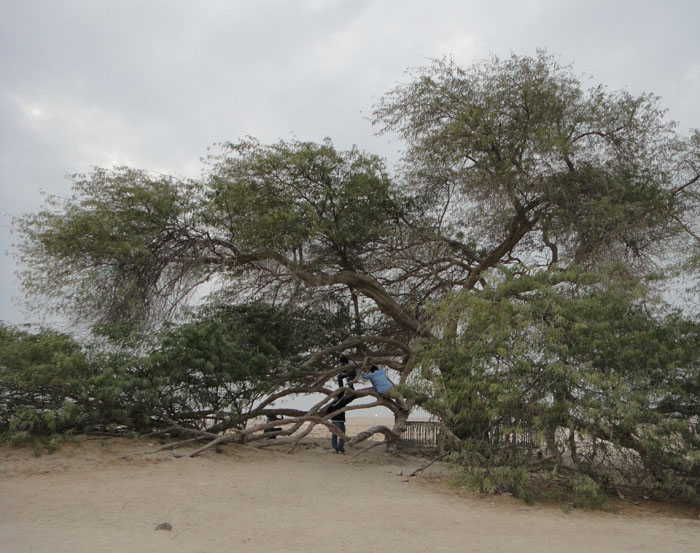
Tourist Climbing Tree of Life featured in Lucy Caldwell’s Book.

I recommend it if you are interested in expat life, Bahrain or enjoy a well told Irish story.

Lavender Oil for Healing the Soul and the Planet

Penlindaba Lavender Farm on the San Juan Islands

Walter Lubeck in his book The Pendulum Healing Handbook wrote about using a crystal pendulum to clear energy blocks from our etheric body.

After the session, Lubeck recommended using natural (!) lavender oil to rub in the main chakras, the hands and the soles of the feet.    The lavender helped to “create an undisturbed  restructuring and healing of the energy system.”

On San Juan Island last summer I purchased the most wonderful organic lavender oil from Penlindaba Lavender.

If you leave Seattle for an Orca whale watching tour you will likely end up at Friday’s Harbor on San Juan Island.  Bring your lunch and snacks for the boat ride over to the island.  On the island take advantage of the 2-3 hour layover to explore the Pelindaba Lavender Farm and the Orca Whale Museum.

Pelindaba Lavender has a lovely shop in town if you can’t make it out to the farm.  I bought several bottles of lavender oil and soaps to give to my friends.  Local artist made special ceramic dishes to hold the square laveder soups.

Penlindaba Lavender - Artist

But if it is a sunny day treat yourself to a visit to the lavender farm.  It is so beautiful you could even hold a wedding there.  Or go to the lavender festival next July 21-22, 2012 and feel the healing energy.

Pelindaba Lavender Farm San Juan

Besides cleansing the aura, lavender can be used for cleansing household grim.  Substitute chemical cleaners for lavender and you have a natural way to clean and deodorize your house.

A Fleeting Glimpse of Sky Walkers

Sky Walkers in the Late Morning. Her head, eyes, nose and mouth are easy to see on her long tall body.There were 4 of them but 2 disappeared before I get my camera. It was so bright I could only point and click.

The body is your only home in the universe.

It is your house of belonging here in the world.  It is a very sacred temple.  To spend time in silence before the mystery of your body brings you toward wisdom and holiness.

Your body is in essence a crowd of different members who work in harmony to make your belonging in the world possible.  We should avoid the false dualism that separates the soul from the body.  The soul is not simply within the body hidden somewhere within its recess.  The truth is rather the converse.  Your body is in the soul, and the soul suffuses you completely.

Therefore all around you there is a secret and beautiful soul-light.

John O’Donohue

from Anam Cara: A Book of Celtic Wisdom pg 48-49

When Snakes Could Fly

Eve's Bible the Book

“I didn’t understand your Sphinx reference,” said Mojo  referring to Who was the Sphinx? .

Walker’s Encyclopedia’s cover  reminded me of who could rectify my error.   I turn to a real expert, Dr. Sarah Forth author of “Eve’s Bible: A Woman’s Guide to the Old Testament.”   She is a theologian whose specialty is the Old Testament.  (note: I added the images for the post.  If they are a bit incorrect blame me, not her.)

In her chapter When Snakes Could Fly, she writes “theacentric” (goddess-centered) civilizations throughout the Eastern Europe, the Near East and India portrayed the goddesses as snake and with snakes as well as bird women.”  These were more than mere fertility figures but “Goddesses of regeneration who were responsible for the entire cycle of life.”

Sumer’s religion “more than forty-five hundred years ago is among the oldest we know much about,” she writes.   But it was Egypt, “the Land Beyond the Rivers” that more directly influenced Israelite beliefs.”

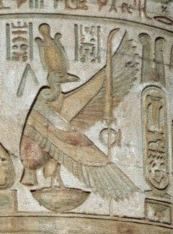
Egypt had a PRE-history, before the dynastic pharaohs.  During this period, Wadjet represented by the cobra was the patron goddess of Buto an important “city” during the Neolithic period.  Her sister Nekhbet was a vulture.

Together they were called the Two Ladies.

Lower and Upper Egypt were combined and the two started to merge into one.

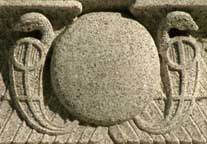
The Narmer Palette is thought to represent the unification of Upper and Lower Egypt.  Notice the intertwined serpent heads of the lions.  Wadjet was also associated with Bastet represented by a cat/lion.

3100BC Narmer Palette thought to depict unification of Upper and Lower Egypt

“Egyptian Snake Goddess Uatchet (I think Wadjet is the more common spelling) was both a woman and a large winged serpent.”

Human Headed Winged Cobra from King Tut's Tomb

Uraeus, a spitting snake, denoted both a goddess and a serpent.  “The Uraeus adorned the headdress of pharaohs for thousands of years.”

Uraeus On King Tut's Death Mask approx 1333BC

Over millennia societies changed from earth based religions and “serpents were demoted to servants of the gods, or worse, their enemies,” says Dr. Forth.

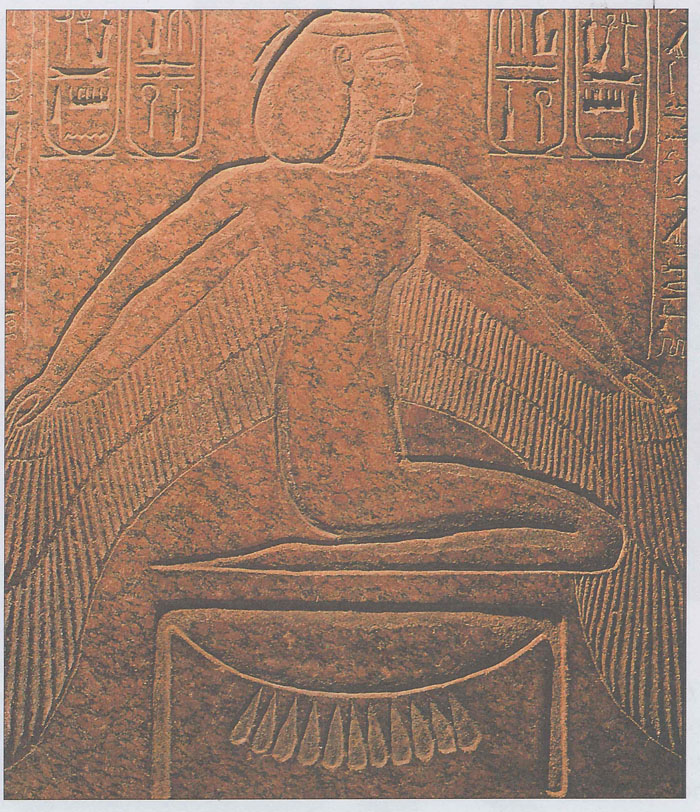
Slowly Wadjet became Isis.  Isis merged with the Great Goddess Hathor and became Horus’ mother instead of his sister.

Isis

In Christianity the most famous serpent enemy was the one in the Garden of Eden who tempted Eve to eat from “the tree of knowledge of good and evil” that Yhwh (God) had made off limits.  Because of this snake incident, the entire human history was changed.

According to Dr. Forth this story “remains the best example of the Israelite campaign against the snake-goddess.  Yhwh (God) reacted by cursing the serpent.”

Because you did this/More cursed shall you be/

Then all cattle/and all the wild beasts

On your belly shall you crawl / And dirt shall you eat/

All the days of your life. (Gen 3:14 JPS)

Dr. Forth writes “Assigning the serpent to crawl on its belly suggests that it had a previous mode of transport.  Wings perhaps?”

Gustav Moreau's Oedipus and the Sphinx located in the Metropolitan Museum of Art

By the time we get to Moreau’s 1864 Oedipus and the Sphinx we see the traces of the ancient goddess: Wadjet  the cat/lion, Nekhbet’s wings, and the female head all rolled into the Sphinx the “winged monster” Oedipus confronts.

Eve and the Serpent demonstrates the power of a good story.  In western civilization, Genesis chapter 3 chopped off the Goddess’ wings and completely changed her-story.

Who was the Sphinx? and other interesting questions

The Woman's Encyclopedia of Myths and Secrets by Barbara G. Walker

If you ever sat down to eat your lunch and “just” took a peek at your friend’s new photos on Facebook, then looked up and saw it was dinner time, you understand the genius of Facebook.

Before Facebook and Wikipedia, there was a genius named Barbara G Walker.  When I open her book The Woman’s Encyclopedia of Myths and Secrets, I find the hours have disappeared as I jump around exploring such things as Montanism, to Cybele, to Antaea. Then I discover when witches were carried to prison their feet were not allowed to touch the ground.  Why Not?

Answer: So they could not get power from the earth ie, Mother Earth.

In the 1960s journalist Barbara G. Walker began investigating the disappearance of a Goddess.  No one seemed to why the Goddess no longer starred in ceremonies or why no one wrote rave reviews about her anymore.  Occasionally close observers noticed her small cameo appearance in books and films.  For twenty-five years, Barbara Walker sifted through the clues to see if she could write a story about her.  Walker discovered the Goddess existed only censured by centuries of patriarchy.

In 1983 The Woman’s Encyclopedia of Myths and Secrets was completed. Walker wrote about all the clues she found: 1,350 entries on magic, witchcraft, fairies, elves, giants, goddesses, gods, and psychological anomalies such as demonic possession; the mystical meanings of sun, moon, earth, sea, time, and space; ideas of the soul, reincarnation, creation and doomsday; ancient and modern attitudes toward sex, prostitution, romance, rape, warfare, death and sin, and more.   Then she linked and cross referenced ideas, religious traditions and people across centuries.

By opening The Women’s Encyclopedia of Myths and Secrets your mind will be introduced to perspectives and ideas never discussed in a classroom or in Bible study.  And you will know why some libraries have banned the book.  If this encyclopedia wets your appetite, you can read one of her eleven other books about myths, symbols, crystals, tarot, spirituality and rituals.

Or if you knit, you can join her fan club at the Walker Treasury Project.  A woman of multiple talents, she wrote 13 books on knitting including the renowned “Treasury of Knitting Patterns”.

I have never met Barbara G. Walker but I would love to.  Born in Philadelphia in 1930, Walker read the King James Bible as a teenager.  “She decided the Bible “sounded cruel. A God who would not forgive the world until his son had been tortured to death–that did not strike me as the kind of father I would want to relate to.”

Walker obviously thinks for herself and has enough confidence to say this idea does not resonate with my soul so I better look at it more closely.  She displays all of her human complexity and allows herself to be passionate about many things: writing, researching, atheism, knitting, humanism, social criticism, social work and dance.  Just like the Goddess she searched for, today, Walker the person is a bit elusive.  She lets her work be her legacy.

Facebook is criticized for revealing too much minutia about people’s personal lives and Wikipedia carries warnings about its lack of authoritative sources yet people “go to” both of them if they want to find out something.  Opponents criticize Barbara Walker for the quality of the information and her feminist bias.   But her bibliography is 15 pages and her cross-referencing is fantastic.

Just like I use Wikipedia for a quick answer to a question or Facebook to find someone, Walker’s encyclopedia is a go-to source if you want to begin to explore anything about women’s spiritual or mythic history.  And 30 years after its first printing, HarperCollins reissued the book with an updated cover proving the Goddess is still in demand.

Whether banned, criticized or lauded, I love it and always find something that makes me say “Now that’s interesting.”

Hvov, “The Earth” an Iranian form of Eve.  Zoroaster’s followers called her Mother of All Living.  Known in India as Jiva or Ieva.

Hmmmm that’s interesting.

Oh yes, the Sphinx.  Look up the Great Goddess Hathor and compare to Oedipus and the Sphinx.

Visionaries Anita Caspary and Steve Jobs’ deaths on Oct 5, 2011

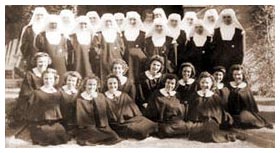
Technology Visionary Apple CEO Steve Jobs died Oct. 5th if you didn’t happen to catch the news.   On the same day Spiritual Visionary Anita M. Caspary passed away.  Forty years ago she was called Mother Humiliata by 400 nuns.

Anita M Caspary AKA Mother Humiliata. “I found peace and happiness in the convent.”

In 1995 I took a graduate class called an “Introduction to Feminist Spirituality”.  By far, I was the youngest student around that square table.  I listened as six grey haired women explained to me how spirituality meant more than participating in a religion, being religious or praying.  They described how Spirituality included a person’s whole experience including the body and the emotions which traditional theology tended to denigrate.  These women were versed in the “feminist praxis (putting a theory into practice) cycle of experience, analysis and reflection.”

I was amazed at how educated, articulate and passionate they were.  They did not shout at one another and everyone had a quiet, calm strength.   I kept asking myself,  who are these women?  I had never met anyone like them.  After numerous references to Jesus, I suddenly had to ask,

“Are you all nuns?”

“Yes,” said five of them, including our instructor, Dr. Susan Maloney.

“I’m sorry but why aren’t you wearing habits?” I asked coming from Protestant side of the divide. They all laughed at me.  “How was I supposed to know you were nuns?”  And they laughed harder.

“You need to get updated,” one former Sister of the Immaculate Heart of Mary (IHM) told me.

Sister Susan SNJM (Sister of the Holy Names of Jesus and Mary) told me the story of how 315 rebellious brides of Jesus broke centuries of tradition, docility and obedience in the hills of Hollywood.  Unlike the 1968 bra-burning myth, in 1970 when these nuns threw off their habits, it was real news.

Time Feb 23 1970 featuring Anita Caspary IHM and James Shannon

The IHMs were a teaching order who worked in the well established Los Angeles archdiocese schools.  Educated woman they believed Pope Paul VI’s Second Vatican Council’s Perfectae Caritatis (1965) empowered and authorized them to take the necessary steps to adapt, renew and change the character of the Church in the modern world.  While the Vatican recognized the church needed to change from being an Institution to a community of believers and to move from a tradition of power over others to service in order to stay relevant, the Los Angeles cardinal archbishop did not.  His Eminence James Francis McIntyre wanted to retain his title over passive, obedient women and could not tolerate the idea of leading a community of mature adult Christians.

After five years of visioning a future, archdiocese visitations, Vatican inquiries, international meetings, a Carl Roger’s encounter group and of course prayer, 400 sisters had to make a choice between living under Sister Eileen MacDonald’s pre-renewal rule or in a new community led by Mother General Anita M. Caspary and live under the 1967 decrees.   The result cannot be counted as hundreds of millions of IPODs sold, but on October 1, 1970, 315 women signed a contract surrendering her vows and status within the Catholic Church and demonstrated her commitment to the newly visioned Immaculate Heart Community.

The table where I sat at the Immaculate Heart College Center, was their legacy, a graduate program unique in all the world, called Feminist Spirituality.

Today I regret not spending more time when I was at IHCC with Anita Caspary, whose soft tissue paper skin and fluffy grey hair reminded me of my grandmother.  She could have been my grandmother born in an age where women were not expected to be fighters.  Like other unexpected revolutionaries, they courageously changed with the times.    If Steve Jobs was a child of the 60s, then Anita Caspary was a Mother of the 60s.

“In a way that re-imagined business itself,” Jobs was described as merging his “innate understanding of technology with an almost supernatural sense of what customers would respond to. “

In a way that re-imagined religious life itself, Caspary merged her innate understanding of the worth of religious women with an enlightened view of the principle of aggiornamento, or updating, that gave millions of women and men the courage to become mature, spiritual beings.

The waves continue to ripple after both these single pebbles were dropped into the river of life.  May they both Rest in Peace.

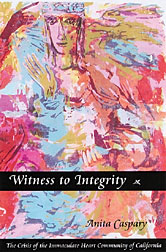
Anita Caspary wrote a first hand account of her experience.  You can read about the IHCs in Witness to Ingrity.

Previous Older Entries Next Newer Entries

Archives

Tales by Chapter