Summer Color In Santa Barbara

Vendors selling cartons of colored eggs lined State Street.

For months the women patiently opened the tips of eggs letting the yolks and whites dribble out.  They carefully cleaned, then painted the shells, before filling them with confetti and covering the hole with tissue paper.  These were not Easter eggs.  The women prepared them for LA FIESTA.

The official name was Old Spanish Days.

But in mid-summer, everyone in Santa Barbara called out “Happy Fiesta” and asked whether your outfit was ready for the celebrations.

Created in 1924 by a city council trying to attract tourists to Santa Barbara, the festival honors the area’s Spanish and Mexican history.

Religion and culture are mixed together for five days of parades, church services, dancing, eating, drinking and shopping for all things Mexican.

Mexican Ponchos labeled with favorite team colors

Even Hello Kitty gets a little jalapeno.

Men dressed in their black mariachi uniforms can be seen carrying their vihuelas along the crowded streets.

A colored version could be found in the market.

But I thought the people having the most fun were the locals who planned and practiced all year for La Fiesta.

And anyone who loved cracking eggs on their friends’ heads.

Cheers to the British People

London Eye

A huge Congratulations to all the British people who worked and volunteered for the Olympic games.  It was superbly run.  The venues were beautiful.  And there were few stories about problems.

It was a terrific event with many inspiring moments.  I am certain XXX will be remembered as a highlight in Olympic history.

It’s been quite a year for Queen Elizabeth.  Thanks for hosting the Olympic games.

On the Way to the Emerald City

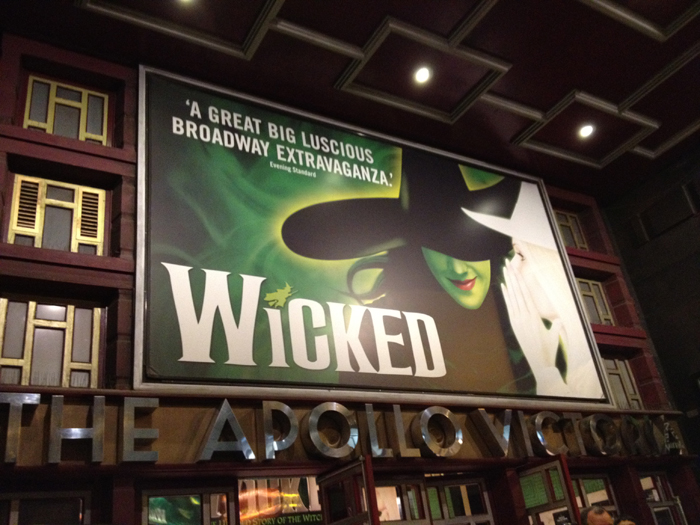
While in London, it was Father’s Day and Mojo wanted to see Wicked.  Susan and I saw it three years ago in LA and loved it.

Mojo’s college roommate and his family were traveling with us.  We took the Tube to Leicester Square to find tickets.  Rows of shops advertised discounted tickets but we didn’t know whether they were legitimate so we walked to the main ticket kiosk in the Square.

Turning the corner, Spiderman’s London Premiere stage was being set up.  This remake promised to tell how Peter Parker became Spiderman after losing his parents.

Andrew Garfield and Emma Stone were scheduled to arrive around 6:30.  We thought Wicked was playing at the Apollo Theatre two blocks from Leicester Square.  We had time to change clothes, get back to see the red carpet walk-by and get to Wicked by 7:30.

At 6pm, Leicester Square was full of people.  Large TV screens had been set up to show the stars’ arrival.  But that wasn’t good enough for our little friend Max.

An adventurous ten-year old, he shouted “I’m going in” and dove into the crowd.

We stood on the outside of the mob only seeing the actors on the big screen.  A half hour later, Max reappeared having met Garfield.

Looking more carefully at our tickets we realized Wicked was at the Apollo VICTORIA which was quite a ways away.  With only twenty-five minutes before the show, we decided the Tube was the fastest way to get there.

Wrong.

The entire platform was filled with people.  When the train arrived, Max like the Artful Dodger led his family onto the train, leaving us stranded on the platform.

We arrived late.  The ushers let us to stand behind the sound engineer where we waited for an appropriate break.

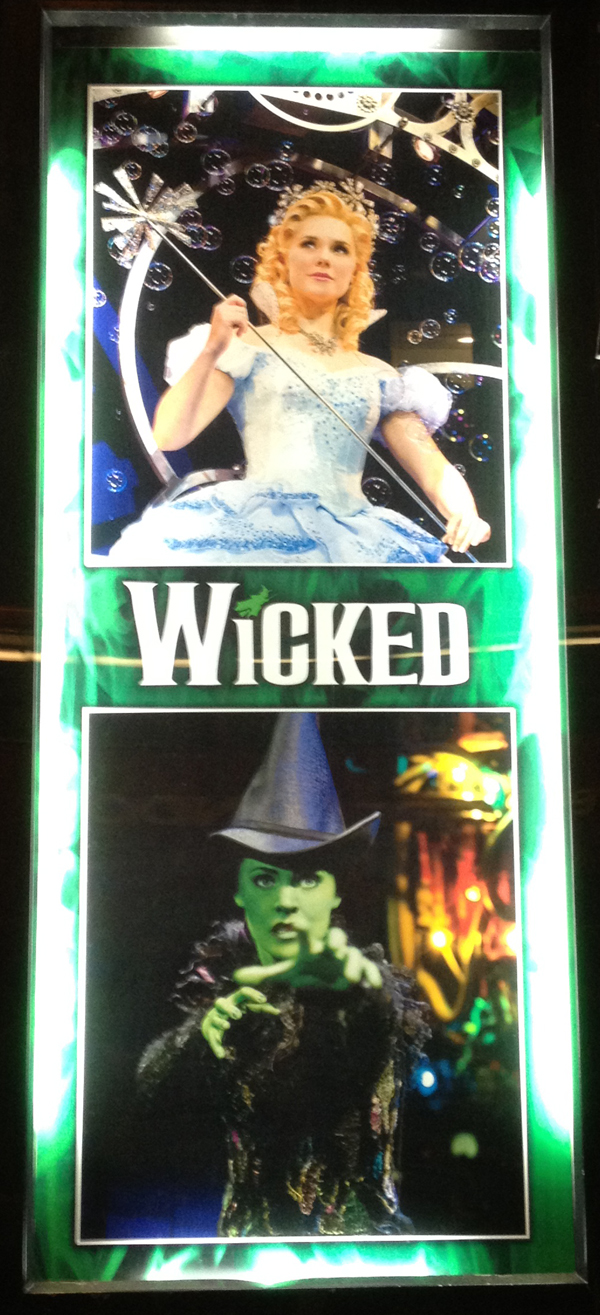
The performance was fantastic.  This cast was much better than the one we saw in Los Angeles.

The Irish Rachel Tucker shined as Elphaba.  Gina Beck was a superb Glinda. Unlike his LA counterpart, Matt Willis was convincing as Fiyero.

When Elpahba and Glinda sang “I hope you’re happy now that you’re choosing this” tears came to my eyes as I watched the friends say good-bye.

I felt Elphaba’s power when she defied gravity and flew into the rafters singing,

“And no one in all of Oz, no Wizard that there is nor was, is ever going to bring me down!”

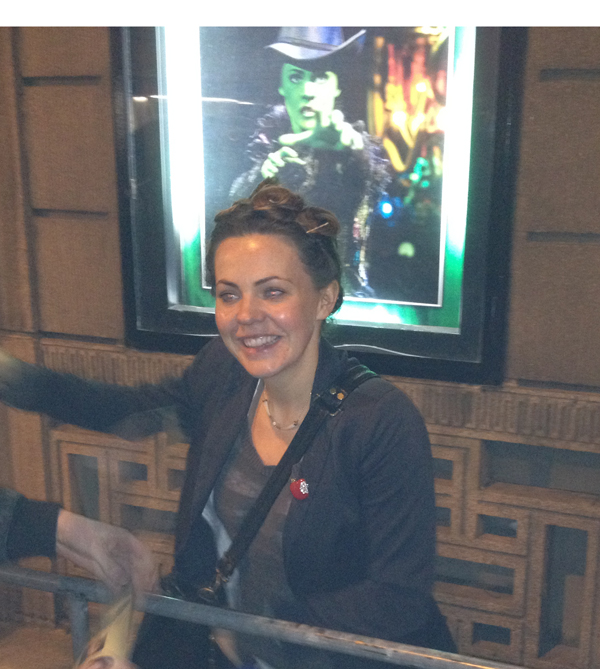
Leaving the theater we saw a small crowd standing outside the backstage door.  The door swung open and out stepped Rachel Tucker in her street clothes.


In Oliver Twist’s London, we met two reluctant antiheros in one day.

The I-Ching According to Michael Jordan

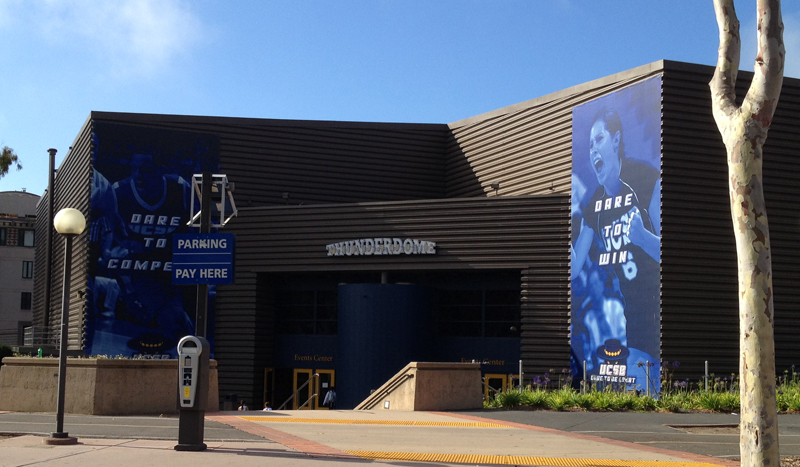
The last few days Mojo, the children and I have been hanging out at the UCSB Thunderdome ostensibly to attend basketball camp.  But really we’ve been hoping to meet Michael Jordan, the greatest basketball player of all time.

Last night Mojo and I arrived early “to see how the kids are doing”.  We were just in time for the nightly camp awards.  After the medals were passed out, the head coach told the kids to gather around the court.

“Who did you come here to see?” the announcer asked.

“Michael Jordan!” the kids shouted.

“I can’t hear you.”

“Michael Jordan!” I shouted.

“Boys and Girls, Michael Jordan!” he said uselessly as the screams overpowered him.

The crowd quieted.  600 camp participants and 1,200 parents pointed roughly 1,500 cameras and phones, each trying to take the winning FACEBOOK shot.

MJ started out with some advice about getting into the game by spinning the ball.  He talked about lay-ups.  He moved onto free throws and asked the kids,

“Free throws are different than any other shot.  Why?

After several attempts, no one gave the right answer.  Finally Michael had to answer his own question.

“Because they are the only shot where you are not already in motion, you have to start from a standing position.  When you free throw you need to have a ritual to get you into the flow.  Do you know what my ritual was?”

A 12-year old raised his hand.  Michael picked him out.

“You spun the ball, then dribbled three times, then you spun it again.”

“You’re right!  How old are you?  You weren’t even born when I was playing.  How did you know that?”

I couldn’t hear the answer, but everyone laughed.

MJ went to the free throw line.  Instead of trying to start from zero, first he got into the Flow, the energy that already existed.  He spun the ball like the earth, dribbled three sacred times, another spin then he directed the ball’s energy straight into the net.  Swoosh! The kids roared.

The I-Ching according to MJ.  Get into the Flow, set your intention, then let the universe make it happen.

To teach the lesson, MJ started a game of Around the World.  If the player made the eleven shots around the court including the easy but treacherous lay-up, the whole team got a pair of new shoes.

The first boy got the lay-up but then missed his second shot.  A second boy was chosen.  With the swagger of a NBA player, he floated the ball through the hoop, easily making every shot.  His team went wild and weaved their way through the sitting kids to pick out their shoes.

The entire gym raised their hand hoping to be chosen.  But it wasn’t as easy as the second boy made it seem.  Child after child missed the first lay-up.  Their team members wailed with disappointment.

After about a dozen kids, MJ pointed at someone under the net.  It was Susan!

Mojo went wild.

Susan made the first lay-up.

She moved to the top of the key.  Swoosh, it went in.

She stepped to the opposite side.  She stopped moving and held the ball.  Concentrating hard, she tried to force it into the net.  It hit the backboard but didn’t go in.

Michael held out his hand towards her.  She didn’t notice.  Her mind was on failing to secure shoes for her team.

We congratulated her on doing so well.  Only two kids completed all eleven shots and maybe four went beyond the third shot.

Her error was she got out of the Flow, the Tao the Chinese call it.  It was a lesson in how MJ turned the I-Ching into Cha-Ching.

Before QEII there was Misia

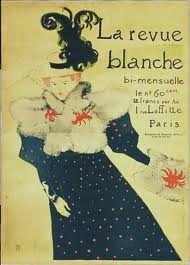
Henri de Toulouse-Lautrec cover for La revue blanche featuring Misia

Queen Elizabeth II may be the most photographed woman in world but my guess is Misia, the Queen of Paris from 1890-1920 was probably the most painted woman of her era.

So how did having dinner with the daughter of a Polish sculptor born in St. Petersburg become the sought after invitation by all Parisian society?

Misia literally became the muse for nearly every important artist, musician and writer during her life, a kind of pre-film Elizabeth Taylor of Culture.

As a young woman, Misia’s magnetic personality, piano playing and ample bosom caught the Nabi artists’ eyes.  Toulouse-Lautrec, Vuillard, Bonnard, Vallotton and Romain Coolus formed the core of avant garde painters who turned away from realism.  For inspiration they looked toward medieval art, Japanese prints, ancient Egypt and Misia.

As the number of painting featuring her grew, Misia figured out how to keep her circle of admirers without having to live with their melancholic poverty.  She possessed the ability to meet and marry the right men.

In 1893 Misia married Thadee Natanson who published La Revue Blanche with his brothers.  Revue Blanche was THE progressive magazine attracting the best writers and artists of the time.  The magazine provided the platform for every political, social and artistic issue during the transition from the 19th to the 20th century.  Misia became the embodiment of the magazine’s elegant Parisian readers.

The plot around her personal life thickened when millionaire Alfred Edwards, the publisher of La Matin newspaper, agreed to bail out her husband’s business in exchange for Misia becoming his fourth wife.  With Edwards’ money, yacht and newspaper, Misia became the friend to musicians Ravel, Stravinsky, and Debussy.

However that life was short lived.

Within a couple of years Edwards fell under the spell of true courtesan and actress Genevieve Lantelme.  Misia attempted to keep her husband by dressing and acting like her young rival.  Misia’s efforts failed and the actress became Edwards’ fifth wife.

Misia countered by becoming involved with Catalan artist Jose Maria Sert.

Through Sert she was introduced de Diaghilev, the director of the Ballet Russes.   Using her large monthly divorce allowance, Misia evolved into the Godmother to Diaghilev’s ballet company.  Her Bonnard decorated Qaui Voltaire drawing room became the center of Paris’ new artistic elite.
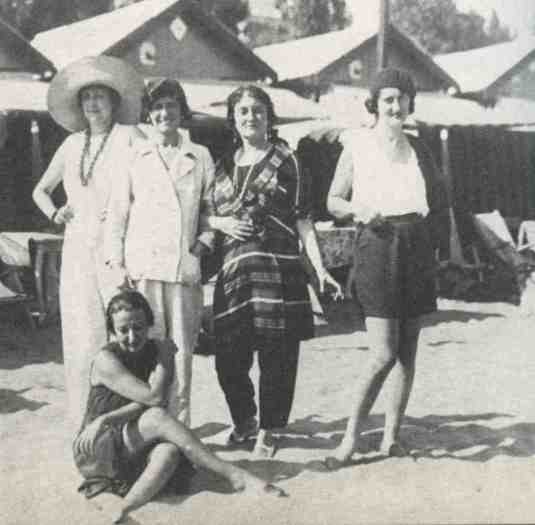
Misia (striped robe) with Coco Chanel (white pantsuit) 1923 in Venice

After WWI, Misia called Gabrielle, aka Coco, Chanel her BFF. Together they were a legendary duo of popularity.  As they partied, addicted to heroin and cocaine, Misia’s figure slimmed into the living model for Coco’s creations.

In 1920 Misia married Jose Maria Sert.  Having learned from her previous mistakes, instead of trying to compete against Sert’s young mistress, she too fell in love with “Roussy” and moved her into their house.  Seven years later, Misia tired of the ménage a trios and divorced Sert.  Interesting enough, like Misia’s previous rival, Roussy died young leaving Sert free to reconcile with Misia.

And the dramas continued.

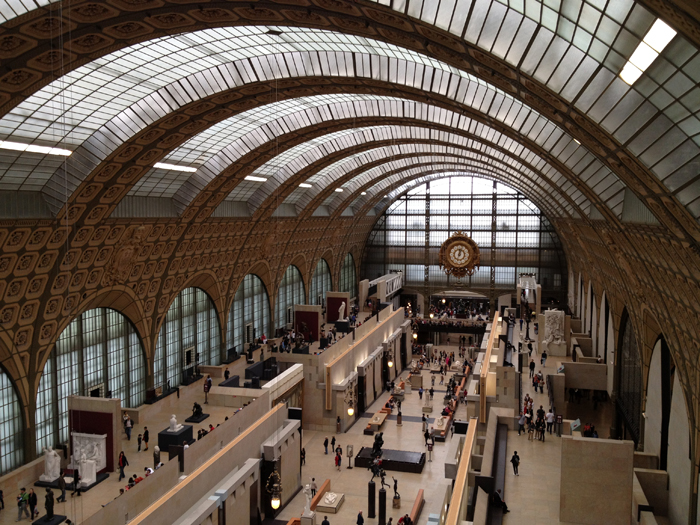
Why my sudden interest in Misia?  She is currently the key subject of a temporary exhibit at the Musee d’Orsay in Paris.
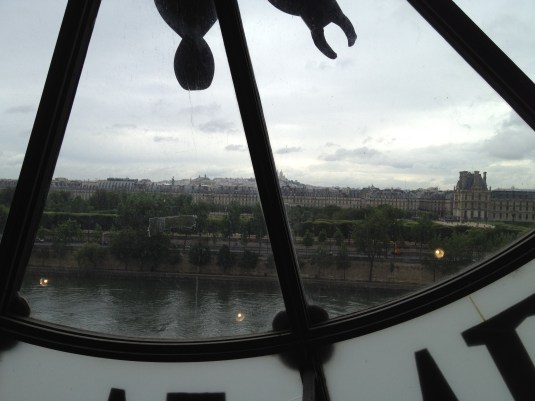
Looking into Les Tuileries Garden from Musee d’Orsay

Misia was the center of a cultural universe that included the rich and the famous at the turn of the century.   Had I read about her before our visit, I could have added some interesting details to nearly half of the museum’s exhibits.

The Musee d’Orsay’s works are world famous.  An art neophyte would recognize many of the paintings.
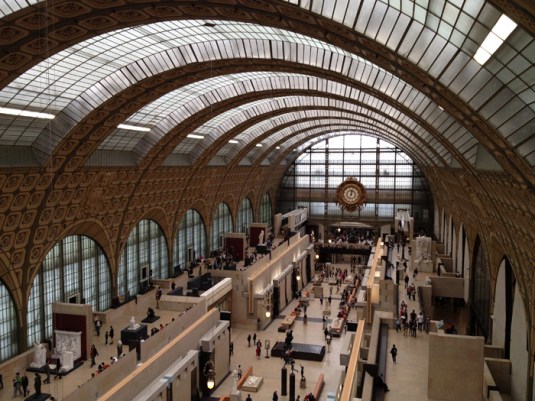
The museum’s building, located in the Saint Germain dstrict on the left bank of the Seine, is an attraction in itself.  Orginally a train station, Victor Laloux designed the building in 1898.  After sitting empty when the trains stopped, the government transformed the interior.   It reopened in 1986 housing the French Republic’s painting, sculpture, furniture and photography from 1848-1914, D’Orsay acts as a link between the Louvre and the National Museum of Modern Art .  D’Orsay provides an excellent tour through a diversity of trends: realism, impressionism, symbolism, Nabis and divisionism.

The Misia exhibit continues through 9 September 2012. 

Having read more about her, I think the exhibit is dull and does not do her life justice.  If you go, I suggest either reading Gold and Fizdale’s book Misia: The Life of Misia Sert or the blog It’s About Time  http://bjws.blogspot.com/2010/09/muse-misia-godebska-sert-1872-1950.html which features more photos than the exhibit.

It’s About Time is a fantastic blog.  The art historian author has created a virtual art museum.   http://bjws.blogspot.com/2010/09/muse-misia-godebska-sert-painted-by.html

Pomp and Horse-cumstance

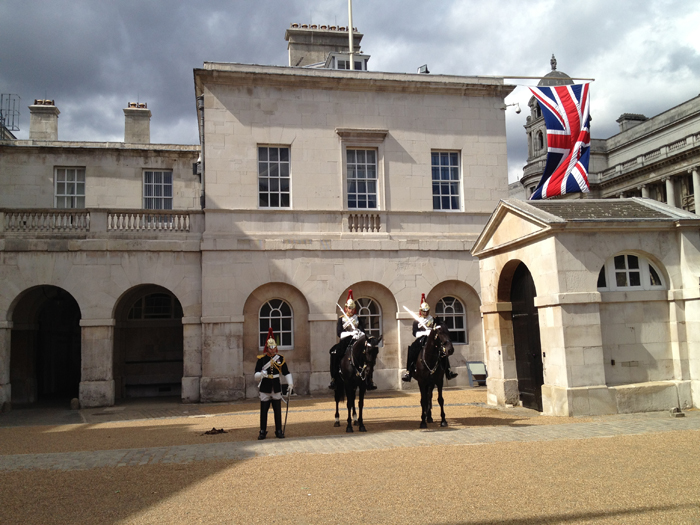
The changing of the Guard at Buckingham Palace might be the highlight of a London Tourist, but you can get close to the Queen’s black horses at the Household Calvary Stable.

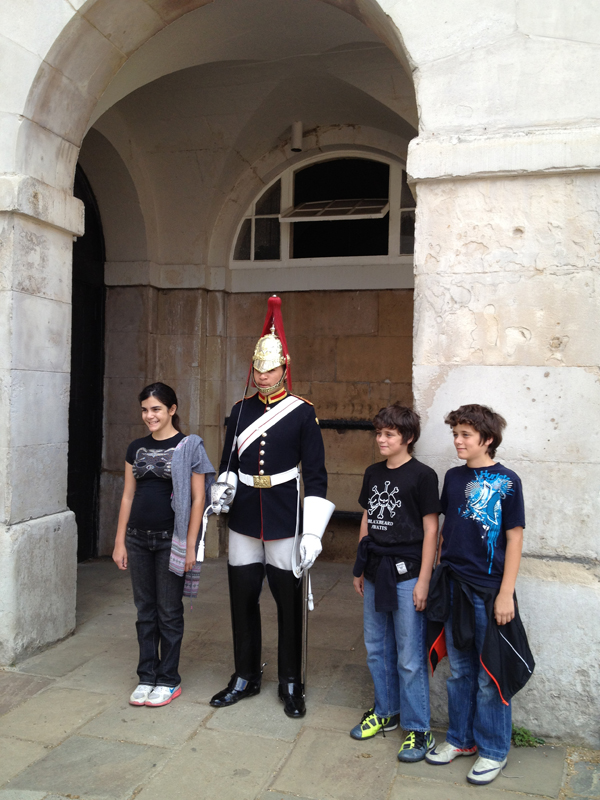
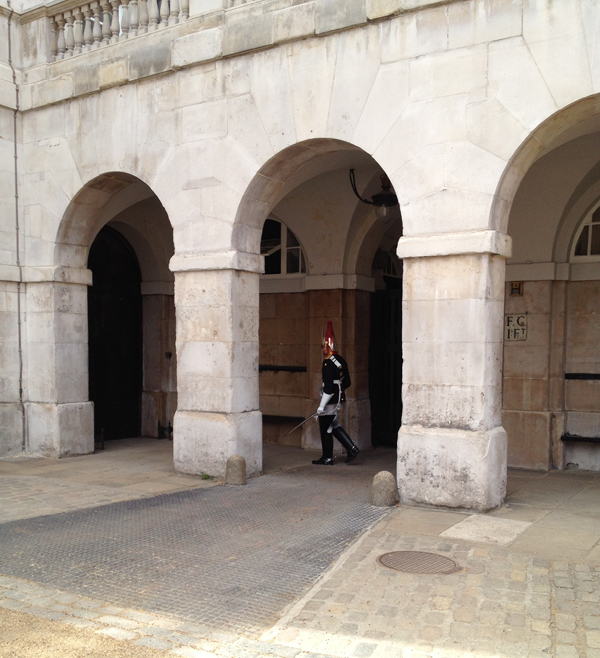
Like the guards at Buckingham Palace, the household stable guards are in full uniform and stand at attention without flinching or interacting with people around them.  Obviously not allowed to move their hands, one amused us as he made funny faces trying to adjust his creeping chin strap without touching it.

After getting their photos taken with the black horses, Mark and Ace wandered through the gate into the empty courtyard.  Seeing the guard did not stop them, the crowd followed them in.

Inside one lone guard marched back and forth.  As he paused standing at full attention before turning around, Ace, Mark and Susan surrounded him and we snapped a photo.

Mama-razzi moment finished, Ace walked to the bench under the roof and sat down.  He got a front row seat as the guard marched towards him, spun on his heel, then marched back.

On the return the soldier stopped in front of the large wooden gate.

“Joe,” he whispered.  Joe didn’t hear him, but Ace did.  “Joe,” he hissed louder.

A brown uniformed man came to the gate.

“That boy is sitting,” the guard whispered.  The man nodded and the guard marched on.

The gate swung open and a soldier came out.  He told Ace to move away then followed him as he returned to our circle.

“That your boy?” the soldier asked.

“Yes.”

“Keep him in the courtyard, please.  He is not allowed to sit on the bench or disturb the guard.”

“Ok.”

The man went back to the gate and came out with a long stick.  He herded the tourist backwards towards the far side of the courtyard.  Uncertain what would happen next, we stepped back until we saw a line in the gravel.

After everyone was behind the line, the changing of the Household Calvary Guards began.  There was a lot of pomp as the guards’ swords were checked for sharpness and boots were lifted to make sure there was no horse poop on the bottom.  After a lengthy review, the horses were ridden behind the gate, the guards filed through and the gate was closed.

Lot’s of pomp for the Queen.

Westminster’s Big Organ – Music

“What’s next,” I asked as we finished up our Westminster Arms fish and chips.

“Westminster Abbey for the organ recital.”

Both my mother and my grandmother played the organ in church so I have a small appreciation for grand, bellowing organ music.  But I wasn’t certain how I was going to sell Ace, Mark and Susan on the idea.

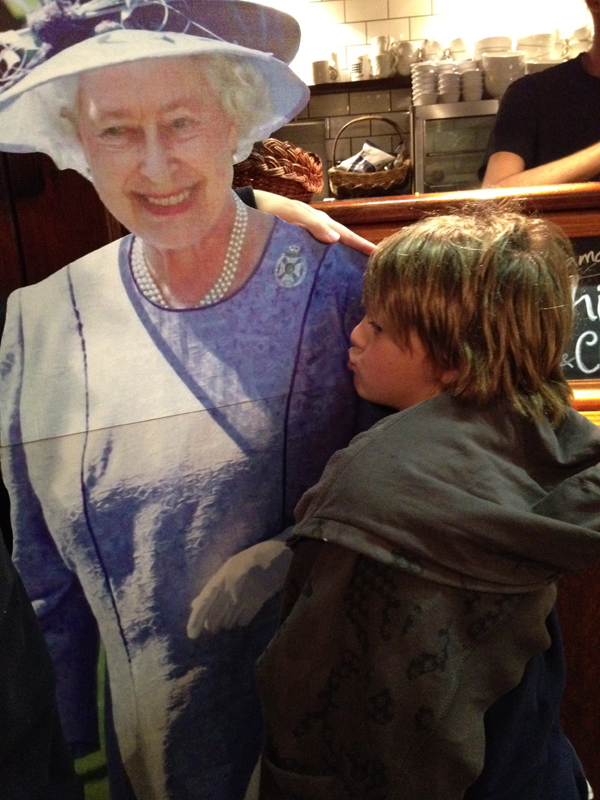
Leaving the pub, we kissed the Queen good-bye then walked to Westminster Abbey.  Standing outside the front doors, the children surveyed the enormous cathedral surrounded by saints and correctly anticipated TV would not be involved.

I tried distracting them.

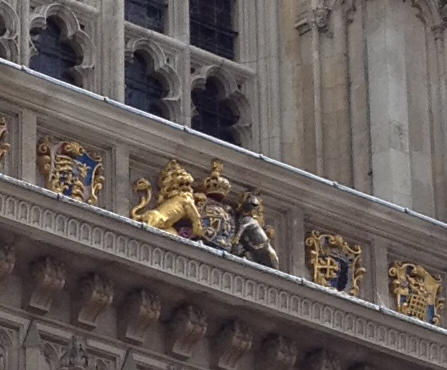
“See the Lion and the Unicorn.  The Lion represents England and the Unicorn represents Scotland where your Burns ancestors came from.”

My kids knew when I called up the ancestors it meant a history lesson.

“Why are we here?” they tried not to moan.

“We are going to a concert.  This is where Prince William and Kate Middleton were married,” I began.

Their eyes glazed over.  Only my friend Deborah and I toasted their marriage ceremony last year.

“Queen Elizabeth was crowned here sixty years ago.”

They sighed.

As it happened we were visiting July 17th, a week before the 503rd anniversary of the Henry VIII and Catherine of Aragon’s coronation.

“King Henry the VIII was also crowned here,” I continued.   “Do you remember which wife was made Queen? “  I directed my question at Susan who had dressed as Henry VIII on Tudor Day.

“The first one, Catherine,” Susan said.

“Right.”

Luckily the doors opened and we flowed in with the waiting crowd.

At 5:45 Martin Ford, the Assistant Organist appointed in January, began Bach’s Fantasia and Fugue in C minor.  Although we could not see him, based on the program, he is quite young.  As the program suggested, at the end of the piece, we kindly reserved our applause.

After the second piece, William Byrd’s Fantasia in A, our friend and his six-year old daughter had disappeared.  During the fourth and final piece, Toccata by Lanquetuit, several people turned around to smile at the sleeping Ace, Mark, Susan, their friend and Mojo.

At least there was no snoring.

Westminster Abbey hosts a free organ recital every Sunday at 5:45.  It’s a nice, civilized way to enjoy the cathedral when you visit London.

Next door is the official gift shop selling royal souvenirs.

The Westminster Arms is a block way on the other side of the park green.

Previous Older Entries Next Newer Entries

Archives

Tales by Chapter