Save A Camel’s Life

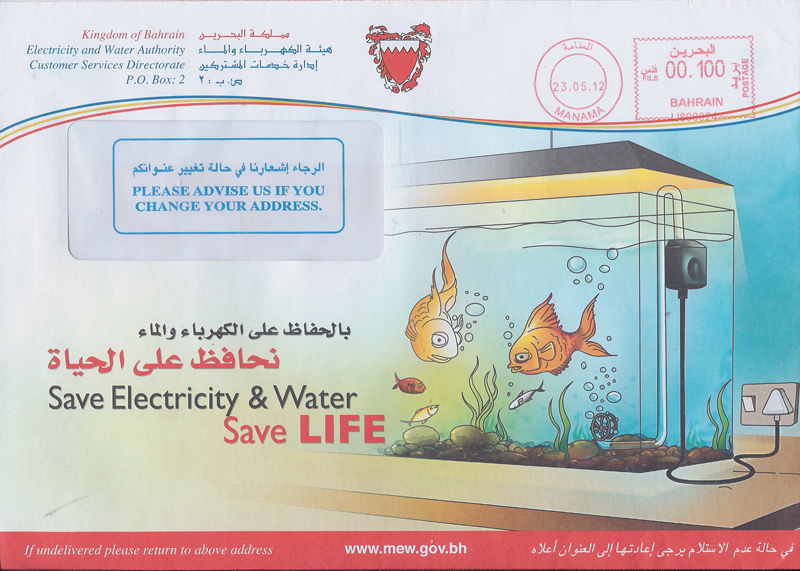
The Ministry of Electricity and Water decorates our bills with helpful hints.  However, this month’s suggestion to “Save Electricity and Water , Save LIFE” stumped me for a few moments.

The electrical outlet for the fish tank’s air supply was intentionally included in the drawing.  Hmmm.

If we reduce the fish’ water and air, we would kill them, not save their lives.  Is MEW implying that fish tanks are a useless waste of water and electricity?

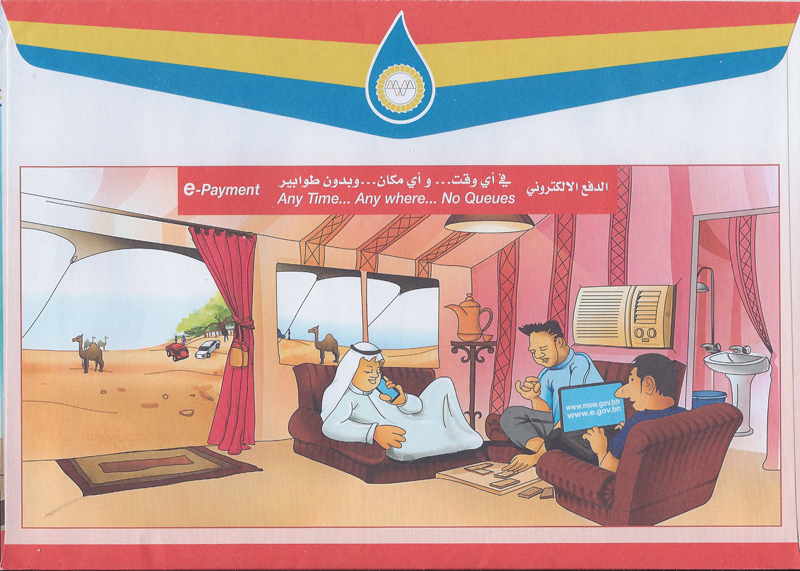
On the envelope’s opposite side is a wonderful drawing of modern Bahrainis getting back to nature during camping season.  While enjoying life in the countryside, and without leaving their tents, they can pay their electricity bill from their mobile phone or laptop.

As the drawing shows, unlike their ancestors who had to put up with the desert’s heat and lack of water, modern men can enjoy desert without suffering its inconveniences.  The traditional fabric tent’s interior is equipped with electric lighting, air conditioning and running water.  Even sand in your pant is no longer a problem because everyone sits on sofas.

Save a LIFE.  Of course!

They want to save camels’ lives by ridding them of their burdens.  Instead of a camel, it is much better to use a sport-utility vehicle to haul all that equipment out to the campsites around the Tree of Life.

And do not take your fish to camp.  They should left at home – where they belong.

I Know What You Like

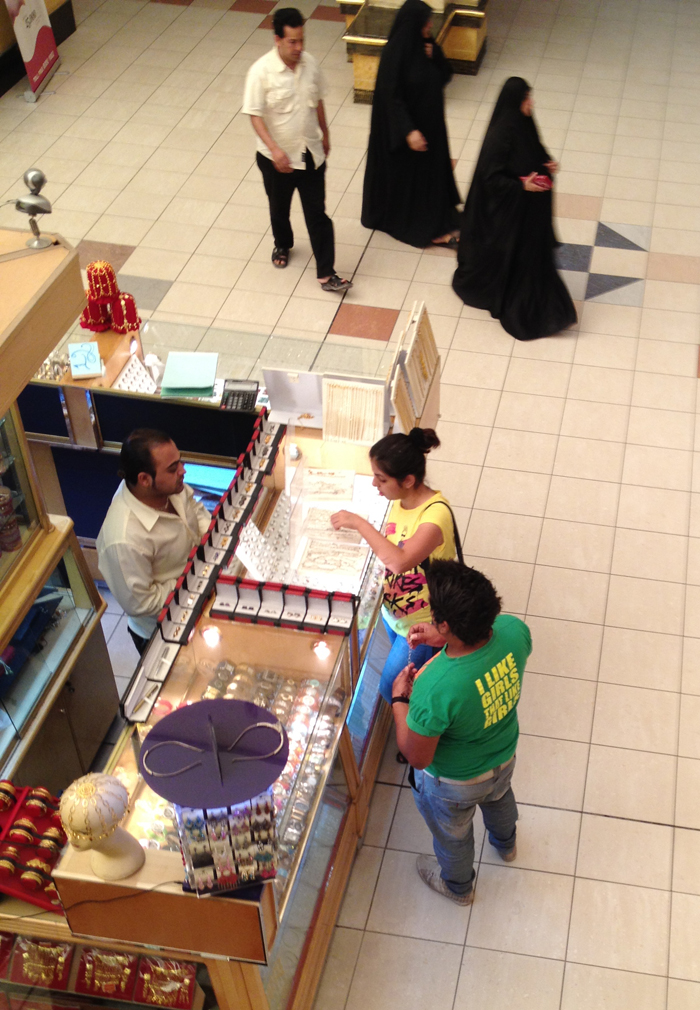
Leaving Geant with my cartload of groceries I noticed this couple.

His shirt said “I Like Girls Who Like Girls” – on both sides.

But I didn’t say “Ugh” because her shirt said “I Like Boys Who Buy Me Jewelry.”

Match made in heaven.

Who Stole the Cookies From the Cookie Jar?

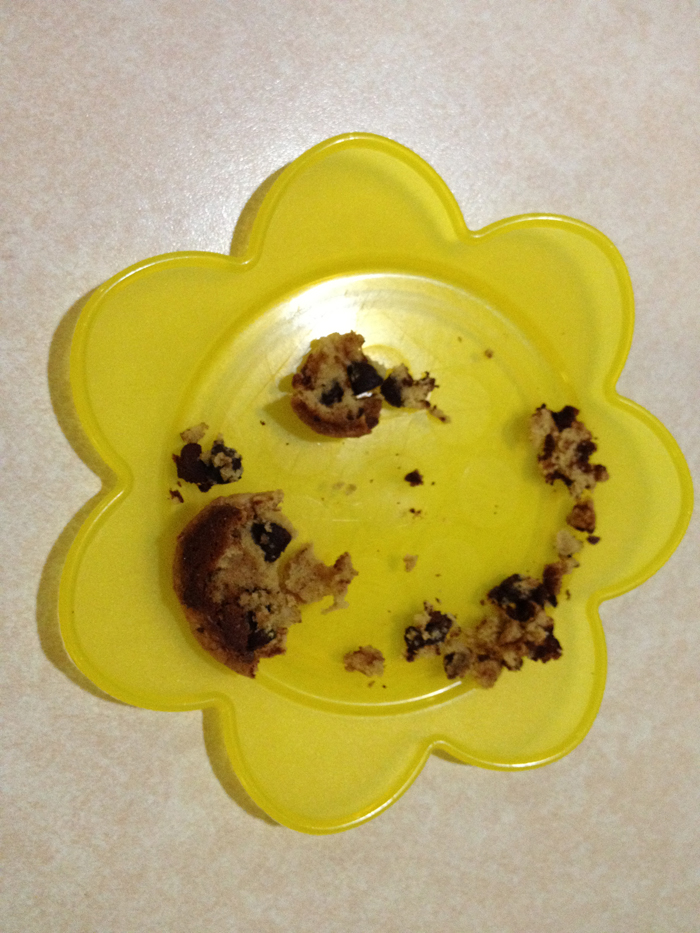
The Evidence

Ace and Mark bake the BEST Neiman Marcus chocolate chip cookies.  They are so delicious an afternoon batch of two dozen is usually finished by 7pm.  When Mojo gets home all he finds is an empty cookie jar.

Sunday night as I was walking out the door to yoga class, the boys were baking again.

“Please save some cookies for Dad,” I told them.  “He feels bad when he gets home and there is nothing left for him.”

“We promise,” they chorused.  “We will leave him FOUR cookies.”

Hungry after my yoga class, I wandered into the kitchen around 9:15 and found a plate with a few crumbs.  I was surprised Mojo would leave even a single chocolate chip crumb.  I thought it would be a funny photo so I took a picture then ate the remains.

When I went upstairs to say hello, I gave Mojo a kiss.

“You smell like chocolate chip cookies,” he said accusingly.

“Yes, I ate your crumbs.  That was all you left me.  Did you enjoy your cookies?” I said sarcastically.

“Cookies?  Where?”  Before I could say anything he was running down the stairs.  I followed.

“Where are the cookies?” he asked me as he searched the cabinets.

I showed him the yellow plate and said “You ate your cookies.  The evidence was sitting right here when I came home.”

He glared at me.

“I cannot believe you ate my cookies!”

“I didn’t.  I came home and found the plate.  See I even took a photo.”  I showed him the picture on my phone.

“The evidence!  You ate my cookies and then you took a picture of the crumbs.  How could you?”

Hearing the boys above us, playing in their dark room, I said “Go ask the boys.”

He went upstairs.  Within a minute both boys ran into the kitchen.  Giggling they looked at the plate then started pointing their fingers at me.

“You ate Dad’s cookies!  We left them here for him.  Why did you eat his cookies?”

“I didn’t.”

“You did.”

Mojo comes into the room smiling.  “See I knew you ate my cookies.  How can you do that to your husband?”

Looking at the three of them, I knew I would not win.  I gave up.

The next afternoon, the boys said, “Mom since YOU ate all the cookies yesterday, can we make some more for Dad?”

“Sure.  Just save one for me please.”

“No way. You ate all of them yesterday.  These are for Dad,” they snickered.

Against three lawyers bonded by sugar and chocolate chips, how can justice prevail?

Where Do You Find Peace In This World?

Driving through a village I saw this on the wall.  It gave me hope.

You shall seek me and find me when you search for me with all your heart.

– Jeremiah

Haj Harmony

Touch the Marble by Jamshid Bayrami

“Mysticism and poetry have always been important elements in Islamic cultures.  This has been the case throughout the centuries.  The Muslim world is not composed of a single color.  And it is not static at all.  It is a tapestry of multiple colors and patterns.

Sufism is not an ancient, bygone heritage.  It is a living, breathing philosophy of life.  It is applicable to the modern day.  It teaches us to look within and transform ourselves, to diminish our egos.  There are more and more people, especially women, artists, musicians and so on, who are deeply interested in this culture.” – Elif Shafak, author of The Forty Rules of Love.

Fareed Ayaz and his eight member party will be performing a Qawwali concert to open the Jamshid Bayrami exhibit at La Fontaine.

Listening to the hypnotic songs which typically last from fifteen to thirty minutes may be a new experience for the modern pop music listener, but Qawwali music is not new.  It is a 600-year old Sufi devotional music.

In the West, the best known Qawwali musician was the late Nusrat Fateh Ali Khan.  Peter Gabriel’s Real World label released five albums of his music.  In film, his contributions were included in The Last Temptation of Christ, Natural Born Killers, and Eat, Pray, Love.  Since the 1997 death of Nusrat Fateh Ali Khan, Fareed Ayaz’s party has continued to spread Qawwali music worldwide, winning numerous awards and playing for global audiences.

Fareed Ayaz’s eight member party comes to Bahrain under the support of the Paris-based Theatre de la Ville.

Theatre de la Ville “finds beauty in the Surrealists”.  The theater’s aim is

“not to run away from the world and find refuge in dreams, not even for a second; it is rather to go to the theater to try on a new vision of things, to open up to events or experiences beyond the norm.”

Through Theatre de la Ville’s long list of Pakistani, Indian and African performers, Western audiences have been introduced to new norms.

The concert is in conjunction with the opening of Iranian photographer Jamshid Bayrami’s exhibit, Haj Harmony.  A photojournalist, Bayrami has covered the Iran-Iraq war and Middle East politics for The Economist, Time, and Agence France Presse.  He won the Grand Prize at the Fajr Festival and a UNESCO World Prize for photography.  He is represented by the London gallery Xerxes Art.

The exhibit opening and concert will be this Friday, May 25th at 7pm at La Fontaine Center for Contemporary Art.  The exhibition and concert will be 25bd and if you include dinner around the fountain, the cost is 35bd.

“How Can You Buy and Sell the Sky?”

Seana Mallen’s homage to George Caitlin’s 1850 painting. In 1844 Caitlin documented Mahaska’s journey to London with a group of thirteen other Ioway people.

In 1848, my great-great grandfather Martin Snider erected the first cabin in Montezuma, Mahaska County, Iowa.

The state of Iowa was named after the Ioway natives who split off from the Oneotas around 1650.  In the early 1800s, through a series of treaties, the US government evicted the Ioways from their land.  Mahaska County was named after the Indian Chief Mahaska, or White Cloud in English.

My great-great grandfather used to tell the story of an Ioway Indian who knocked on the door and asked to borrow milk.  The Ioway’s wife had died during childbirth.  My grandfather agreed but admitted he was a bit perplexed when the man went into his barn and led his cow away.  However he did not stop him.

When the baby was weaned, the Ioway brought the cow back.  Later during the “Indian uprising” my grandfather was the only settler in the area the Ioway did not attack.

European colonists viewed the Native people as either vicious barbarians or as Noble Savages.  The Noble Savage image dates back to Bartolome de Las Casa’s 1530 writings about American natives.  1987 American high school textbooks summarized this history.

“For thousands of centuries –centuries in which human races were evolving, forming communities, and building the beginnings of national civilizations in Africa, Asia and Europe-the continents we know as the Americas stood empty of mankind and its works.”  The story of Europeans in the New World “is the story of the creation of a civilization where none existed.”  – Charles C Mann, 1491

This American myth has lasted over five centuries.  In the book 1491, Charles C. Mann calls it Holmberg’s Mistake.

“The supposition that Native Americans lived in an eternal, unhistoried state – held sway in scholarly work, and from there fanned out to high school textbooks, Hollywood movies, newspaper articles, environmental campaigns, romantic adventure books and silk-screened tee-shirts.” – Charles C. Mann, 1491

Historically the North American Indian population prior to Columbus was estimated to be around 1.15 million with a total of 8.4 million throughout the Americas.  Mann outlines new evidence that points to an American population more likely between 90 to 112 million people.  New estimates suggest by the sixteenth century, 80 to 100 million Indians were wiped out by the European smallpox.

Mann also presents evidence the Indians were not just Noble Savages living off the land; rather they were active agents agriculturally shaping the land.  Mann writes the Amazon rainforest is not wild.  Rather this wet desert is the remnant of a large, managed landscape.

The Native Americans were not simply farmers or hunters.

In 1100AD, at the mouth of the Mississippi River was the port city called Cahokia.  The largest concentration of people north of the Rio Grande, hundreds of high-peaked, deeply thatched roofs like those on traditional Japanese farms were built around a four-level earthen mound bigger than the Great Pyramid of Giza.

Further south, the Mexican Olmec developed a dozen different systems of writing, established wide trade networks, tracked the orbits of planets, created a 365-day calendar more accurate than the Europeans’ and recorded its histories in books of folded bark paper.  The Mexican capital of Tenochtitlan was larger than Paris.

The South American Inka empire was bigger than the Ming Dynasty in China, Ivan the Great’s Russia, the Ottomon Empire and the Triple Alliance.

The use of zero considered “one of the greatest single accomplishments of the human race” was first whispered around 600BC when the Babylonians tallied numbers in columns.  India used a zero in the first few centuries AD.  Europeans began using it in the 12th century when the Arabs brought it to them.

The first recorded zero in the Americas was in a 357AD Mayan carving.  Before that, a calendrical system based on the existence of zeros was used.

Seana Mallen’s painting is based on Edward Curtis’ photograph. Curtis’ life work was to document the tragic decline of the Native American peoples.

“Man did not weave the web of life.  He is but one strand within it.  What we do to the web we do to ourselves.  All things are bound together.  All things connect.”  Chief Seattle.

When we read the “sage” sayings of White Cloud and Chief Seattle, it is not simply the Noble Savage’s spirituality or mythology.  Their wisdom comes from millennia of experience and reflects the “remarkable body of knowledge about how to manage and improve their environment.”

I highly recommend 1491 to open your eyes to a new perspective on history.  It is not the easiest read but it is very interesting.

Currently on display during America Week, Seana Mallen’s paintings can be seen in the Seef Mall near the Starbucks.
Dubai’s Changing Skyline

Dubai Bus Stop with Burj Khalifa in the background

As the sign says

Dubai is

A map that gets updated every day.”

One afternoon, the Burj Khalifa is there and the next morning …

Burj Khalifa blasting off into space. Photo by Mojo in April 2012.

It blasts off to parts unknown.

Previous Older Entries Next Newer Entries

Archives

Tales by Chapter