Playing Baseball in a Shamal

Bahrain’s Minor League

As we drove up to the baseball field the wind blew in from the northeast.  The shamal blocked out the sun and sand filled the air.  But the game wasn’t cancelled.  I consoled the kids.

“You can tell your kids, when I was growing up we used to play baseball during sandstorms.”

Actually it’s been quite a year for Ace, Mark and Susan’s baseball team.

Baseball is NOT Bahrain’s national sport.  However, the season began with enough kids for three teams in the Minor League.  The third team folded within a few weeks as players and coaches quit coming to practice.

Tires burning behind the baseball field.

The two remaining teams played each other 22 times this “season” amidst burning tires and tear gas.  Often they spent hours on the road as traffic was diverted by political demonstrations.

For the top fifteen players, going to Dubai for the Little League Tournament was the highlight of their year.  Saudi Arabia, Kuwait, Qatar and Dubai each fielded two teams of their top players and for the first time, three teams from Perth, Australia showed up.

The Bahrain team played their hearts out and endured despite some tough umpiring.  They lost all their games to Dubai, Qatar and two of the Perth teams.
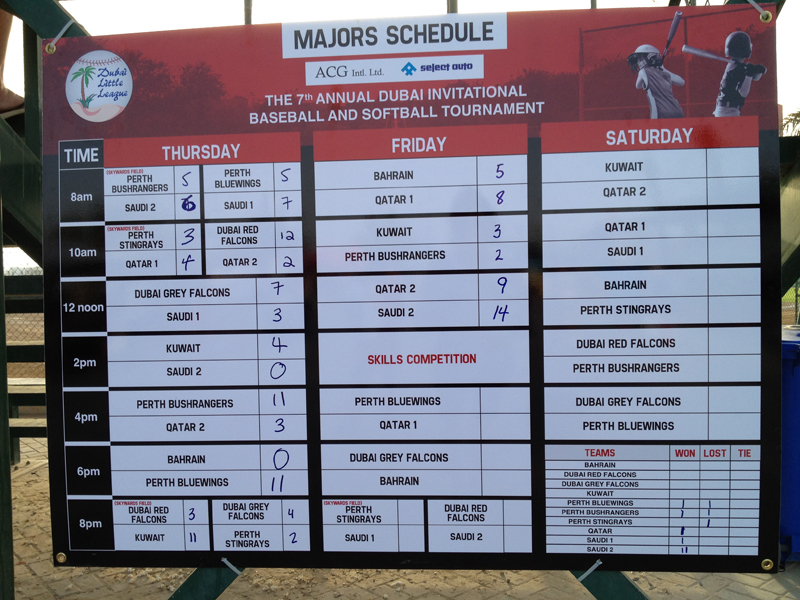
After forging ahead, the Perth teams recognized they had the upper hand and in both games they displayed good sportsmanship and eased up.  They quit stealing bases and called in their back-up pitchers.  They still won by a huge margin but they did not completely trounce our younger, less experienced team.

And as they shook hands after the final game, the Perth coach told our kids that they heard about what had been happening in Bahrain.  They wanted to remember them and asked if they could trade jerseys.
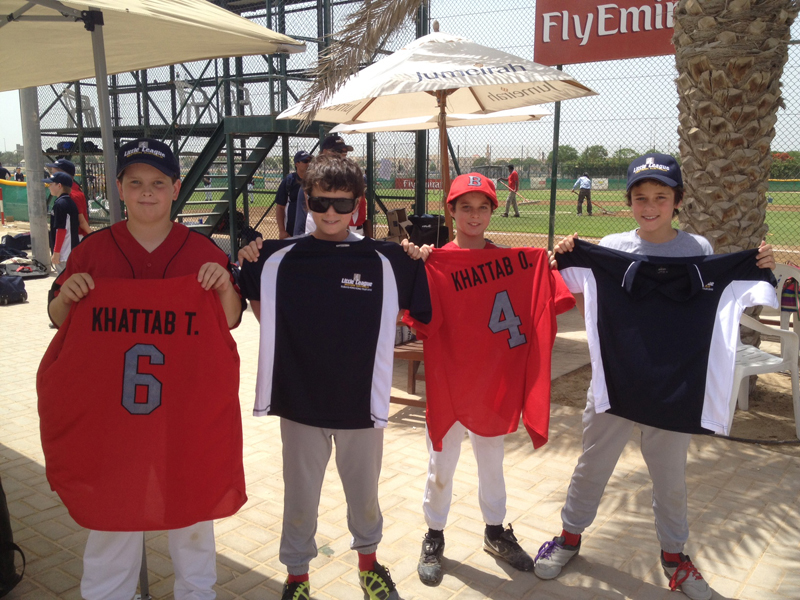
Our team eagerly traded their red jerseys for the Perthian blue and white.  The next morning they all went to the Wild Wadi water park together.  The trip ended with heart-felt hugs and promises to see each other at next year’s tournament.

Yesterday morning as he got out of the car, Mark said in an Australian accent,

“Remember to put a shrimp on the barbe for me, Ma.”

Despite the losses, it was a perfect life lesson in sportsmanship, playing for the love of the game and the camaraderie of team sports.

My Beautiful Bahrain Book Launch

My Beautiful Bahrain compiled and edited by Robin Barratt

My Beautiful Bahrain will be officially launched this Saturday May 5th.

40 international writers submitted their poems, memoirs and stories about living in Bahrain.

Yours truly submitted a short story called Ali and the Hummer.

It’s a story about a man literally chasing the girl of his dreams, a leather clad woman who drives a pink Hummer.

Written a couple years ago, you might call it history as the chase takes place around a now-dismantled Bahraini landmark that was prominently featured in international headlines.

You might call it fact as I personally witnessed all the elements.

You might call it a complete fabrication, a figment of an over-active imagination, because at the end…

Well, I can’t tell you the end.  That would spoil the story.

This Saturday evening May 5th at 8pm there will be at least 40 people gathered at Jashanmal’s in the Seef Mall Atrium to celebrate this book.

I invite my spouse, children, my fellow yoginis and sculptors, any visiting family members, my compound neighbors, the gardener, anyone named Ali and all of my loving and supportive friends with money to join us for a glass of mint lemonade to celebrate this event.

BTW mention my name and you’ll get a 10% discount.  What more can you ask for?

Winfred Marcel Peppinck

What the Eye Cannot See by Winfred Marcel Peppinck

Any child given the name Winfred Marcel Peppinck is destined to become either a diplomat, a novelist, or an adviser to a King.

Or like my friend Fred – as I call him – you can be all three.

Ringing in the New Year together, Fred and I chatted about what we were going to accomplish in 2012.  He had finished his book and was figuring out how to get it published.  I was to finish my book and figure out how to get it published.  Fred has done it.  I have not.

Which is why it is Winfred Peppinck who will be talking about his latest book, WHAT THE EYE CANNOT SEE, and not me.

WHAT THE EYE CANNOT SEE is an Aesop’s Fable for grown-ups with great characters and all too real circumstances.  Fate may conspire to bring people together, but what happens when it grows bored with the game?

Reviewer  Debbie Al Asfoor (how does she get these books before I do?)

“Loved this book. Couldn’t put it down. Racy and exciting. An unexpected twist in the story. Thought provoking and the one ultimate crime in a partnership that the majority of us dread … infidelity! All very real and certainly gives food for thought!”

If you are interested meeting this Dutch author who grew up in Perth, then come along to WORDS on Budaiya Highway this Tuesday, May 1 at 7pm.  Fred will talk about this book, his other novels including The Diplomatic Dog of Barbados and e-publishing.

WORDS is on Budaiya Highway in the Palm Square Shopping Center.  It will be on the right hand side if you are coming from the Burgerland Roundabout towards Al Osra.

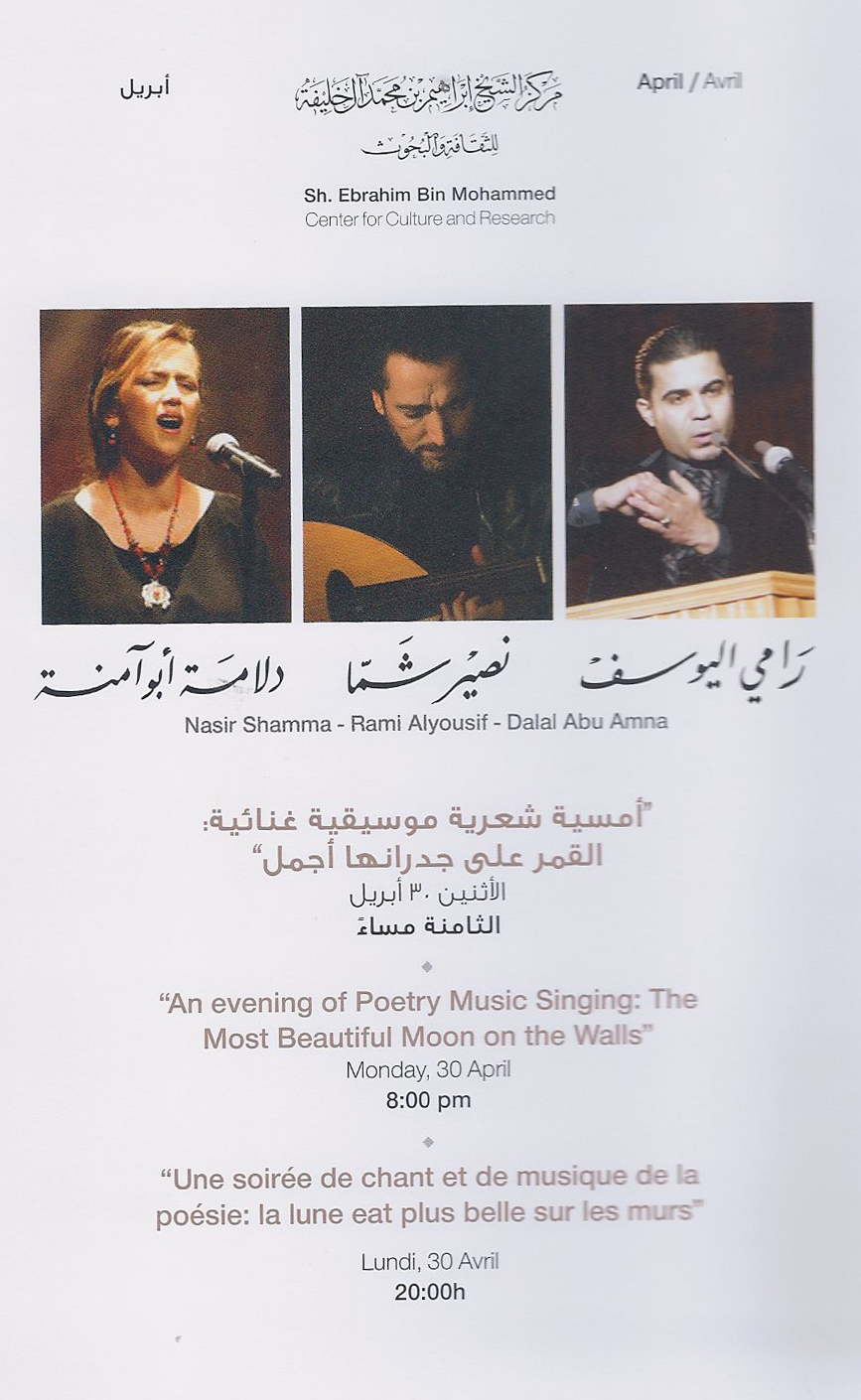
The Most Beautiful Moon on the Walls

An Evening of Poetry, Music, and Singing:

The Most Beautiful Moon on the Walls with

Nasir Shamma, oud player

Rami Alyousif,poet

Dalal Abu Amna, Palestinian singer

Monday, 30 April at 8pm.  Sheikh Ebrahim Center in Muharraq Bahrain.

Post mortem.  I hope someone remembered to go see this.


Culture Clash – If Only It Was This Easy

As I chewed my Paul’s sandwich in the Mall of the Emirates, I watched a Chinese woman surrounded by a crowd of people blow her nose onto the marble floor.  I thought of this sign and wondered whether management should put up a “USE A TISSUE” sign.

In fourteen languages it might work.

Finding Universal Oneness in a Courtyard

Majlis Gallery Courtyard Dubai

The Majlis Gallery is the oldest art gallery in Dubai.  When we ducked through its entrance, I was delighted to find myself in an interior courtyard.  Opened in 1979 in an old Bastikiya wind tower house, it was the kind of place I always imagined we would live in.

We strolled under the Christ’s thorn tree through the central courtyard.  A gallery and working studio, a man was busy framing as a woman painted.  In the main gallery Lynette Ten Krooden’s landscapes were on display.  And the owner, Alison Collins, was trying to soothe a crying baby in a pram.

“My grandson is so tired,” she said.  “I am waiting for my daughter to come back.  Please take a program.”

I admired Krooden’s paintings before crossing into another room.  A man was seated on the sofa working on a large painting.  We greeted each other.

“You are working today,” I said nodding at his paint palette.

“Actually I am on vacation but decided to come in and do some work while it is so hot outside,” he said.

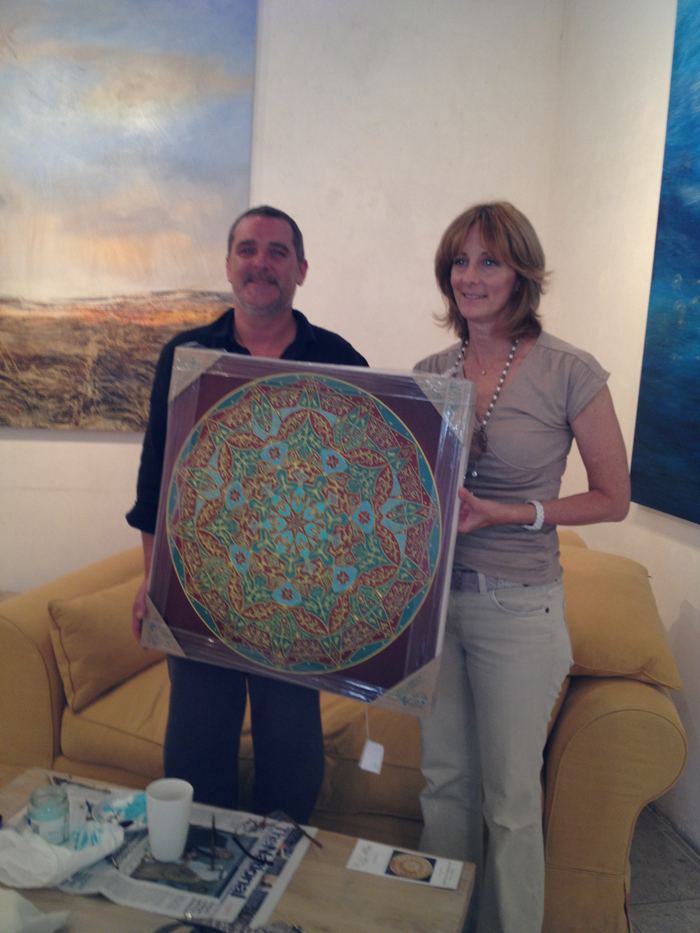
I took a step closer to see what he was working on.  It was a large maroon and green circle with intricate designs like a Tibetan mandala.

Artist Stephen E Meakin at Majlis Gallery in Dubai

He began explaining to me how Orchis 7 was created.

“Seven, you know, is the number of the days in the week corresponding to the creation of the earth, the seven colors of the rainbow and the seven heavens where the order of the angels dwell.  Seven is the universes’ dynamic wholeness. ”

He pulled out his compass and ruler and continued to explain the relationship between the circle and the triangle.

I was talking to Stephen E. Meakin the Sacred Geometer.

As Meakin described how a circle can be divided and the symbols he included in his work, I listened with wonder.   Of all the artists I could have met, I found it amazing I met the one whose work was based on Pythagoras’ sacred geometry.

The first philosopher, Pythagoras said

“All Things consist of Three.”

Sacred Geometry Triangle

α2 + β2 = γ2

Pythagoras taught everything in nature could be divided into three parts and no one could become truly wise if they did not view each problem as being diagrammatically triangular.

“Establish the triangle and the problem is two-thirds solved” Pythagoras said.

For nearly a half an hour Stephen Meakin and I discussed sacred geometry.  My sister and mother wondered in and joined our conversation.   The feeling that somehow this meeting was Divinely contrived stayed with me the whole time.  I asked him whether I could take a photo and thanked him for explaining his ideas.

“To me each painting is sacred,” Meakin said.  “But in the end it really is just art, isn’t it?”

The Majlis Gallery is open everyday except Friday.  They acknowledge parking can be difficult.  They make some suggestions on the website.

Stephen Meakin’s Desert Rose exhibit is currently at the Dubai Fairmont Hotel.

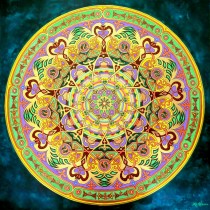
CYGNUS  – The Swan is one of the paintings.

Cygnus by Stephen E. Meakin Acrylic on Canvas

About Cygnus, Stephen Meakin writes on his website:

“The Enneagon is an extraordinary polygon with mystical connotations.  It is very seldom used in sacred architecture, even though it is the highest number that consists of one digit.

The number nine is full of symbolism.  It consists of three triads announcing the end of a cycle and the beginning of a new one. The human embryo needs nine months of growth before birth. Egyptian, Celtic and Greek myths have an ennead of nine gods and goddesses, representing the entire archetypal range of principles.  Nine is the number of perfection.”

(Stephen 11/03/2012)

Although the paintings range from 3×3 to 6×6 feet, Meakin said “like feminine energy, the twenty paintings are hidden within a very masculine structure.”

If you feel some softness as you walk along the Fairmont’s marble hallways, stop and see whether you have stumbled upon one Stephen’s inspired circles.

Who will Prevail? – Mother Nature or the Desert Sheikhs

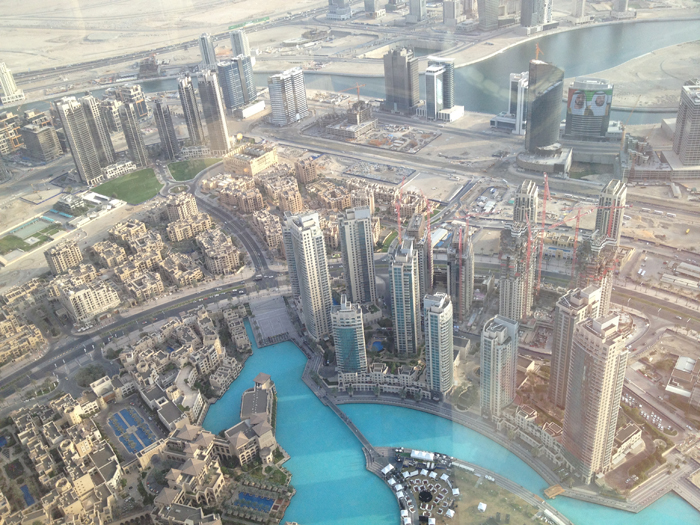
View of area next to Dubai Mall from Burj Khalifa

Dubai reminds me of Las Vegas – without the gambling.  From the desert’s blank slate ambitious people employed modern engineering and literally created a fanciful world reminiscent of Arrakeen from the Dune series.

After years of going to Dubai for “events” and shopping, during my artist sister and mother’s visit, I finally went against traffic and followed Sheik Zayed Road to its origin at the Dubai Creek.  Two-story floating palaces anchored along the corniche’s edge reminded me of the Nile River cruisers.  Reaching the water, our taxi turned left and followed the Al Seef Road to its end at the wrought iron gates of the Ruler’s Court.

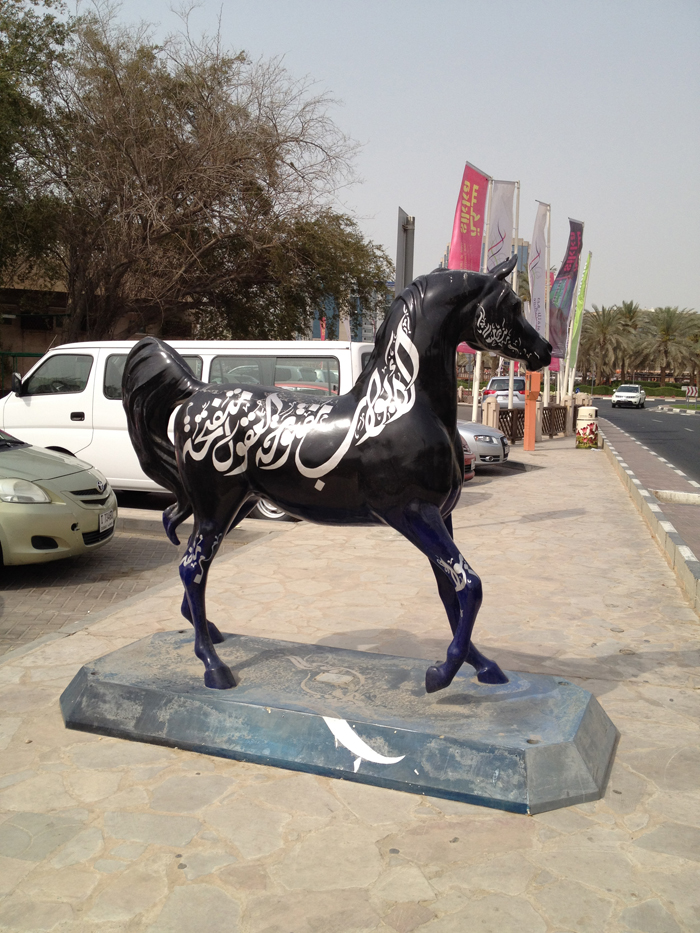
Arabian Horse outside Bastikiya Dubai

The road veered left, past the painted Arabian horse to the first roundabout. There on the right is Bastikiya.

Wind Tower House in Bastikiya, Dubai, 2012

Bastikiya is a restored village previously inhabited by the Persian pearl and textile traders.  It is one of the last remaining historical neighborhoods in Dubai.  Compared to the tourist filled Dubai Mall with its dancing fountains, aquarium, 1,200 stores and view of the Burj Khalifa, the world’s tallest building, Bastikiya felt like a ghost town.  But what it lacks in excitement the small village made up for in its artist charm and peacefulness.

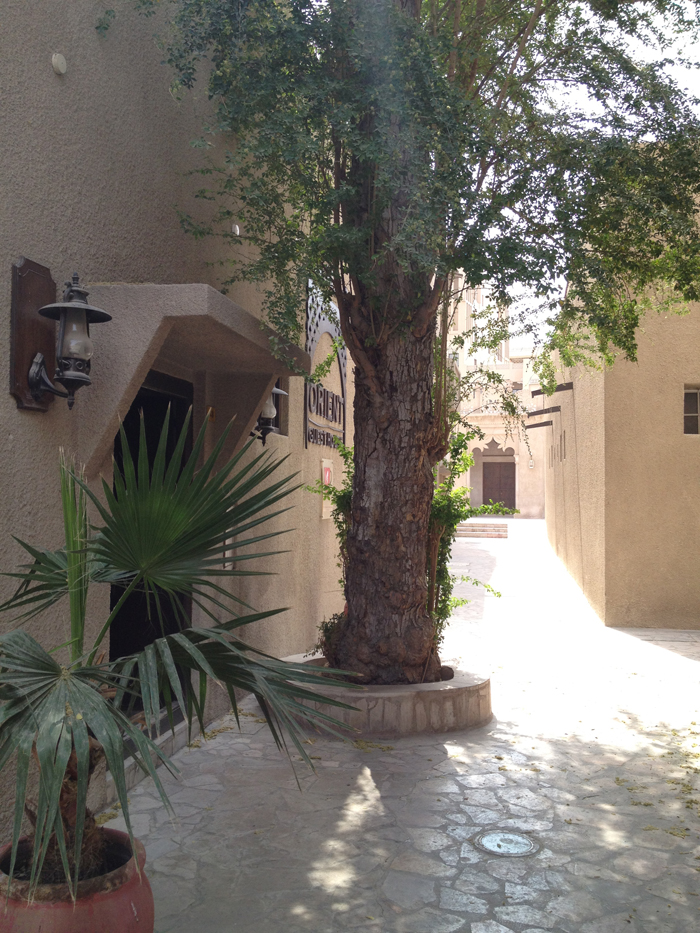
Alley pathway between houses in Bastikiya Dubai

The old-Dubai architecture is similar to Bahrain.  Tiny alleys between mud houses with palm-frond roofs (barasti) are a kind of human warren built as a fortress against the desert.  Most houses had a central courtyard.  Larger houses also incorporated wind towers.

Wind tower were natural air conditioners that took advantage of ocean breezes.

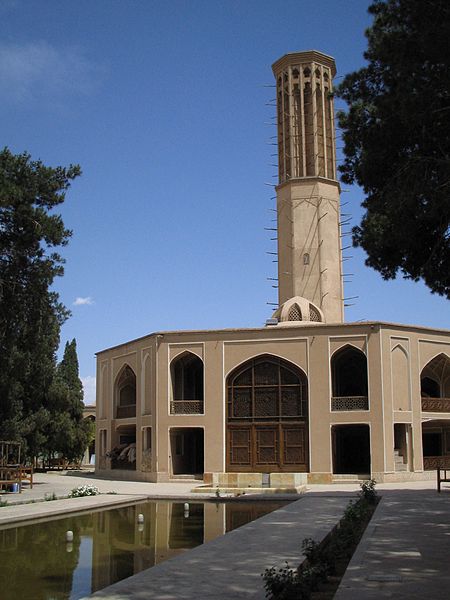
Tallest wind tower in Yazd, Iran

Brought to the Gulf by Persian immigrants, wind towers date back to the fourth millennium BCE in Iran and are found in central and southern Iranian deserts.  There are several types of wind towers including a style built over a cellar or an underground reservoir.  The evaporating water cooled the air and the inside of the house.

Windtower Shutters in Muharraq, Bahrain

Equipped with shutters, the tower could be opened from any of the four sides.  Depending on the wind’s direction, the shutters were opened to capture the wind and directed it to the sitting rooms below.

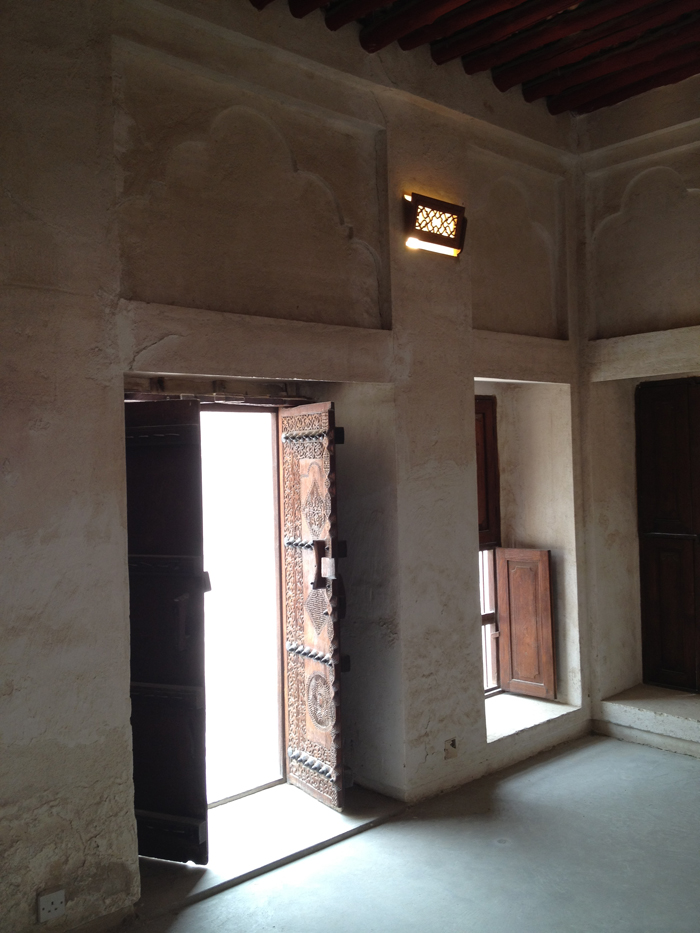
Windtower House. Inside sitting room. Muharraq, Bahrain

In Bahrain most of the old houses with wind towers have disappeared.  A few Muharraq wind tower houses have been preserved by the Sheikh Ebrahim Center for Culture and Research.  La Fontaine Center for Contemporary Art, a restored private home, has a wind tower.

Perhaps someday in the future, this tiny village using traditional desert architecture with thick mud walls and wind towers will be the last building standing in Dubai.   Only time will tell.

Previous Older Entries Next Newer Entries

Archives

Tales by Chapter