A Good Day

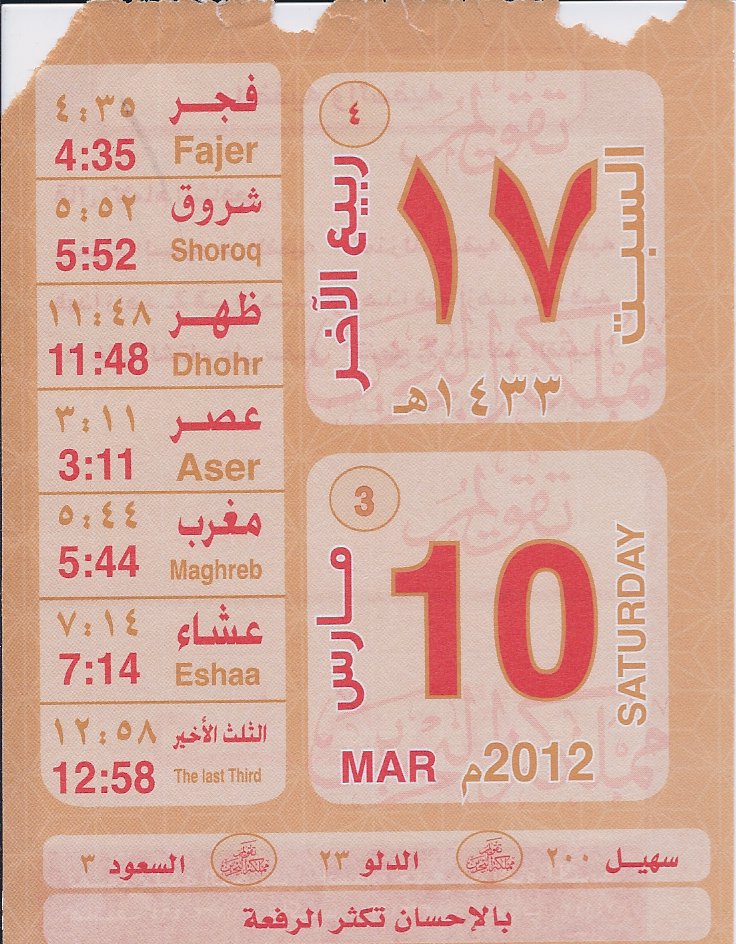
March 10th was a good day.

In the morning air, I felt the seasonal shift from winter to spring.

In the afternoon, yoga class was excused early and I got to enjoy the sunshine.

In the evening, I discovered Tales of Dragons, Rabbits and Roosters was viewed 149 times, the highest daily count yet.

It was a good day.

Andrea Bocelli Concerto – One Night in Bahrain

Andrea Bocelli performed his One Night in Central Park Concert last night.  As the solar flares whipped around our sun, the energies of cultures, music, eras and beliefs mixed in the air next to the sea.

Italian Andrea Bocelli was the headliner, but the young Bahraini woman with the bobbed hair and boots sitting behind me did not seem to understand the concert was not just Andrea singing.  The renowned Russian State Hermitage Orchestra conducted by veteran Eugene Kohn was FEATURED.  And Soprano Paola Sanguinetti who has performed with Bocelli for over ten years was more than arm candy.  But each time Bocelli was walked on and off stage, the audience held their breath wondering whether HE was going to come back.

My neighbor thought when Bocelli was not on stage it was a mini-intermission so she laughed and chatted with her friends.  After Ponchielli’s Dance of the Hours, I finally turned around and said “your laughing is distracting” and suggested that she save her comments for between the movements.

She said “I will try.”

The program’s second half gave the audience some operatic relief.

During his famed rendition of Shubert’s Ave Maria, the stage screen featured a video of Bocelli standing at the foot of a four-foot tall Virgin Mary covered in a floor length veil.  Muslims respect the Virgin Mary.  There are more passages devoted to her in the Koran than in the Bible.  But as Bocelli placed a white rose at her feet and the Virgin’s veil was gently pulled from her face, the Islamic tenet that idol worship is forbidden came to mind.  When the song ended, half the audience clapped and Mojo leaned over and whispered, “oops”.   Already MPs had been calling the Spring of Culture “immoral”.

The Incanto favorites Mamma and Funiculi, Funiculi did not relieve the discomfort hanging over the audience.

Bocelli left the stage and the orchestra played a suite from Romeo and Juliet.  Excerpts from Zeffirelli’s 1968 film’s balcony scene were projected behind the orchestra.  I heard tongues clucking when the blue-eyed, 17-year old Leonard Whiting snuck into 15-year old Olivia Hussey’s window and kissed her.  I don’t think anyone told the producers that in the Bahrain cinemas even Shrek’s first kiss with the princess-turned-ogre Fiona was cut out.

Ultimately it was Elvis, a showgirl and the Las Vegas crooners who saved the night under the Lenten moon.

When Bocelli sang Elvis’ familiar Can’t Help Falling in Love, the mood began to lift.  The audience cheered after he gave his young guest artist, Ilaria Della Bidia, a big hug between their duets.  The audience went wild over his New York New York encore and gave him a stomping ovation for this Liza Minelli and Frank Sinatra staple.

Just as earth lucked out without any power grid disruptions, the Spring of Culture‘s Bocelli concert ended on a HIGH NOTE.

And the audience bundled in their winter jackets and scarves proved the concert did not simply “please semi-naked women” as the MP claimed.

My Beautiful Bahrain

Some people are doers and some people talk a lot.

Robin Barratt is a doer – and a creator, an organizer, an inspiration and an all around good guy.  Just a little over a year ago Robin told the Bahrain Writers’ Circle that he would put together a book about Bahrain and get it published.  And he did it.

My Beautiful Bahrain compiled and edited by Robin Barratt

My Beautiful Bahrain is now available as a Kindle ebook on Amazon.

Forty writers from fifteen countries contributed short stories, mini-memoirs, poems and articles about this tiny, tiny island kingdom in the Arabian Gulf.

Based upon my numerous trips to the Ministry of Traffic, my short story “Ali and the Hummer” was chosen for the anthology.  I was inspired by a mysterious Arab woman clad in black leather I saw in the Seef Mall parking lot and another one driving a neon-pink Hummer who swerved in front of me near the Fateh corniche.

I am especially grateful to Robin for taking on a project no one else has done before.  Just as he made his contribution to the community, Robin is leaving Bahrain as work takes his family elsewhere.

That is what this book is about – Bahrain’s timeless appeal.  Since the Babylonians settled in Qal’at al Bahrain, people from all over the world have landed on the island and enjoyed their respite before sailing back into the world.  Nearly everyone who experiences living in Bahrain fondly – and longingly – remembers their days in paradise.

To view a Kindle ebook, you do not need a Kindle Reader.  You can download the free Kindle software onto your computer or IPAD or other tablet device.

WARNING reading My Beautiful Bahrain may tempt you to taste the forbidden fruit.  Do not read while driving.

You Can’t Be Grumpy When Julio Sings

The last three days I have been feeling quite grumpy.

It’s because I am having to come to terms with the age-related adjustments I must make to my yoga practice.  As I watch my young teacher bend, bend, bend, my ego is having difficulty accepting that I cannot mimic her without injuring my knees, back or _____   (insert nearly any body part).

Perhaps next week.  If only I stretch a little further……..

Last night Mojo and I attended Julio Iglesias’ concert at the Arad Fort.  He came to Bahrain as part of The Spring of Culture.  Even though I only knew his “All The Girls I Loved Before” duet with Willie Nelson, we both agreed the show was terrific.


The good news was his voice is still strong.  And he was still surrounded with young women whose legs sliding out of their evening dresses trounced Angelina Jolie on the red carpet.

HRH King Hamad was impressed too.  He presented the 69-year old Spaniard an award for his prolific musical achievements.

I can only imagine Julio must be pretty grumpy today after the local newspaper featured his award on the front page.  Why? The photo was taken from his left side.

Based upon his myriad of publicity shots, Julio prefers his right side.  Even in his younger days, he entered the stage from the left and sang to his partner so his right side faced the audience.  The same was true last night.  His three sinewy backup singers all stood on the right side of the stage.

After flying in from a concert in Moscow and two nights outside in the Bahrain winter, I hope today he is resting and not obsessing about the photo.  But I know as I watched him carefully execute his choreographed moves, his age was on his mind.

“I am 47 years old” he joked with the audience.

He pretended his water was vodka.
When his saxophonist offered him a scarf, he turned it down, shouting “I feel terrific!”

Wearing only his suit jacket, he sang for an hour and a half while being pelted by an icy desert wind.

Watching him I wondered “at his age, why is he subjecting himself to this?”

Today I went to see my young hairdresser after a two month hiatus.  He looked at me and said, “You look great.  Have you lost weight?”

“No,” I said thinking a moment.  “But I have been immersed in my yoga training since January.”

“I have never exercised.  My doctor told me I should do yoga.  Everyone says yoga is excellent for you.” He continued, “You look different, better.  After seeing how you were walking, I am motivated to find a yoga class for me.”

I was so pleased.

“Yoga is great,” I agreed.  And thinking about Julio telling us how his music came from his heart and how much he enjoyed singing to people around the world, I added,

“And always do what you love.  That will keep you feeling young.”

Touring Oman: Zaher Drives Us Back to Muscat

Passing One Year of His Majesty's Call to Minimise Road Accidents. Traffic Safety Day - First Anniversary Stamp. 18 October 2010

On the way home we chatted and told jokes.  When we hit the highway, the ding, ding, ding started.  I said to Zaher,

“It was so nice when the bell was not going off.”

He slowed to 120 kilometers per hour and we sat quietly wondering who was going to blow first.

About halfway back we needed to pull over for petrol.

It was nearly 4pm.

Zaher had a hard time keeping his foot from pressing the pedal.  The ding, ding, ding would come on and he would jokingly shush it as the car decelerated.

Suddenly we came to a complete stop.  At least two kilometers ahead of us, the mountain highway was a parking lot.

“Oh my god,” Zaher kept repeating.  “There must be a terrible accident.”

We waited in one of the two lanes of traffic.  After twenty minutes of not moving, Zaher could not take it.

He turned right and started driving down the road’s shoulder.  He kept looking out into the desert.  Other four-wheel SUVs had already pulled out of the traffic and were crossing the desert to a dirt side road.  With the low Camry, he had to wait for the right opportunity to pull out into the desert.

I observed one Land Rover stuck in a dry stream as cars waited behind it and said to Zaher “that car is stuck.  Be careful where you are driving.  I don’t want to get a puncture.”

He looked at me, “We have a spare and you are two strong women.”

“Oh no,” I told him.  “I am older than you and my knees are aching.”

That kept him from driving into the desert.  Instead he continued driving on the right hand shoulder passing all the other cars.  Several cars began following us.

An ambulance came up from behind trying to get through to the accident.  It slowed to a crawl because the line of cars Zaher led on the right hand shoulder blocked its path.

“An ambulance is coming,” I told him.  “There are probably people who are hurt.  You’d better get out of the way.”

Zaher forced our car back into the traffic leaving just enough for the ambulance to scoot through.  As soon as it passed, he pulled right again and followed closely behind.

It sped ahead only to be stopped completely by another white Camry.   The white Camry did not move out of the way despite the ambulance driver trying to use the siren to push it out of the way.

We did make progress following the ambulance.  Finally the white Camry pulled back into the traffic, creating quite a pile-up.

I am somewhat used to this type of driving.  I decided if he doesn’t care, it’s not my car.  If it gets dented….

Still I could not keep my mouth shut.

“There’s a police officer up ahead,” I informed him.  “He is giving that guy a ticket.”

The police officer was waving for the white Camry to get out of the way to make room for the ambulance.  The ambulance got through and the officer seemed to be writing the guy a ticket.

Zaher pulled left between two large trucks.  He squeezed in between the bumpers that were even with our heads.  I didn’t say anything.  I thought, I am not his mother.  I am not his employer.  I am not his wife.

He began weaving and maneuvering into the left hand lane, forcing his way around the trucks.  Once in the left lane, we discovered the police were funneling people back into the right lane.  Zaher negotiated his way through and around the cars, waving and beeping, forcing them to halt and let us through.  No dings, no hits.

We finally got to the ten car and the one hundred air conditioner accident.  A large truck carrying air conditioners fell over while swerving to miss a five car pile up in front of him.  People were strewn across the road holding their heads.

“Wow wow wow,” said Zaher as he slowed to three kilometers an hour to look at the damage.

As soon as we passed the mess, he pressed the gas and we were at 150 – ding ding ding ran the bell.  But he didn’t care.

Five kilometers flew by before we were suddenly in another traffic jam.

“What is going on?” he said.  Tired of being a tour guide, he pulled his ghuttra off his bald head and threw it down on the center brake and unbuttoned his top button.  Now he was the real Zaher.

Again he started pushing his way through the traffic until we were absolutely stopped by a big jam around a huge tanker that had turned over in the road.

The tanker was so large a huge crane had been set up in the road to hoist it from the ground.  The crane operator had to have nerves of steel as he lifted the tanker.  Cars filled with families sat within a foot of the crane beeping and swerving around its braces as they squeezed their way through the traffic.  Police officers tried controlling the chaos but people drove in literally every direction to get around the crane.

Zaher managed to get around the crane and sped into Muscat.

“Oh no,” Zaher started moaning as we entered the city and slowed again.  “It is Thursday night.  Festival night.

As much as Zaher tried, he could not outwit the traffic.

We found ourselves at six-way intersection with cars standing still in virtually every direction.  Instead of waiting behind the line where the traffic light stopped us, Zaher plunged into the middle as soon as a tiny space was made. We were surrounded by a sea of cars.  No one could move as no one gave an inch.

We sat in the intersection for about fifteen minutes through at least eight changes in the traffic signal.  Absolutely zero cars moved.

Suddenly a space opened up.  The police had arrived.

Gesturing and shouting, they got the unruly drivers out of the intersection and back to following the lights.  Within three lights we zoomed through the center of the intersection, made a left and found ourselves on the road to the Crown Plaza.

We pulled at 6pm.  Not bad, our itinerary said we would return by 5pm.  I really didn’t want to congratulate him on getting us back so timely as I didn’t agree with how he did it.  I didn’t complain though and we tipped him well.

“That was a lot of traffic,” I said.  “At least we made it back in one piece.”

“Usually I am back here by 3pm,” he complained.

I didn’t take the personal business card he offered.  We bid good-bye.

Inside, Goldi and I washed up then headed down to the pool side bar to recover from our day.

The next morning, I really couldn’t imagine Sultan Qaboos was happy when he read about both accidents in the newspaper.  It was barely three months after Traffic Safety Day.
Touring Oman: Sixth Stop Jabreen Castle

Our final destination was Jabreen Castle.

Afraid he was not going to get a tip, Zaher led us through the castle pointing out the signs on the walls.  The renovated fort/palace/university was built in the 15th century.

Throughout the castle, the rectangular rooms were similar with low windows that opened near the floor and high ceilings that vented outside, naturally cooling the rooms.

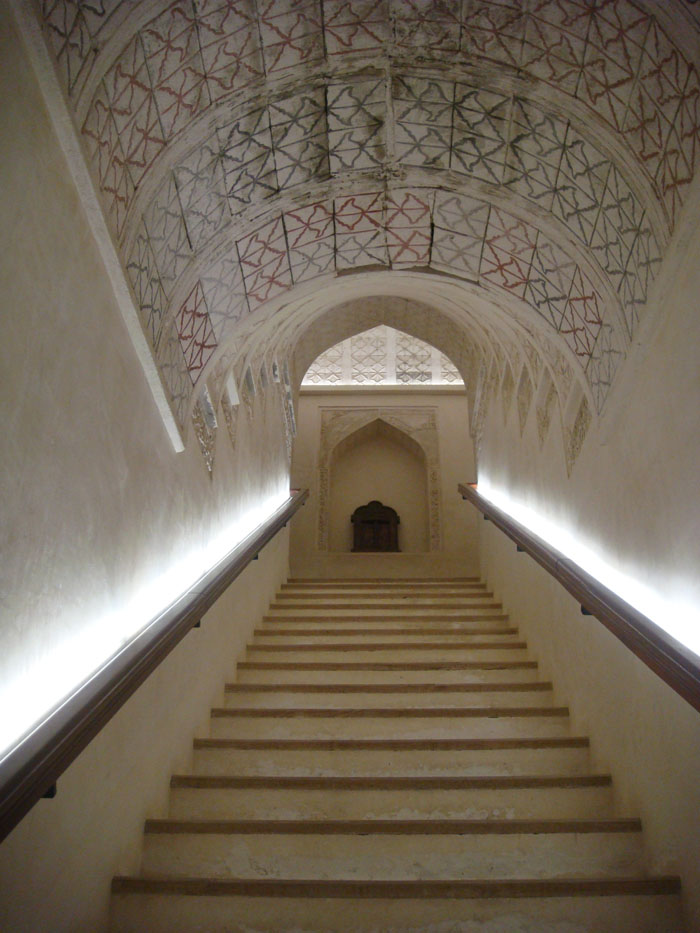
The beautiful, recently painted ceilings looked like carpets.  We wove through the maze of rooms.

Hoping we didn’t want to go up, our guide weakly pointed to the upper floors and said “the rooms look the same upstairs.”

“Let’s go,” I said, “you’ll get your exercise.”

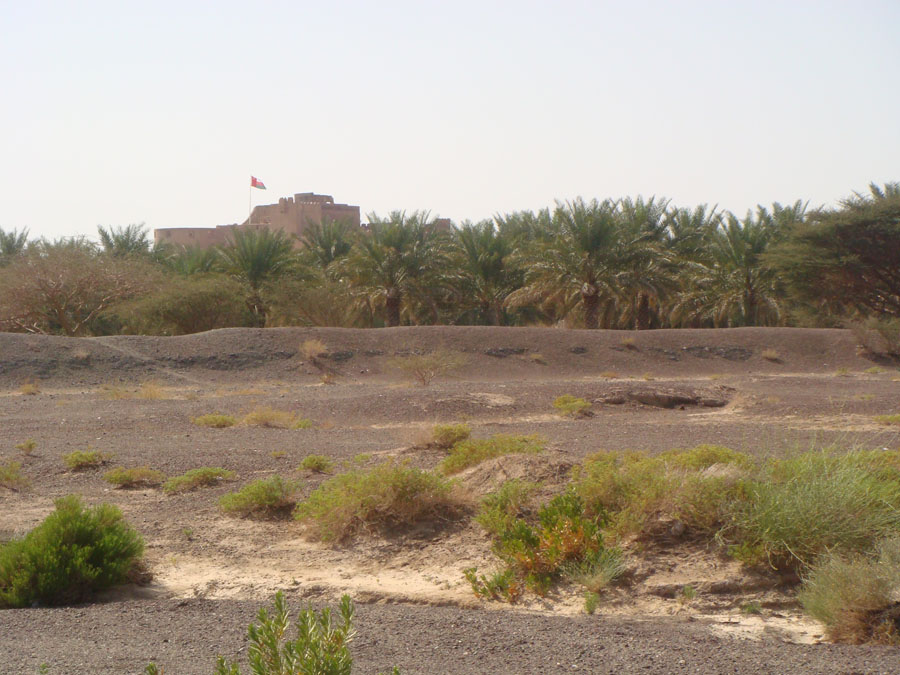
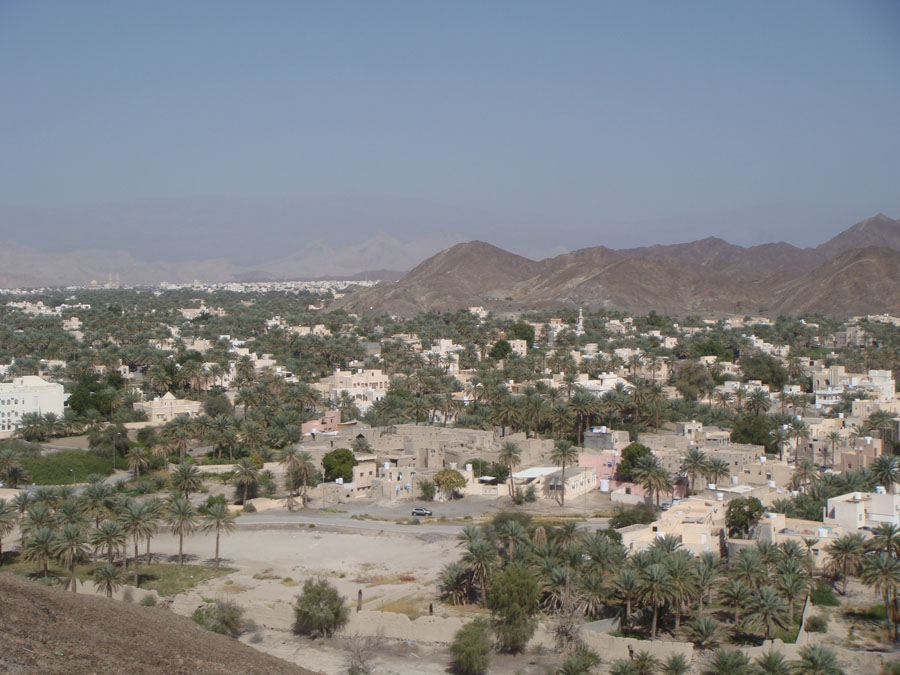
The interiors were similar but the views were great.  Eventually we made our way to the highest rooftop that overlooked the valley.  A French TV camera was taking pictures of the Omani flag waving in the wind.

We took the same photo and chatted with the tourists.

An Omani man was lecturing his maid (seen in the first picture at the castle door), his wife holding a newborn and his five children under the age of seven on the palace architecture.  When he saw Goldie and I walk through the doorway, his eyes lit up.  He left his family and made a bee-line to us.  We were the audience he was looking for.   Before we could say salam, he began telling us about the architecture.  Unable to add to the conversation, Zaher sat on the side strumming his fingers.

After a half an hour of his time, we thanked him and he thanked us.  We moved on trying to take artistic photos that might make us famous.

As we left Zaher asked if we needed the ladies room before our hour and a half drive back to Muscat.

We decided to take advantage and were pleased we did.  The restrooms at Jabreen Castle were new, modern and clean.  We told Zaher,

“From now on don’t bother with the hammam in Bahla.  Just bring your clients to the Jabreen Castle.”

We started our drive back to Muscat.

I asked, “What is the difference between the Ibadiyyah and the Sunni and Shiite.”

“There is no difference really.  We are all Muslims.”

“But there must be something different otherwise you would be Sunni.”

“It is mostly how we pray.  We pray like this,” he said taking his hands off the steering wheel, putting his hands together and not moving.  “And they pray like this,” he said moving his hands from chest down to his thighs.  “See little difference, we are all Muslims.”

It didn’t seem like enough difference to make a distinction between the sects.

Zaher said “I am not a good Muslim” and admitted he did not know what the deeper differences were.

At home after doing some research I understood Zaher’s description better.

There is a fundamental difference in how the Ibadi pray – standing up.  There are also some particular doctrinal differences with the Sunni around how Imams are chosen and what happens to fallen Muslims.  Ibadi rejected the Qunut prayer which says:

O’ Allah ! I seek help from You, ask forgiveness from You, and believe in You and praise You for all the good things and are grateful to You and we part and break off with all those who disobedient to You. O Allah, You alone do we worship and pray exclusively to You and bow before You alone and we hasten eagerly towards You and fear Your severe punishment and hope for Your mercy, for Your severe punishment is surely to be meted out to the disbelievers.

My understanding is Ibadi rejected this prayer because it said “we part and break off with all those who (are) disobedient to you” and “Your severe punishment is surely to be meted out to the disbelievers.”

Ibadiyyah practice barā’ah: dissociation (but not hostility) towards unbelievers,sinners, and those destined for Hell.  They believe in wuqūf: reservation towards those whose status is unclear.  This view allows for them to have quiet interaction with others, but not in a way that causes strife or disagreement.  This underlying belief probably explains some of Zaher’s casual “Maybe this or maybe that” attitude.

Zaher admitted he had never even traveled to any other Gulf country so he really didn’t know any Muslims besides the Ibadiyyah.  Like his forefathers, Zaher was isolated – and protected – from the other Gulf countries by the Hajar mountains.

We rode in silence observing the countryside.  There were quite a few newer, two and three story villas near the road.

Zaher pointed out, “these villages are further away, but these houses are moved out.”

I finally understood what he was saying.  The small villages were expanding and we were seeing the new houses being built on the outer circumference.

“What is the population of Muscat today,” I asked thinking about the new roads and houses that seemed to be popping up around the countryside.

“5 million”

“5 million?”  That sounded very high.  I pulled out our guide book.

“Wow,” I said.  “This guidebook was written in 2003.  There were 2.3 million then.  In less than ten years the population has doubled.  That is amazing.  Why are so many people coming to Oman?” I asked.

“Some people they come and some people they go,” he said in his non-committal way.

Later when I checked out Oman’s population, the World Bank’s estimate was 2.78 million in 2010.

Ding, ding, ding.

Touring Oman: Fifth Stop – Bahla Fort

Our 2003 guide book said that Bahla Fort was the largest fort in the area and was not open due to renovation.  Eight years later Zaher confirmed we still could not go inside.

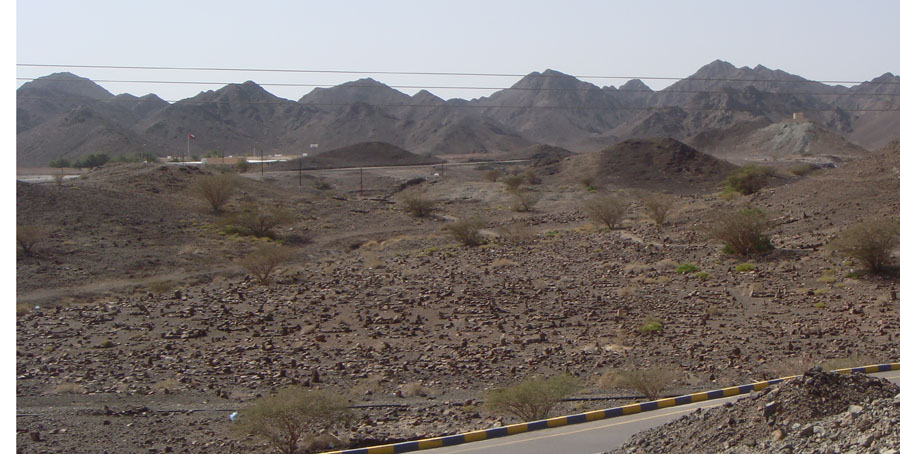
Although my guidebook said the village had many interesting ruins, a great souq and nice palm plantations, we drove up the mountain where the tv antennae facility sat to get a good view and take pictures.   Also, according to my guide book, Bahla was actually about 46 different villages.  It is believed to the oldest inhabited town in Oman.  Archeologists found some artifacts dating back to the third century BCE.

Finally a little Omani knowledge that was not included in our guidebook came out of Zaher.

“See that wall that surrounds the village,” Zaher said pointing.  “The people say that it was built during the night by jinns.”

“Jinns?”  Jinns are ghosts in Arabic.

“Yes.  When they went to bed it wasn’t there and when they woke up it was.”

“They must be very good people if the jinns want to protect them,” I offered.

“Some people were good and some people were bad.” He continued, “This is why the renovation has not finished.  The jinns keep taking down the construction.  They work on the fort and the next morning it is taken down.”

“Then perhaps the jinns don’t want the fort rebuilt.  Perhaps they are afraid the people are preparing for war,” I suggested.

“Maybe – some people were good.  Some people were not.  I don’t know.”

The village and the fort were picturesque.  We climbed back into the car and made our way down the hill.

At the bottom of the hill, we passed a cemetery – a flat-ish area with stones unnaturally turned on their sides.  The work of jinns?

Next Stop: Jabreen Castle

Previous Older Entries Next Newer Entries

Archives

Tales by Chapter