Finding Universal Oneness in a Courtyard

Majlis Gallery Courtyard Dubai

The Majlis Gallery is the oldest art gallery in Dubai.  When we ducked through its entrance, I was delighted to find myself in an interior courtyard.  Opened in 1979 in an old Bastikiya wind tower house, it was the kind of place I always imagined we would live in.

We strolled under the Christ’s thorn tree through the central courtyard.  A gallery and working studio, a man was busy framing as a woman painted.  In the main gallery Lynette Ten Krooden’s landscapes were on display.  And the owner, Alison Collins, was trying to soothe a crying baby in a pram.

“My grandson is so tired,” she said.  “I am waiting for my daughter to come back.  Please take a program.”

I admired Krooden’s paintings before crossing into another room.  A man was seated on the sofa working on a large painting.  We greeted each other.

“You are working today,” I said nodding at his paint palette.

“Actually I am on vacation but decided to come in and do some work while it is so hot outside,” he said.

I took a step closer to see what he was working on.  It was a large maroon and green circle with intricate designs like a Tibetan mandala.
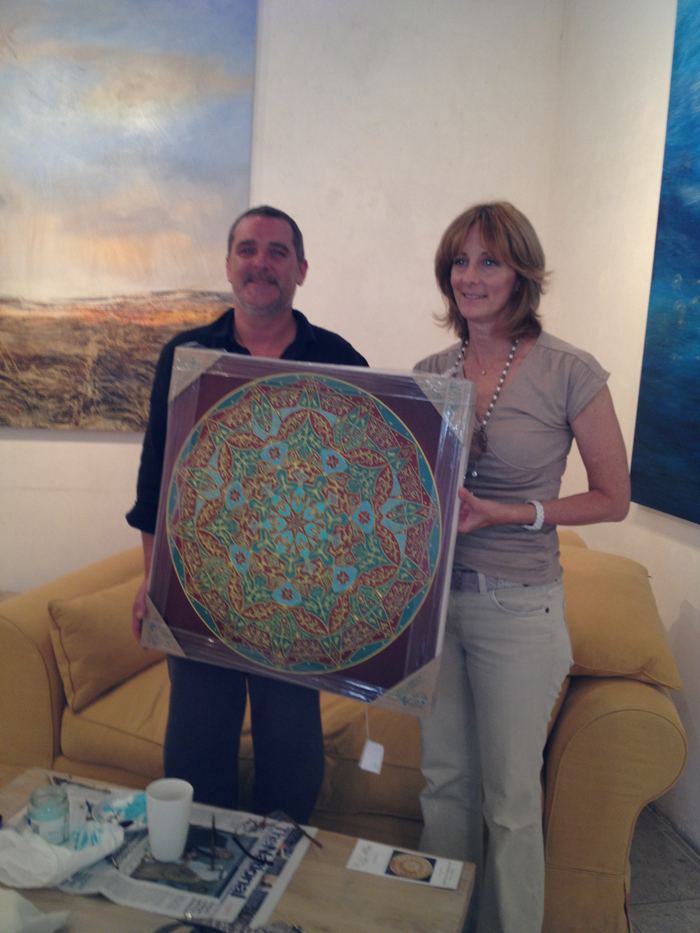
Artist Stephen E Meakin at Majlis Gallery in Dubai

He began explaining to me how Orchis 7 was created.

“Seven, you know, is the number of the days in the week corresponding to the creation of the earth, the seven colors of the rainbow and the seven heavens where the order of the angels dwell.  Seven is the universes’ dynamic wholeness. ”

He pulled out his compass and ruler and continued to explain the relationship between the circle and the triangle.

I was talking to Stephen E. Meakin the Sacred Geometer.

As Meakin described how a circle can be divided and the symbols he included in his work, I listened with wonder.   Of all the artists I could have met, I found it amazing I met the one whose work was based on Pythagoras’ sacred geometry.

The first philosopher, Pythagoras said

“All Things consist of Three.”
Sacred Geometry Triangle

α2 + β2 = γ2

Pythagoras taught everything in nature could be divided into three parts and no one could become truly wise if they did not view each problem as being diagrammatically triangular.

“Establish the triangle and the problem is two-thirds solved” Pythagoras said.

For nearly a half an hour Stephen Meakin and I discussed sacred geometry.  My sister and mother wondered in and joined our conversation.   The feeling that somehow this meeting was Divinely contrived stayed with me the whole time.  I asked him whether I could take a photo and thanked him for explaining his ideas.

“To me each painting is sacred,” Meakin said.  “But in the end it really is just art, isn’t it?”

The Majlis Gallery is open everyday except Friday.  They acknowledge parking can be difficult.  They make some suggestions on the website.

Stephen Meakin’s Desert Rose exhibit is currently at the Dubai Fairmont Hotel.

CYGNUS  – The Swan is one of the paintings.
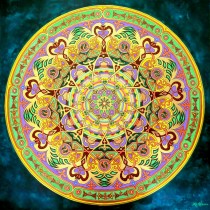
Cygnus by Stephen E. Meakin Acrylic on Canvas

About Cygnus, Stephen Meakin writes on his website:

“The Enneagon is an extraordinary polygon with mystical connotations.  It is very seldom used in sacred architecture, even though it is the highest number that consists of one digit.

The number nine is full of symbolism.  It consists of three triads announcing the end of a cycle and the beginning of a new one. The human embryo needs nine months of growth before birth. Egyptian, Celtic and Greek myths have an ennead of nine gods and goddesses, representing the entire archetypal range of principles.  Nine is the number of perfection.”

(Stephen 11/03/2012)

Although the paintings range from 3×3 to 6×6 feet, Meakin said “like feminine energy, the twenty paintings are hidden within a very masculine structure.”

If you feel some softness as you walk along the Fairmont’s marble hallways, stop and see whether you have stumbled upon one Stephen’s inspired circles.
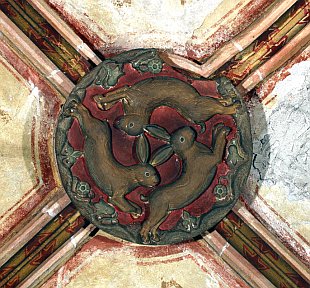
The Rabbit Triad – a little known bunny’s tale

Medieval Roof Boss Wissembourg France, Three Hares Project

The secret is not great when one knows it.

But it is something to one who does it.

Turn and turn again and we will also turn,

So that we give pleasure to each of you.

And when we have turned, count our ears,

It is there, without any disguise, you will find a marvel

–   1576 Dutch engraving from a book by Jurgis Baltrušaitis

I unearthed another interesting rabbit fact while doing my research.

In 1991 archaeologist Tom Greeves wrote about the Three Hares symbol found in Dunhuang, China.  He noted a similar symbol was used in European churches.  Over the next decade, photographer Chris Chapman and art historian Sue Andrews joined Greeves on a worldwide rabbit hunt.

Map of locations where The Three Hares were found

The Three Hares were not as elusive as one might imagine.  The trio discovered a trail of the trinity rabbit along the Silk Trade Route.  The earliest Three Hare symbol found in China was encircled in a sacred lotus.

The Tao-Te Ching says

“The Tao produced one, one produced two and two produced three.”

Baseplate detail found in Trier, Germany. Three Hares Project

To the Chinese three was the perfect number representing wholeness and fulfillment.

Three, the triad, and the triangle are universally regarded as a fundamental number or even a perfect number expressing the divine order in the cosmos and mankind.

Buddhists find fulfillment in the Triple Jewel – Buddha, Dharma and Sangha.

Hindus view the threefold manifestation of the Godhead as Brahma, Vishnu and Shiva.

In the Great Work, alchemist used the three elements sulfur, mercury and salt.

Ancient Persians had a threefold motto: “Good thoughts, Good words and Good deeds.”

And the Christian trinity – Father, Son and Holy Ghost – is an example of a sacred triad.

Emmanuel Swedenborg’s angels told him,

“For love, wisdom and usefulness are three things that cannot be separated…. Nothing is complete or perfect unless it has this trinity…You can see why the number ‘three’ in the Word can be understood spiritually to mean ‘complete and total’.”

Conversations with Angels, pg. 144 and 145

A child reveals the presence of a mother and a father.  A tree trunk reveals the presence of leaves above and roots below.

The Three Hares are both a puzzle and a perfect symbol.

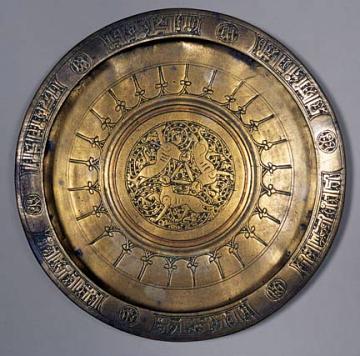
Iranian Tray, Three Hares Project

Each TWO-eared hare gets its second ear from another hare.  It is only when the THREE are gathered together as ONE that they are whole and complete.

You can join in the rabbit hunt.

When traveling the world if you find a Three Hare symbol, you can forward your photo with the details to Sue Andrews, Chris Chapman or Tom Greeves at The Three Hare Project.

Life as Art – ALWAN338

ALWAN338 at Bohemia

LmbK described Life as Art when the first creation provided the idea for the second making life a multi-layered experience.

Or walking around ALWAN 338 you might describe Life as Art.

ALWAN 338 was led by one of Bahrain’s preeminent arts advocates, Bayan Al Barak Kanoo.  Since 1998 she has promoted new artists and actively sought to creatively engage the community.

This year in conjunction with the Spring of Culture Festival, her gallery the Al Riwaq Art Space, with the aid of government and non-government supporters, teamed up with its neighbors in the 338 restaurant block to create a community space for art.

Last week my friend and I drove over to ALWAN338.

As the threshold for ALWAN338, Zoe’s restaurant, got a facelift.  The outside was painted a bright blue with gold, oriental-style motifs.  Mercedes Gonzalez de Garay’s graphic cut-outs of old Egyptian movie stars hung between the windows.  Across the street from Mirai, Scottish artist Alan Goulbourne created a wood sculpture on the plywood around the vacant lot.

Late as usual, we hurried over to Al Riwaq to meet a third friend.  She had already toured al mahata – the station – exhibit featuring Egyptian artist Mohamed Sharkawy.  His tarbouched-figures graphically interpreted Old Cairo.

Playing catch-up I dashed through the rooms.

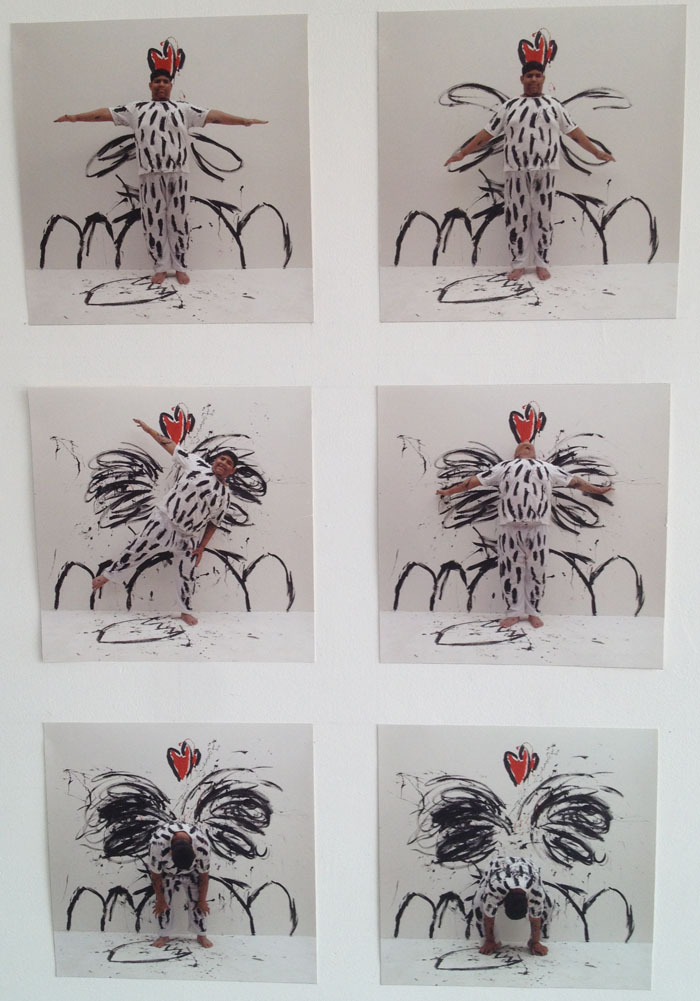
Waheedah Mallulah at ALWAN338

Waheedah Mallulah’s Big Rooster and the Little One, a montage of black, white and red photos of Mallulah doing yoga-for-roosters, delighted the rooster-lover in me.    The gift shop was transformed into a space for Zilia Monteiro’s videography.

Mohamed Sharkawy at ALWAN338

I climbed the curved stairwell to the second floor where Sharkawy’s Egyptians continued to go about their daily business.

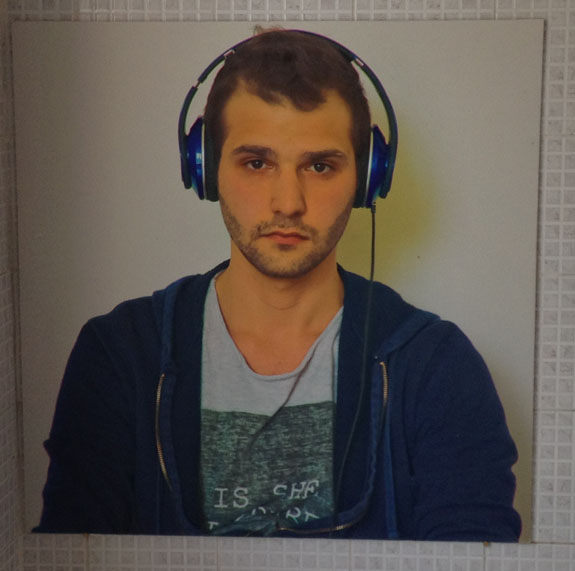
Next to the colorful, but undifferentiated beings, a young man sat on the couch, his earphones around his neck, working on his laptop.  He smiled at me and asked whether or not I had seen the exhibit at Bohemia, the building encircled with flying bicycles.

I told him no, but said “we were on our way over there”.  I asked him if he was working.

He said, “I am finishing up an assignment.  I go to school at NYIT.”

“Good luck.”  We smiled at each other and said good-bye.

The renovation of the old Bohemia restaurant into a four-story exhibition for I AM THE OTHER is the crowning achievement of ALWAN338.  Visiting-artist Mo Reda connected with over 20 Bahrain-based artists to comment on

“how do we exclude the OTHER, when we ourselves are the OTHER to those around us?”

This is a critical question in a time when the EU considers whether “to let” Turkey join their union, after France and Switzerland created legislation responding to their Muslim populations, and in the USA where mainstream Americans describe the OTHER as Teacup Conservatives, uber-rich executives or illegal alien-workers.

A microcosm of global politics, Bahrain has faced its own challenges over the past year.  As the diverse community members entered into the National Dialogue, the question of Who am I?  Am I the OTHER? became particularly relevant.  ALWAN338 gave established and emerging artists an opportunity to publicly add their distinctive “voice” to the dialogue and answer the question in their unique ways.

Bahraini, Bahrain-immigrants and Arab artists of “mixed” parents presented their personal experiences as the OTHER.   Being and raising third-culture children, the exhibit felt relevant to me.

However, I found the most striking artists were Bahrain Contemporary Arts Association member Nader Abdulrahim, street-artist Huvil and architect Maysam Nassar.

Maysam Nasser at ALWAN338

The fact that they can publicly describe their perspectives regarding truth and current social issues speaks volumes on Bahrain’s openness compared to its neighbors.

But the ALWAN338 artists are not just visual artists or limited to these two venues.

DJs will be performing live at The Meat Company, an excellent place to go during this pre-summer lull in the heat.

Architect Sara Kanoo created a temporary “Park”; an outdoor stage, library and cinema screen.   In this under-utilized public space, films “Life in the Day” (April 10, 7:30pm) and “Man Without a Cellphone” (April 12, 7pm) will be shown; jazz-band 13th Note (April 13, 8pm) and Watan (April 20, 8pm) will perform; and several workshops for kids (Spray Painting, Cartoon Animation) and Adults (Photography, Mosaic, Street Art Intervention) will be held.

My friends and I left Bohemia hoping it would become a permanent gallery and walked to Coco’s for an outdoor lunch.  Coming towards us was the tall, slim man I saw earlier at Al Riwaq.

Only then I knew his name.  Ghalib Zuhair.  He was the Iraqi artist whose visage was featured on the  I AM THE OTHER cover.

Ghalib Zuhair at ALWAN338

According to his bio, he is looking for a place to call home.

“I just saw your installation in the gallery.”  Being recognized, he beamed.   “How long have you been doing photography?” I asked him.

“About twelve years.  This is my second exhibit.”

“Congratulations.  You did a great job.  It seems like Bahrain is home for you.”

“For now,” he smiled.

That, my friends, is Life as Art.

ALWAN338 continues through April 22nd from 10am-10pm.  The entire schedule is on the Al Riwaq website and exhibit programs can be found at the restaurants in Adliya where the ALWAN338 flag is displayed.   The restaurants that have given support and invite you to experience art-camaraderie, Bahraini-style include Blaze Burgers, Block 338, Café Italia, Mezzaluna, Tian and Masso at the Palace Hotel.

In case you don’t remember Bohemia (next to the Adliya Café Lilou which for some reason is not a sponsor), you can plug this address into your GPS:  Adliya, Block 338, Road 3816, Building 502.

From Clay She Molded an Image of Herself

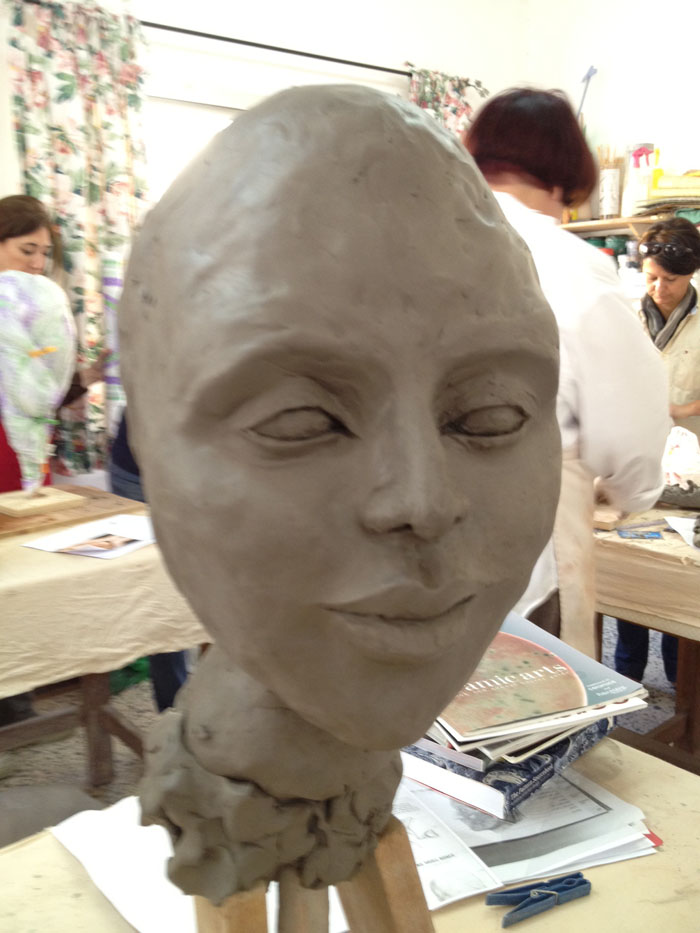
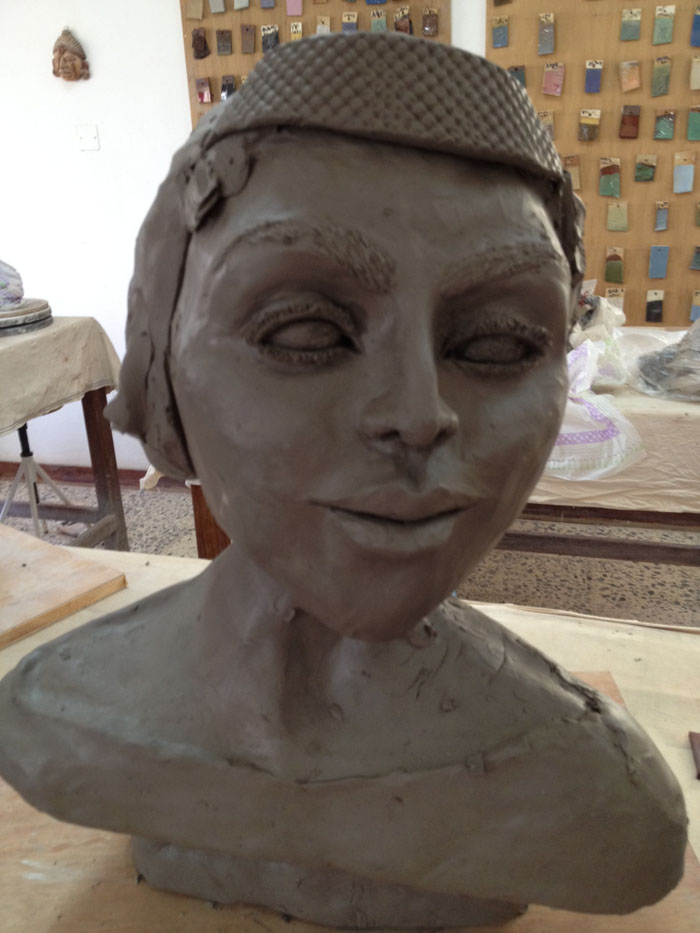
This was actually after the second session. I forgot to take a photo of the first session.

The past four weeks I have been taking a sculpturing class from Michelle Karam.  For twenty years Michelle has been operating a ceramics studio.  This is the first time I got the opportunity to take her class.

She is teaching head sculpting.  Using her technique, in 8 sessions, we have gone from a figure that resembled a grey alien to a completed project.  She taught an amazing method to make the eyes.

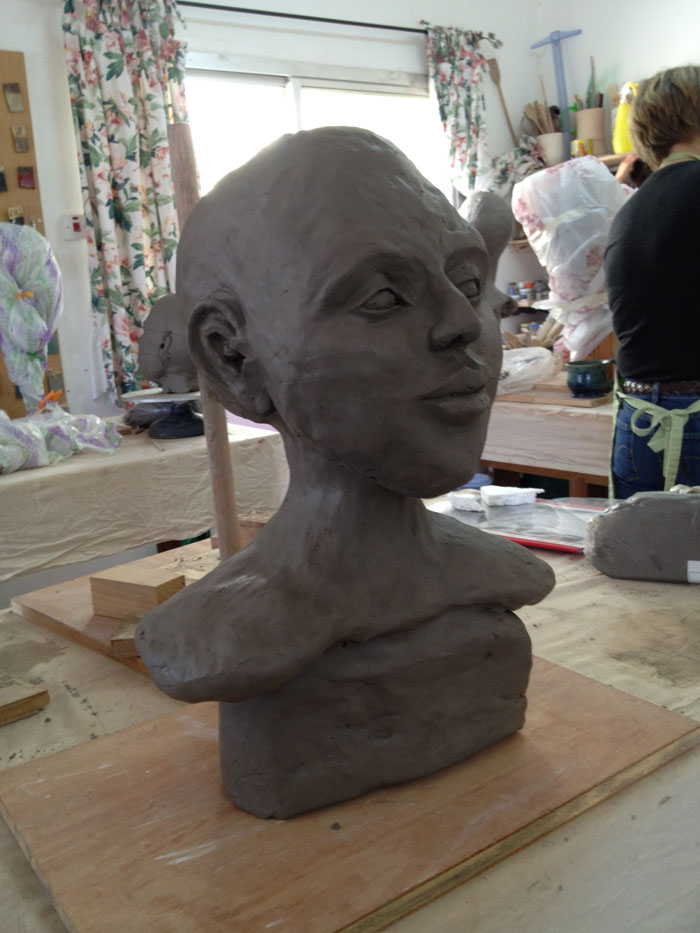
Session 3 - adding ears and a base.

Session 4 - Fixing shoulder proportions and adding hair.

Session 5 -

Session five, I had to give her a lobotomy. I cut off the back of the head, scraped out the interior clay and reattached the cranium. I gained a new respect for brain surgeons.

Session 6-7.

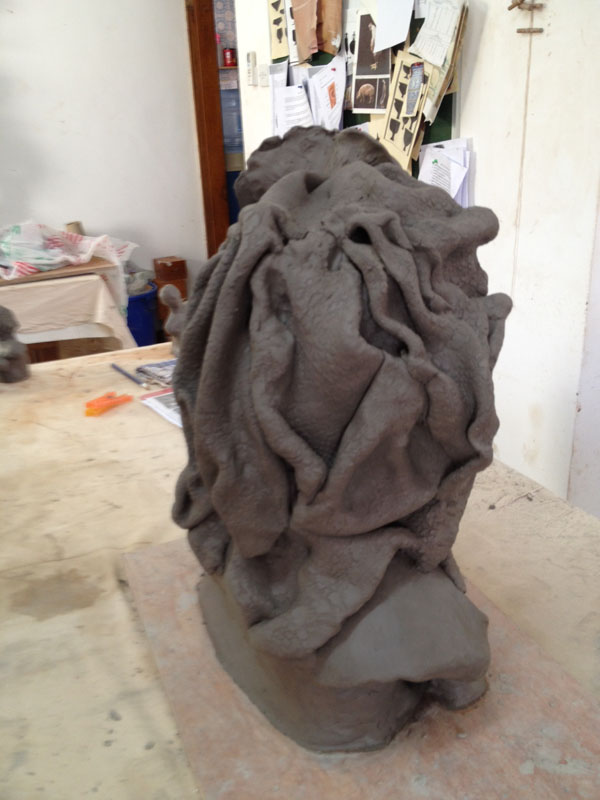
For sessions 6-7, I spent most of the time hollowing out the stand and entire head, before stuffing it with newspaper.  I began attaching a hairpiece.  It was too heavy.  Her neck split open and her head fell backwards, nearly rolling off the table into my neighbor’s lap.

With help, I repositioned the head so she leaned forward and patched her severed neck.  Then added clay to the stand to support it.  Once everything was stable, again, I attached a head scarf.

The headscarf

It took four tries to get the headscarf correct.

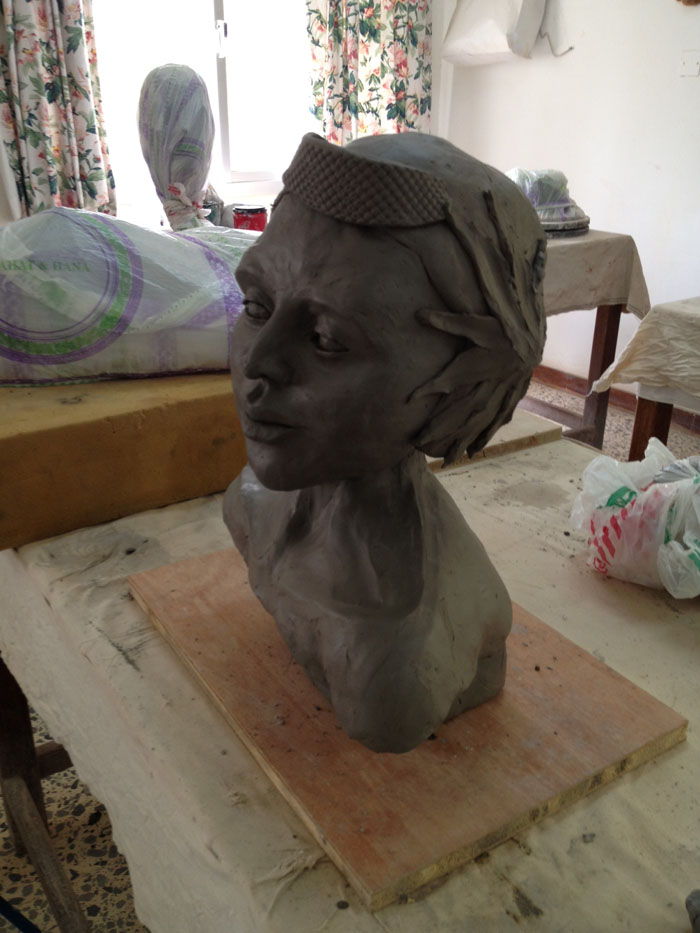
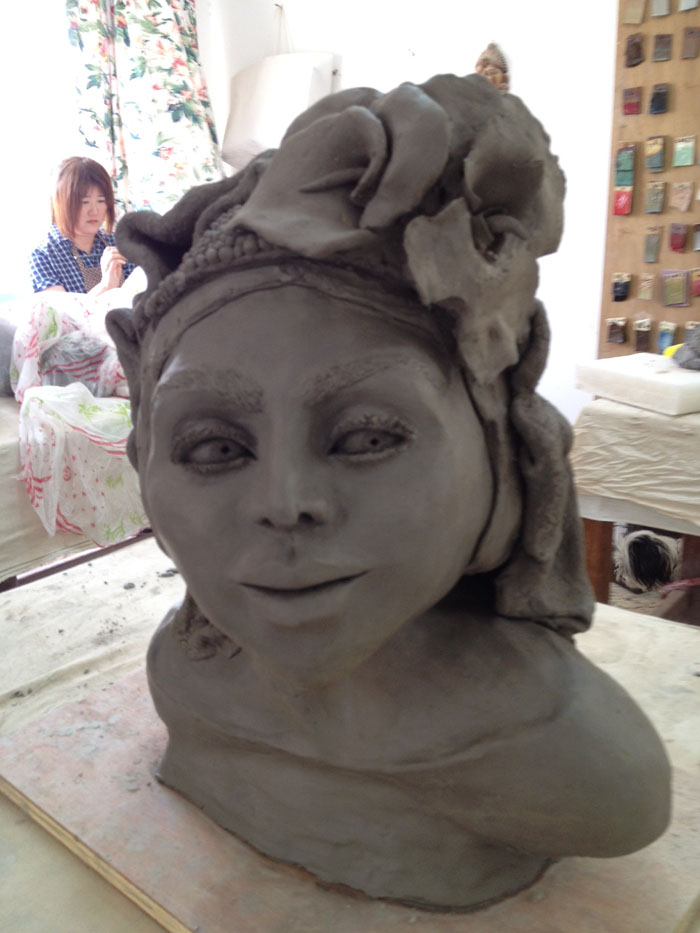
Then I practiced making flowers until I came up with a strange lily and hibiscus arrangement.  It was time to be done – for now.  The class has been a fantastic experience.

The final outcome.

The amusing aspect of sculpting is that many of the heads looked quite a bit like their creator despite the attempts to create an Other.  I do not think mine looks like me.  It was only as I stared at Mojo over dinner did I realize she resembled him – with bigger lips.

I have no idea what will happen when she dries and is placed in the kiln.  I don’t know if she will live through her trial by fire.

Perhaps like the Divine I will have to create billions and billions in the hope that one day my creation will be perfect.

On Different Lines – An Exhibit

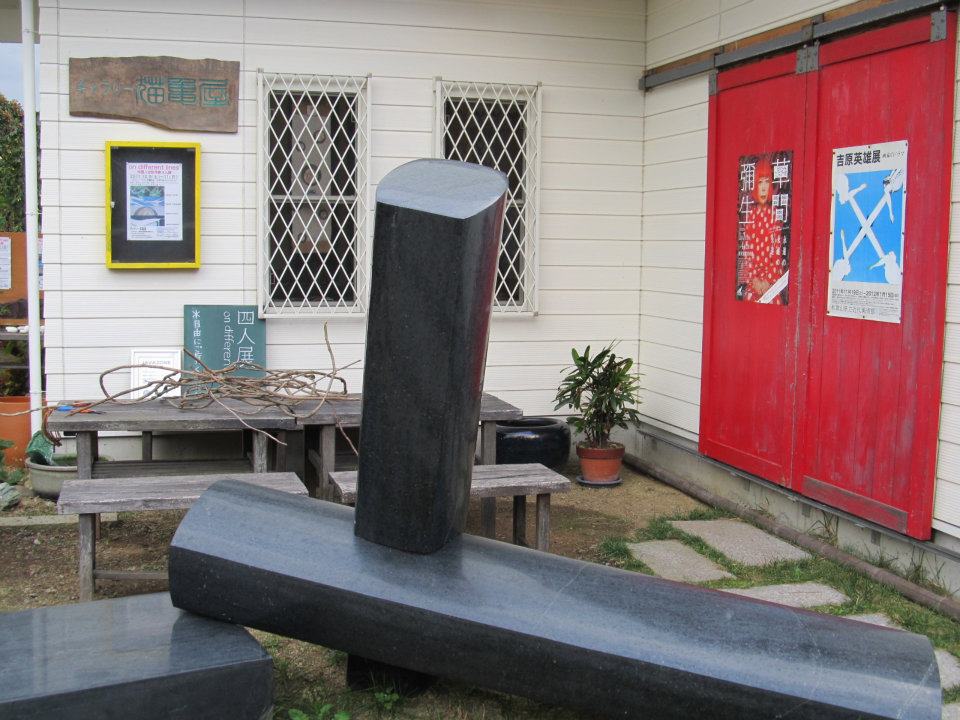
Gallery Nekogameya

“When you find the small building with the red door, please enter and sign in.” said the invitation.

Guest Book at Gallery Nekogameya

Outside Wakayama, Japan,  a group of artists held an exhibit at the Nekogameya Art Gallery.

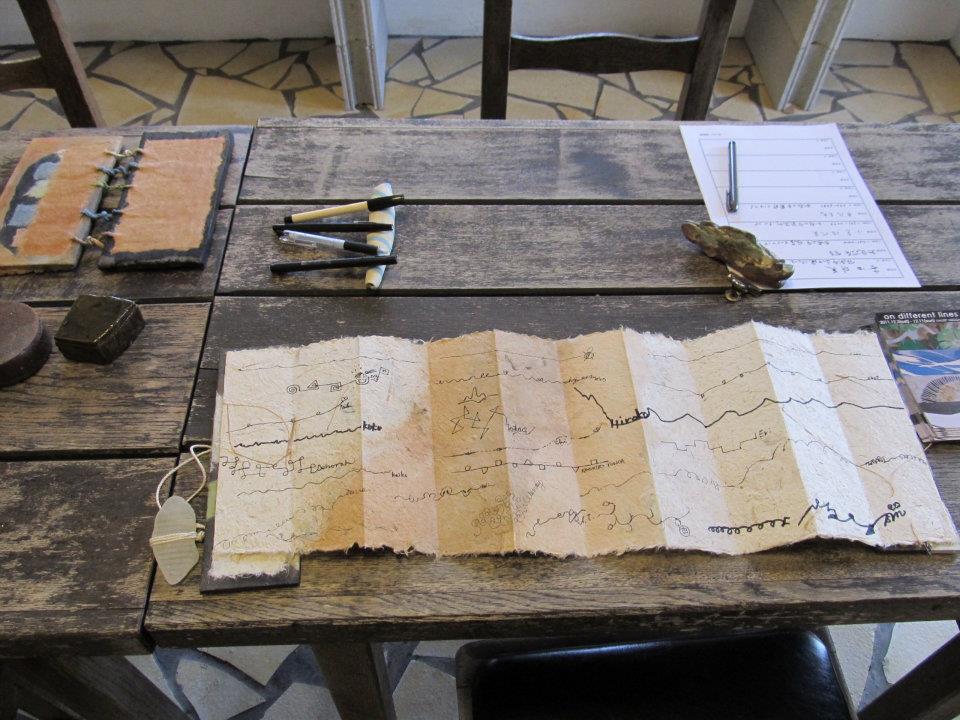
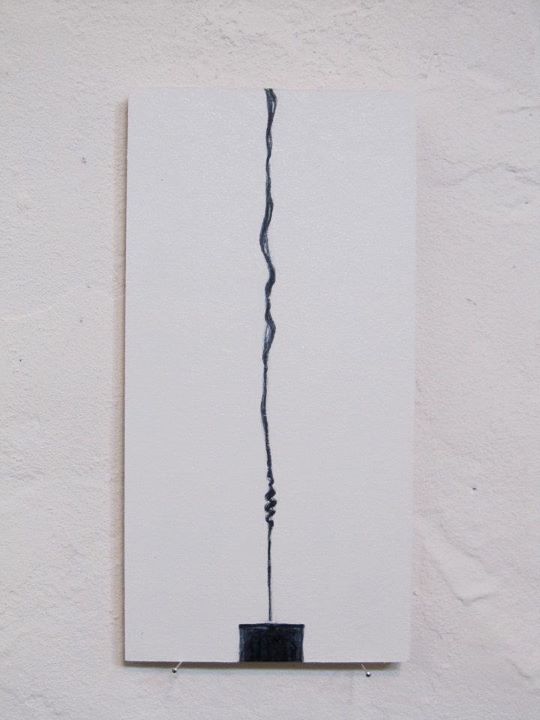
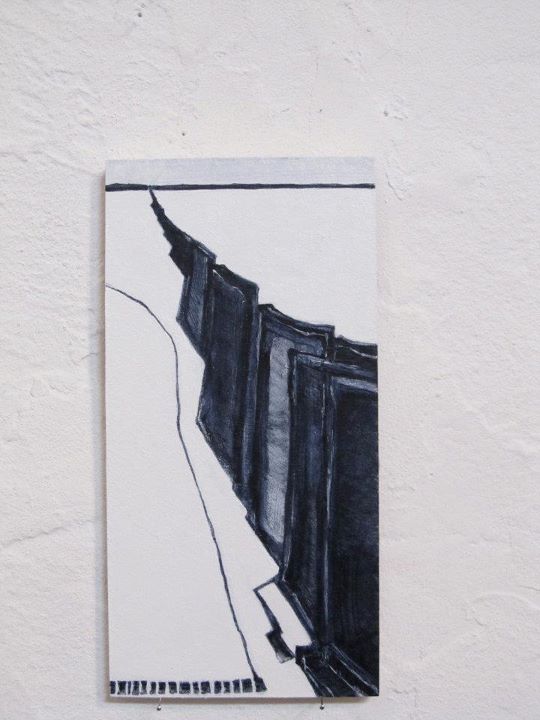
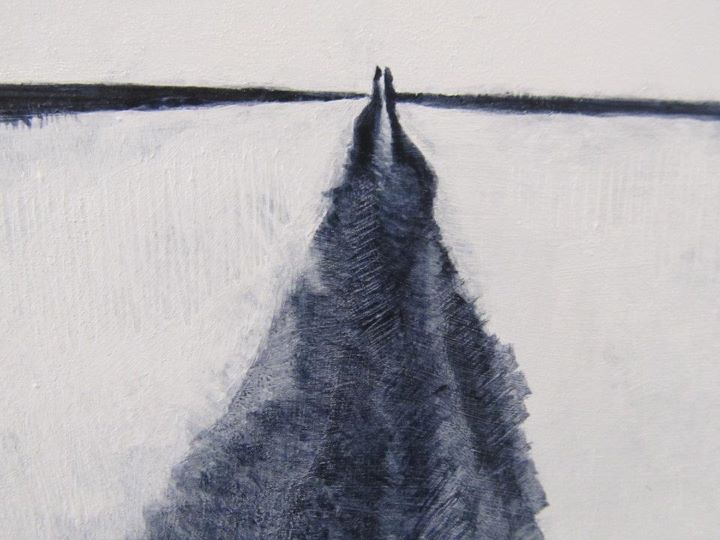
Launa MB Karasuno, my sister, was one of the artists displaying her work.  Her series of black ink drawings on homemade paper was titled “On Different Lines”.

I rarely bother her when she is getting ready for an exhibit.  Like all artists, she gets stressed and works long hours finishing up her paintings before the opening.

On Different Lines, 2011 by Launa MB Karasuno

On first glance, her work looks so simple  and I wonder why did it take so long to create this?

But as I stare, the detail and the meaning begin to emerge.  And instead I wonder does she sit in front of her easel staring at the blank sheet, waiting for a shape or an image to grow in her mind?

Puddle, 2011, Launa MB Karasuno

As High as It was Deep, Launa MB Karasuno, 2011

Cavernous, detail, Launa MB Karasuno, 2011

Or does it come from her dreams?

Different than the decorative art we hang in our house, her work is difficult for me to describe.  Modern, simple, organic, minimal, from the soul are some words that come to mind but they inadequately convey the depth and detail.

She sees something in the world that I do not.

a big one detail, Launa MB Karasuno, 2011

She appears to be describing her feelings or perhaps the culture she lives in.

Too Heavy, detail, Launa MB Karasuno, 2011

Tethered - not, Launa MB Karasuno, 2011

She’s a kind of poet, solidifying her entire expression into one thin line, describing her life in images.

Went Another Way, Launa MB Karasuno, 2011

When We Are Old and Still, Launa MB Karasuno, 2011

I think Japan is the right setting for her work.  The exhibit has the feel of a Japanese choka, a brief 5-7 sound unit poem that reverberates with feeling.

My sense is her creativity is not based upon what she sees.  It seeps from the very silent dimensions within her mind.

Artist Demi Mcleod Exhibits at the Capital Club

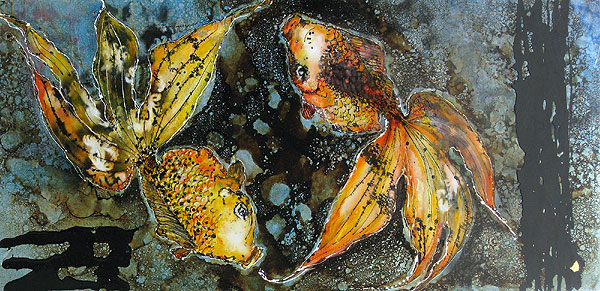
Yin Yang by Demi Mcleod

Artist Demi Mcleod is showing her work at the Capital Club in the Bahrain Financial Center through this weekend October 6th, 2011.  At midnight the exhibition closes and she takes off her glass heels and runs back to her studio.

Demi is inspired by the things she is most familiar with – her goldfish, African animals and textures in fabrics.  In her mind’s eye they explode larger than life and that is when her alchemist side takes over.

Talk to Demi and she’ll explain how she combined a paint or an ink with a process which inevitably turns to gold.  Her works take time to develop because she experiments with materials gathered from her global travels.  Intrigued with each paints’ qualities she describes how they interacted with the light, the humidity and other colors.  Unafraid of the results she boldly moves forward.  Each layer deepens the painting creating new textures until her final vision comes to life.

Next Newer Entries

Archives

Tales by Chapter