Save A Camel’s Life

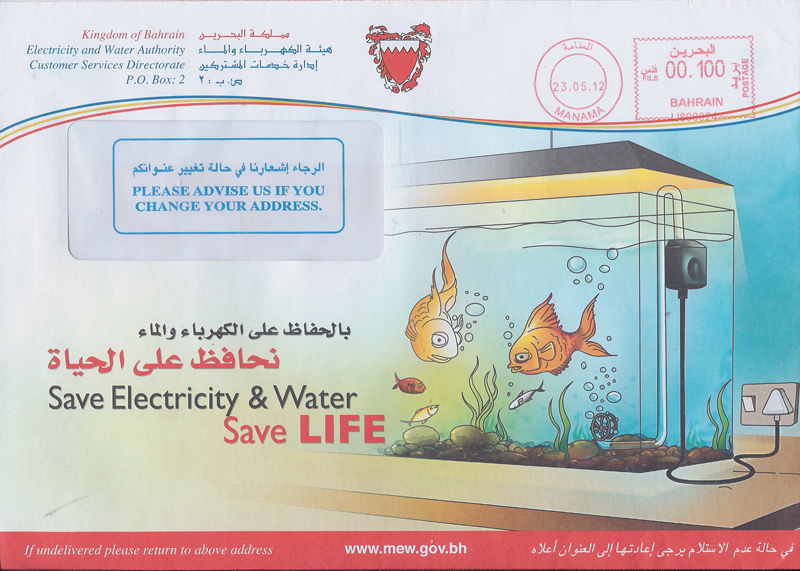
The Ministry of Electricity and Water decorates our bills with helpful hints.  However, this month’s suggestion to “Save Electricity and Water , Save LIFE” stumped me for a few moments.

The electrical outlet for the fish tank’s air supply was intentionally included in the drawing.  Hmmm.

If we reduce the fish’ water and air, we would kill them, not save their lives.  Is MEW implying that fish tanks are a useless waste of water and electricity?

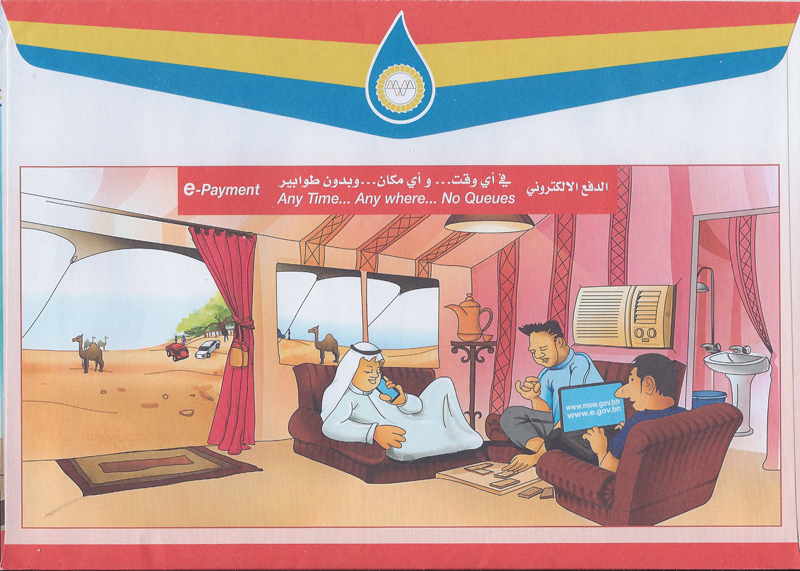
On the envelope’s opposite side is a wonderful drawing of modern Bahrainis getting back to nature during camping season.  While enjoying life in the countryside, and without leaving their tents, they can pay their electricity bill from their mobile phone or laptop.

As the drawing shows, unlike their ancestors who had to put up with the desert’s heat and lack of water, modern men can enjoy desert without suffering its inconveniences.  The traditional fabric tent’s interior is equipped with electric lighting, air conditioning and running water.  Even sand in your pant is no longer a problem because everyone sits on sofas.

Save a LIFE.  Of course!

They want to save camels’ lives by ridding them of their burdens.  Instead of a camel, it is much better to use a sport-utility vehicle to haul all that equipment out to the campsites around the Tree of Life.

And do not take your fish to camp.  They should left at home – where they belong.

Where Do You Find Peace In This World?

Driving through a village I saw this on the wall.  It gave me hope.

You shall seek me and find me when you search for me with all your heart.

– Jeremiah

Touring Oman: First Stop Fanja

Oman lies south of Bahrain.  For centuries, Muscat situated on the Gulf of Oman was protected from its northern neighbors by the Hajar Mountains.  Sea-faring traders like the Bahrainis, the sprawling southern coast placed Oman directly on important trading routes between Africa and Asia.  Somewhere in the Rub al-Khali desert, Oman shares a border with Saudi Arabia.

Last year my friend Goldie visited us.  She heard the best frankincense in the world was grown in Oman.  And she wanted see Sultan Qaboos’ famous Al Alam Palace.

We decided to leave the other dragons and rabbits at home and used her snake birthday as an excuse for a long girls’ weekend.  But because she hurt her foot, we could not climb Oman’s mountains, hike through the fjords or explore its caves.  Instead I booked a driver to take us around to some of the key historical sites, planned a day in Muscat and hoped a bottle of champagne would make her birthday magical.
Just as promised, our guide met us in the hotel lobby at nine am.  He shook my hand and introduced himself as Zaher.  He pointed out our car, a small white compact, and we jumped in.  I sat in front while Goldi reclined in the back with her foot up on a pillow and latte in the holder.

We took off towards Nizwa, 120 kilometers away.  The new highway was open, the sky was clear and we were anxious to see what was in store for us – as was our driver.

“Ding, ding, ding” went a bell.

“What’s that?” called Goldie from the backseat.

“It’s a GCC speedometer alarm.  He’s going over 120 kilometers per hour so it rings.  The purpose is to keep people within the speed limit.” I said looking sideways at Zaher.

“Does it bother you?” Zaher asked looking at the beautiful Goldi in the rear-view mirror.

“No it’s fine,” she said going back to the newspaper.

“What about you?” he directed the question towards me, the front seat driver.

“I will put up with it for awhile,” I said already irritated by the incessant ding ding.  “I‘ll let you know when I can’t stand it any more.”

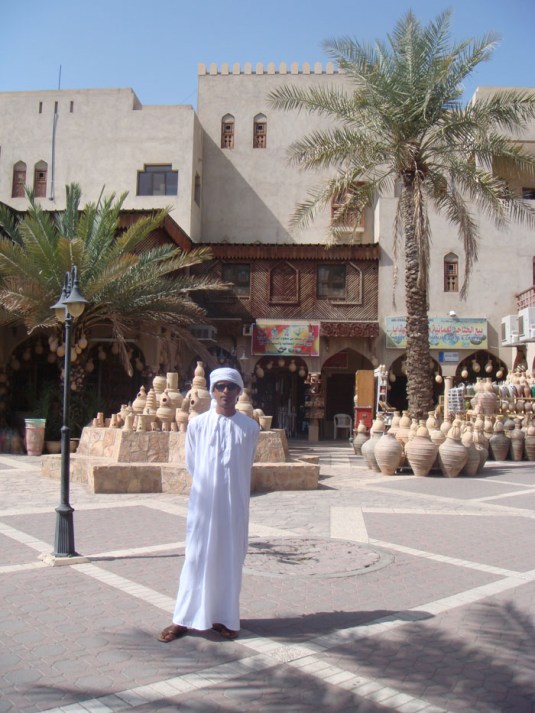
In Bahrain we see a few Omani.  Get about twenty Omanis together and suddenly the place becomes more exotic and filled with color.  Wearing their distinctive head dress and thobe with its small tassle hanging down to the right of the center button, Omani men are easily distinguished from the other Gulf countries.  Their ghuttras can be white, but many times they are colored and then wrapped in Omani fashion around and around the head into a kind of turban with a tail.

Their alternative to a ghuttra is a kumah, an embroidered hat with a flat top.

In the mid 18th century, the Omani empire extended all the way to Zanzibar and Mombassa in Africa and eastward into Persia, Pakistan and India.  When Sultan Said died, the empire was split between his two sons who became the Sultan of Zanzibar and the Sultan of Muscat and Oman.  The colorful attire was likely influenced by African and Indian designs.

“Can you tell us about the head gear the Omani men wear?” I asked Zaher.  “Why do some men wear ghuttras and others wear kumah?”

“Some people like ghuttra and other people like kumah.”

“Yes, we understand that.  But why do you have colored ghuttras and the other Gulf men wear black and white or red and white?”

“Omanies – we like our ghuttra and the other Gulf men like their ghuttras.”

There it was – a full explanation of the cultural differences.

“Here is Fanja”, he said pulling off to the side of the road.  “You can get out and take pictures.”

Fanja was a picturesque village with a dry wadi (river) bordering the edge.  Palm trees lined the imagined banks where the water ran during the wet season.

“People here grow palm trees for dates,” Zaher told us.  We waited for more.  There was not any more.

“The wadi is dry now,” we commented.  “When is the wet season?”

“During the mansoons.”

“When?”

“During mansoon season.”

OK.  We got back into the car and drove off.

“Are we going through the village?” I asked.  My guidebook said Fanja was renowned for its pottery, local fruits and vegetables, honey and woven goods from palm trees.

“No, no time now.  We drive onto Nizwa through the Sumail Gap.”

The highway was smooth.  The alarm dinged.  When we saw photo opportunities Zaher gladly pulled over.  He smoked as we took pictures.

The black, rocky Hajar mountains provided a stunning backdrop.  The landscape was so different from flat, dusty Bahrain.

Next Stop: Nizwa Souq
Water, Eco-Tourism and the Westerner

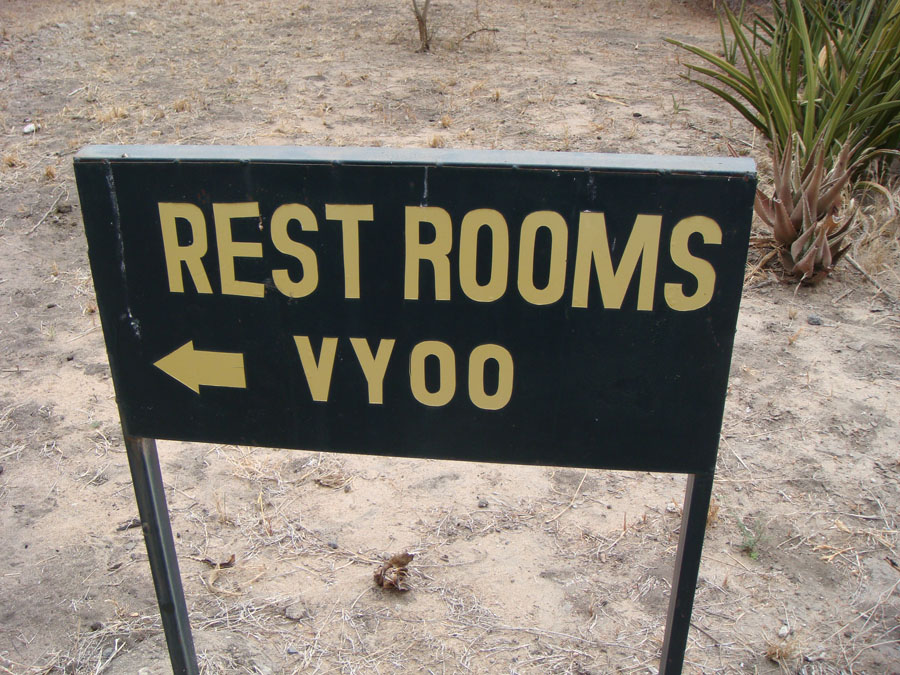
Restroom in Swahili, Tarangire National Park, Tanzania

Eco-tourism is a popular travel option now.  But one area I feel the eco-tour operators fail to educate their customers about is water and toilets.

Developing countries rely on cash-rich tourists to visit.  But to create an infrastructure that will support large numbers of tourists, finite resources such as water are shifted away from the local population to appease the nearly insatiable tourist palate.

When I moved to the Middle East, I was as guilty as most Westerners complaining about how inefficient the toilets were.  I did not know why women filled the wastebasket next to the toilet with toilet paper.  Nor did I understand the signs that said “Do Not Throw Paper Towels in the Toilet.”

To me paper towels meant the heavy type used in the kitchen or to dry your hands.  I did not realize the owners were talking about toilet paper, or toilet tissue, or Kleenex or whatever else you might call paper used to wipe our bottoms.

It was after the Sewerage Truck backed into our driveway and began to pump out our villa’s septic tank that I began to understand the bigger issue – we live in a desert.  Water is scarce.

Masai Village in Tanzania

In Tanzania where we took sneaky snapshots of tall Masai herding their boney cattle across the nearly desert landscape, their lack of water hardly affected us.  We could pay for airlifted bottles of water ported in our van’s cooler and flushing toilets in air conditioned guest rooms.  The Masai’s daily search for water never touched our experience.

At the Tarangire Game Reserve I popped into the government supported latrine before we embarked on our four hour safari.  A busload of American tourists followed me.

The modern, made-for-tourist bathrooms had several stalls, sinks, and mirrors.  The toilets had just enough water to clear the bowl.

Next door to me I heard the woman flush the toilet several times.  She came out of the stall and apologized to her waiting friend,

“Sorry I could not get the toilet to flush the paper down.”

I could not hold my tongue.  I said to her and the dozen other women waiting,

“There is hardly enough water here for the people to drink let alone flush a toilet.  Just carry your used toilet paper out with you and throw it in the trashcan.  And only flush the toilet when it is absolutely necessary.”

Coming from America where we reclaim toilet water making it drinkable again, the idea had never crossed their minds.

“Thanks for telling us,” one woman said genuinely grateful.

Why am I writing about this?

Because when I see a clean toilet bowl clogged up by a mass of toilet paper, I realize another uneducated Westerner has been there.  Is it necessary to flush the toilet after a pee?  And why throw masses of toilet paper in the bowl?  It takes two or three flushes to clear the paper and taxes the septic system.

Unlike the West where we are unaccustomed to using bidets, I believe the Arabs and the Indians wash with the water hose next to the toilets.  Then they use a small amount of paper to dry themselves and throw that in the trash bin next to the toilet.

Masai walking alongside of the highway, Tanzania

I am uncertain what the best method is, but in desert countries like Bahrain where water reclamation does not exist and 98% of the sewage is pumped just offshore into the ocean, introducing less garbage into the water system seems like the best solution.

National Geographic did a great story on “Water: Our Thirsty World” in April 2010.

Next Newer Entries

Archives

Tales by Chapter