“How Can You Buy and Sell the Sky?”

Seana Mallen’s homage to George Caitlin’s 1850 painting. In 1844 Caitlin documented Mahaska’s journey to London with a group of thirteen other Ioway people.

In 1848, my great-great grandfather Martin Snider erected the first cabin in Montezuma, Mahaska County, Iowa.

The state of Iowa was named after the Ioway natives who split off from the Oneotas around 1650.  In the early 1800s, through a series of treaties, the US government evicted the Ioways from their land.  Mahaska County was named after the Indian Chief Mahaska, or White Cloud in English.

My great-great grandfather used to tell the story of an Ioway Indian who knocked on the door and asked to borrow milk.  The Ioway’s wife had died during childbirth.  My grandfather agreed but admitted he was a bit perplexed when the man went into his barn and led his cow away.  However he did not stop him.

When the baby was weaned, the Ioway brought the cow back.  Later during the “Indian uprising” my grandfather was the only settler in the area the Ioway did not attack.

European colonists viewed the Native people as either vicious barbarians or as Noble Savages.  The Noble Savage image dates back to Bartolome de Las Casa’s 1530 writings about American natives.  1987 American high school textbooks summarized this history.

“For thousands of centuries –centuries in which human races were evolving, forming communities, and building the beginnings of national civilizations in Africa, Asia and Europe-the continents we know as the Americas stood empty of mankind and its works.”  The story of Europeans in the New World “is the story of the creation of a civilization where none existed.”  – Charles C Mann, 1491

This American myth has lasted over five centuries.  In the book 1491, Charles C. Mann calls it Holmberg’s Mistake.

“The supposition that Native Americans lived in an eternal, unhistoried state – held sway in scholarly work, and from there fanned out to high school textbooks, Hollywood movies, newspaper articles, environmental campaigns, romantic adventure books and silk-screened tee-shirts.” – Charles C. Mann, 1491

Historically the North American Indian population prior to Columbus was estimated to be around 1.15 million with a total of 8.4 million throughout the Americas.  Mann outlines new evidence that points to an American population more likely between 90 to 112 million people.  New estimates suggest by the sixteenth century, 80 to 100 million Indians were wiped out by the European smallpox.

Mann also presents evidence the Indians were not just Noble Savages living off the land; rather they were active agents agriculturally shaping the land.  Mann writes the Amazon rainforest is not wild.  Rather this wet desert is the remnant of a large, managed landscape.

The Native Americans were not simply farmers or hunters.

In 1100AD, at the mouth of the Mississippi River was the port city called Cahokia.  The largest concentration of people north of the Rio Grande, hundreds of high-peaked, deeply thatched roofs like those on traditional Japanese farms were built around a four-level earthen mound bigger than the Great Pyramid of Giza.

Further south, the Mexican Olmec developed a dozen different systems of writing, established wide trade networks, tracked the orbits of planets, created a 365-day calendar more accurate than the Europeans’ and recorded its histories in books of folded bark paper.  The Mexican capital of Tenochtitlan was larger than Paris.

The South American Inka empire was bigger than the Ming Dynasty in China, Ivan the Great’s Russia, the Ottomon Empire and the Triple Alliance.

The use of zero considered “one of the greatest single accomplishments of the human race” was first whispered around 600BC when the Babylonians tallied numbers in columns.  India used a zero in the first few centuries AD.  Europeans began using it in the 12th century when the Arabs brought it to them.

The first recorded zero in the Americas was in a 357AD Mayan carving.  Before that, a calendrical system based on the existence of zeros was used.

Seana Mallen’s painting is based on Edward Curtis’ photograph. Curtis’ life work was to document the tragic decline of the Native American peoples.

“Man did not weave the web of life.  He is but one strand within it.  What we do to the web we do to ourselves.  All things are bound together.  All things connect.”  Chief Seattle.

When we read the “sage” sayings of White Cloud and Chief Seattle, it is not simply the Noble Savage’s spirituality or mythology.  Their wisdom comes from millennia of experience and reflects the “remarkable body of knowledge about how to manage and improve their environment.”

I highly recommend 1491 to open your eyes to a new perspective on history.  It is not the easiest read but it is very interesting.

Currently on display during America Week, Seana Mallen’s paintings can be seen in the Seef Mall near the Starbucks.

The Potter

‘Why is a potter second only to God?’

The boys shook their heads in unison and Iskander explained, ‘Because God created everything out of earth, air, fire and water, and these are the very same things that a potter uses to make his vessels. When a potter makes something, he acts in the image of God.’

‘Are you more important than the Sultan Padishah then?’ asked Mehmetcik, astonished.

‘Not on earth,’ replied Iskander, ‘but perhaps in Paradise.’

–          By Louis de Bernieres from Birds Without Wings

I sculpted my clay into a woman.  She dried in the air before being baked in the kiln’s fire.  Pleased she emerged intact, Michelle, my teacher and I discussed many, many options for the finishing touch – color.

Michelle guided me towards some tried and true glazes, encouraging me to keep it simple.  I choose only two colors.  I poured Fire Opal, a pinkish/blue over her headdress and powdered her face white.  Having prepared my creation the best I could, I let go.  My woman faced the fire alone.

As I walked into the studio, I was anxious to see how she managed when mixed with the other creations and put under pressure.

To summarize, she fared poorly.

Under the combination of the elements, she cracked.  My intended colors did not stick.  The vibrant pinks and blues melted away.  Their residue burnt her surface and scorched it brown.  Although she retained her original shape, she did not turn out at all like the woman I imagined.

And then I wondered, ‘If God is a potter, how disappointed does he feel when looking down at the earth? ‘

Ferrari Red

Vanity Fair writer Kurt Anderson argued the appearance of the world has hardly changed at all over the past two decades.  One reason is before the 1990s, factories were smaller and each decade’s goods had a distinct iconic style.  Over the past twenty years, businesses have invested in huge factories and production lines that are continually put at risk if consumer tastes change radically.

To be unique requires handcrafting.

On a small island like Bahrain, wherever you go, you will see at least three people you know.  Stylish people strive to be different.  Many design their own clothing and have the village tailor stitch it up.  And the million-dollar home owner can easily pimp his car at the auto shop next door.

Yet even stylish Bahrainis are not immune from the global corporate-style culture.

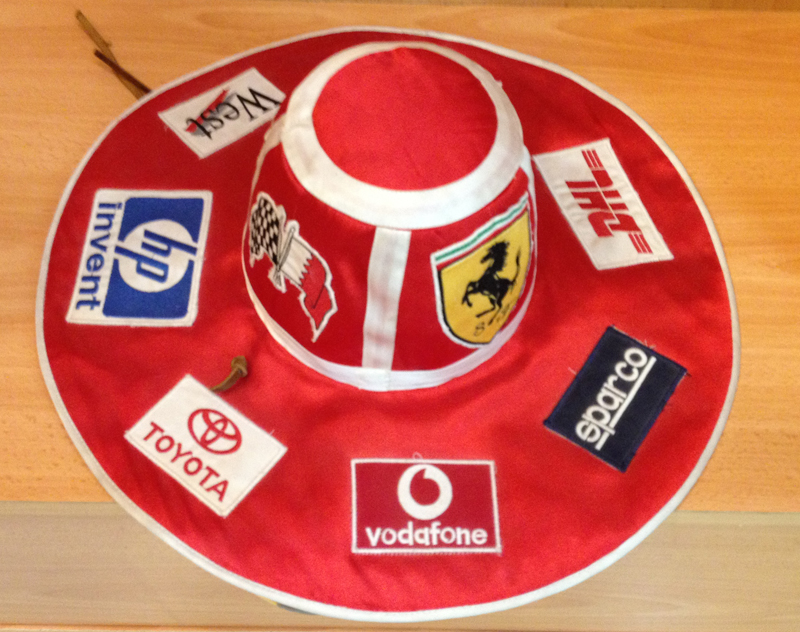
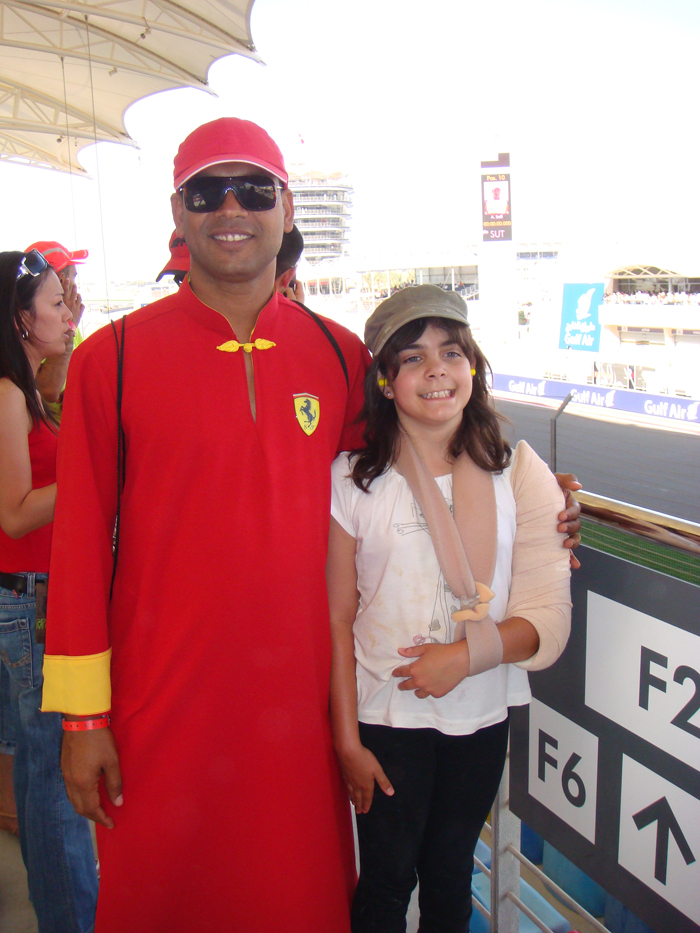
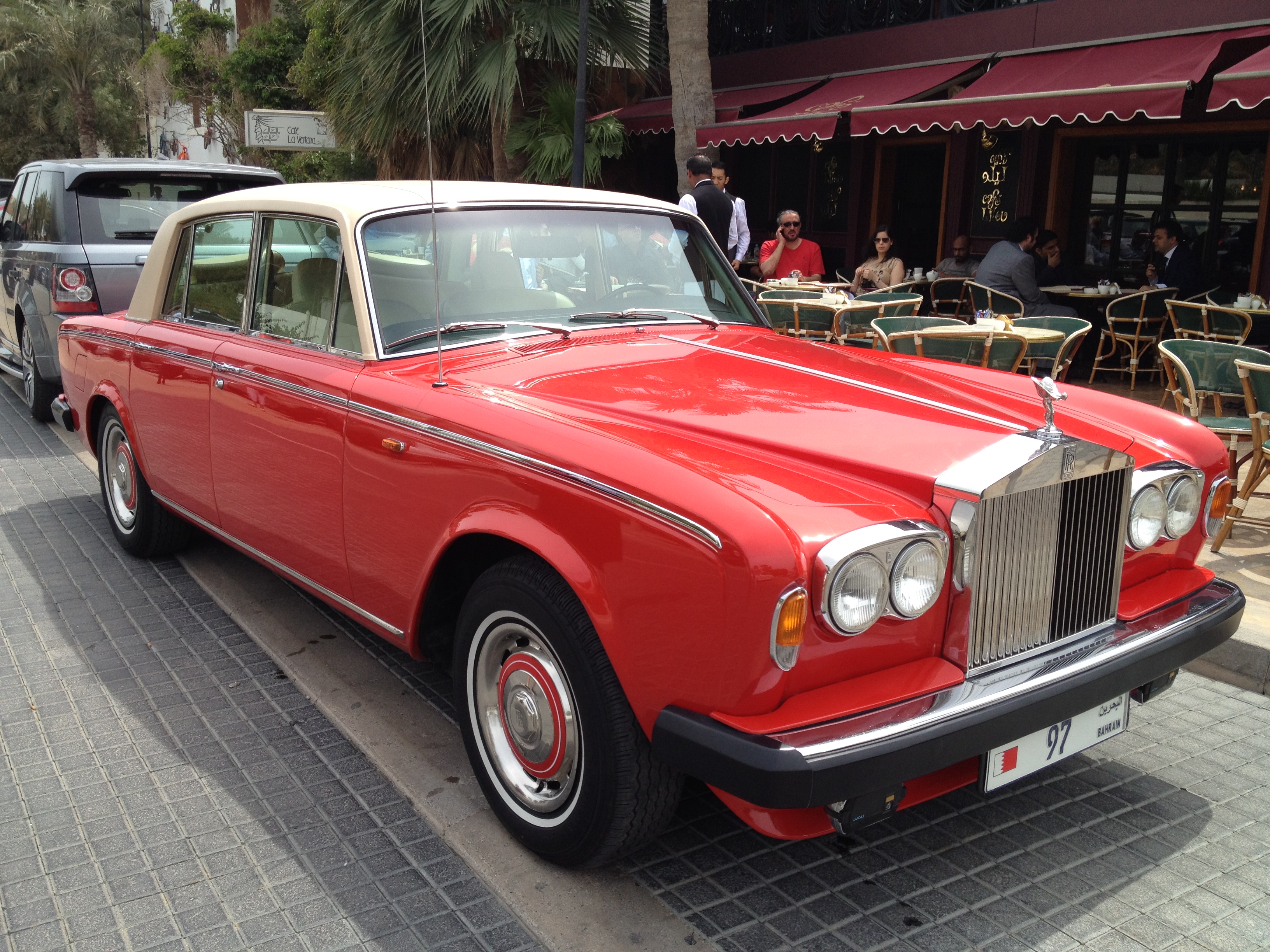
Only in Bahrain have I seen a hand-crafted, Ferrari Red

silk cowboy hat,

thobe and

Rolls Royce.

Beauty at the Burgerland Roundabout

Burgerland Roundabout

“In a sense, all the contemporary crises can be reduced to a crisis about the nature of beauty.

The media are becoming the global mirror and the shows tend to enshrine the ugly as the normal standard.  Beauty is mostly forgotten and made to seem naïve and romantic.

The blindness of property development creates rooms, buildings and suburbs which lack grace and mystery.  Socially this influences the atmosphere in the community.  It also results in the degradation of the environment that we are turning more and more of our beautiful earth into a wasteland.

Much of the stress and emptiness that haunts us can be traced back to our lack of attention to beauty.  Internally, the mind becomes coarse and dull if it remains unvisited by images and thoughts which hold the radiance of beauty.

Beauty offers us an invitation to order, coherence and unity.  When these needs are met, the soul feels at home in the world.”

–          John O’Donohue from Beauty The Invisible Embrace

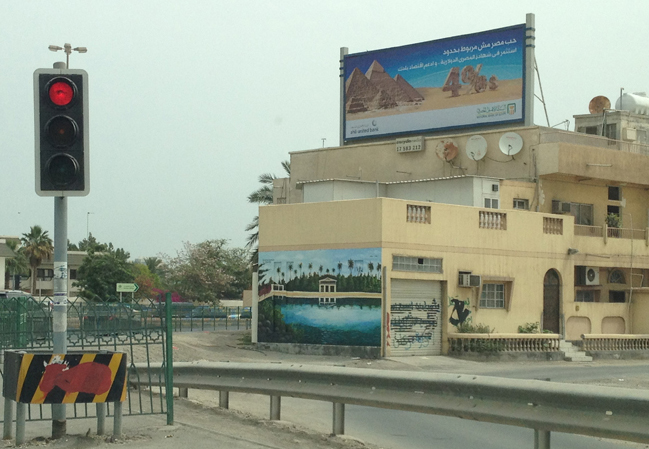
Racing towards Jidhafs the other morning, I was frustrated when I missed the green light.  But as I slowed I saw this new mural painted on the side of the house.

Instantly my heart lifted.   No longer did I need to hurry.  I was surprised how how peaceful I felt as I waited for the light to change.  And I was struck by the power of Beauty.

Thank you Romantic Moments for bringing some Beauty to the Burgerland roundabout.

And thank you John O’Donohue for so eloquently articulating why we need Beauty in our lives.  His book Beauty The Invisible Embrace : Rediscovering the True Source of Compassion Serenity and Hope is “a gentle, urgent call to awaken.”

Another Pomegranate Noir Story

June begins the summer exodus.  People fly to other continents to escape the summer heat.  The school year over, military and expatriate families bid farewell as they move onto their next work assignment.  May is the month for good-bye parties.

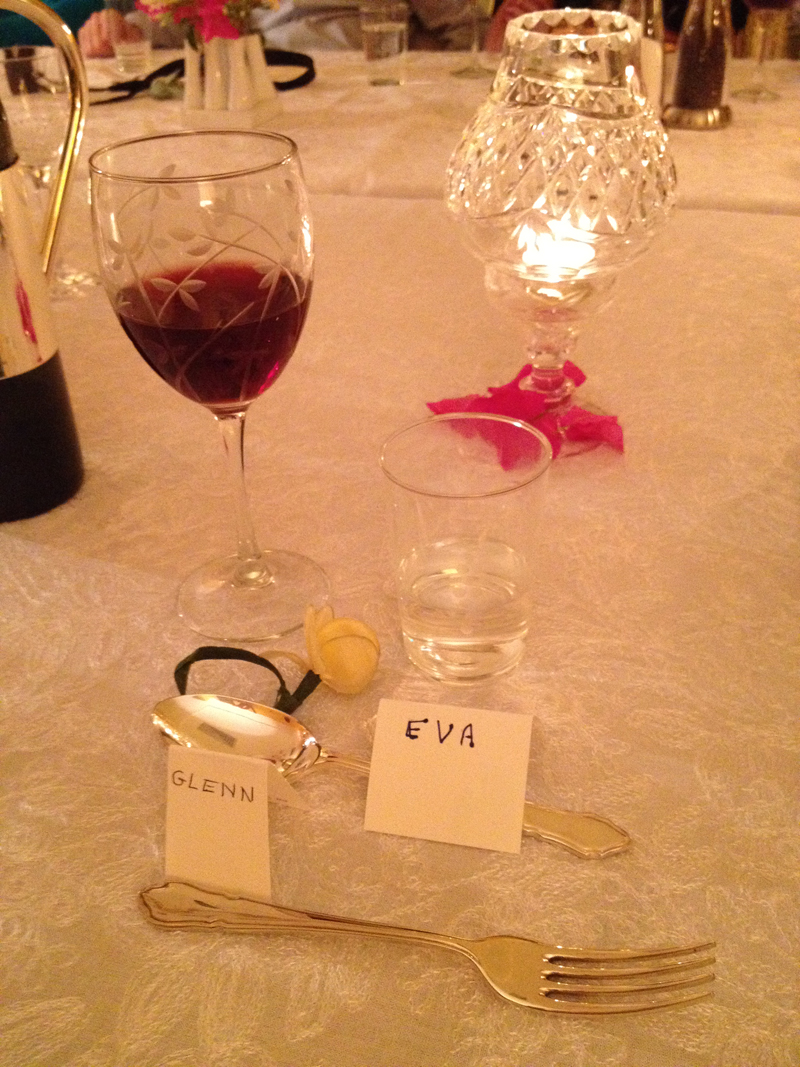
It started with my friend author Melissa van Maasdyk.  She and her husband Glenn are off to Canada for a new life adventure.

Uncertain what exactly they will be doing, at their good-bye dinner we toasted to “future travels,” “a new beginning in Canada, Uruguay or Panama” and “until we meet again.”  To the very end, Melissa lingered with me and her friend Reem, standing in the parking lot, saying good-bye until Glenn gently reminded her they had to catch their plane.

Another blow was the sad news that after successfully launching the Bahrain Writer’s Circle and editing My Beautiful Bahrain, Robin Barratt’s wife got a new job outside of Bahrain.  Soon he will leave to start fresh somewhere else.

His Navy father’s three year stint complete, our baseball team’s star pitcher’s family is moving to some new secret location.

One of the baseball coaches, a teacher and our martial arts trainer, is taking his family back to Washington state to teach at a new school there.

By June 9th my yoga training will be complete.  My teacher, her philosophic husband and a fellow yogini are headed back to their respective countries.

As Bahrain’s future remains uncertain, two ladies from my sculpting class are headed back to Europe.  Several fathers of the children’s school mates and one of sculpture class buddies have been transferred to Dubai where the grass is definitely greener.

And after eight years in the Junior school, Ace and Mark are graduating and following their sister to the Senior school.  No more chauffeuring for me, they will take a bus to school.

Another tearful, hopeful time.

Baby It’s Hot Outside

This was taken on April 29th

Did summer officially start?

A 50 degree change from four months ago.

Playing Baseball in a Shamal

Bahrain’s Minor League

As we drove up to the baseball field the wind blew in from the northeast.  The shamal blocked out the sun and sand filled the air.  But the game wasn’t cancelled.  I consoled the kids.

“You can tell your kids, when I was growing up we used to play baseball during sandstorms.”

Actually it’s been quite a year for Ace, Mark and Susan’s baseball team.

Baseball is NOT Bahrain’s national sport.  However, the season began with enough kids for three teams in the Minor League.  The third team folded within a few weeks as players and coaches quit coming to practice.

Tires burning behind the baseball field.

The two remaining teams played each other 22 times this “season” amidst burning tires and tear gas.  Often they spent hours on the road as traffic was diverted by political demonstrations.

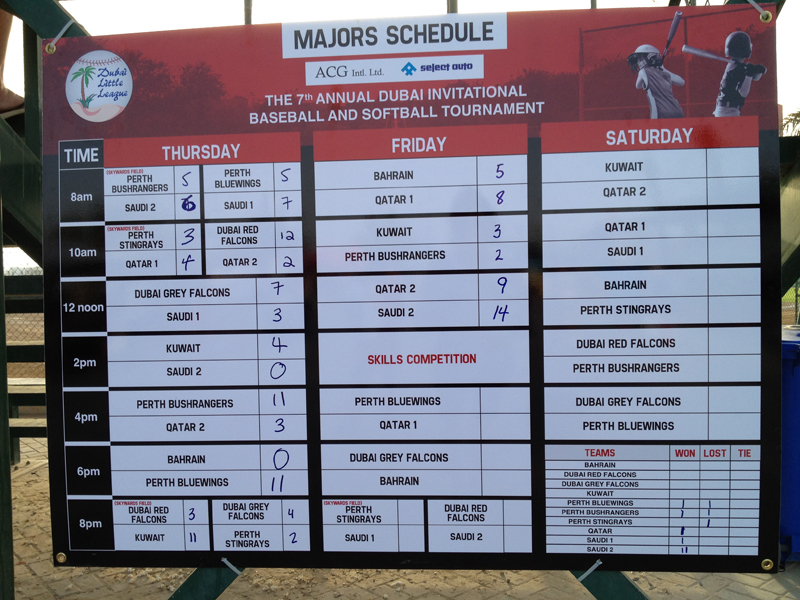
For the top fifteen players, going to Dubai for the Little League Tournament was the highlight of their year.  Saudi Arabia, Kuwait, Qatar and Dubai each fielded two teams of their top players and for the first time, three teams from Perth, Australia showed up.

The Bahrain team played their hearts out and endured despite some tough umpiring.  They lost all their games to Dubai, Qatar and two of the Perth teams.

After forging ahead, the Perth teams recognized they had the upper hand and in both games they displayed good sportsmanship and eased up.  They quit stealing bases and called in their back-up pitchers.  They still won by a huge margin but they did not completely trounce our younger, less experienced team.

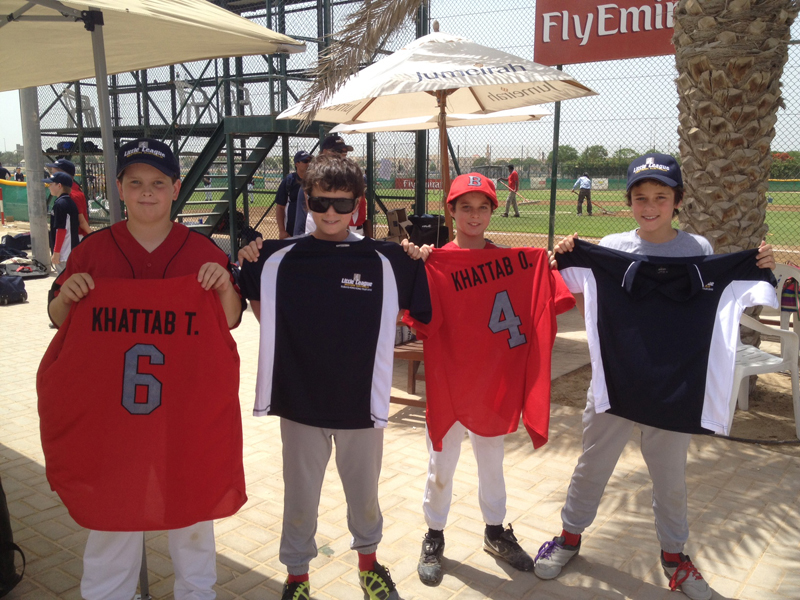
And as they shook hands after the final game, the Perth coach told our kids that they heard about what had been happening in Bahrain.  They wanted to remember them and asked if they could trade jerseys.

Our team eagerly traded their red jerseys for the Perthian blue and white.  The next morning they all went to the Wild Wadi water park together.  The trip ended with heart-felt hugs and promises to see each other at next year’s tournament.

Yesterday morning as he got out of the car, Mark said in an Australian accent,

“Remember to put a shrimp on the barbe for me, Ma.”

Despite the losses, it was a perfect life lesson in sportsmanship, playing for the love of the game and the camaraderie of team sports.

Previous Older Entries Next Newer Entries

Archives

Tales by Chapter