Tidying Up for the New Age

November 13 1833 the night the stars fell

A story my great,great-grandfather used to tell was when he was a young boy working on Erie Canal, he watched the greatest astronomical spectacle in recorded history – The Night The Stars Fell.

What? You never heard of it?

On November 12-13, 1833, watching what they believed were falling stars, people concluded the Day of Judgment had arrived.  The nine-hour, meteor show was so intense the night sky looked like a snow storm.  The story had a happy ending.  The humans survived, and from that night, scientists began formulating their first meteor theories.

Today, scientists are busy posting articles that December 21st is the end of a Mayan calendar cycle, not the apocalypse.  They are also busy debunking the Planet X rumors.

Twelfth Planet by Zecharia Sitchin

In 1976, the late author Zecharia Sitchin claimed in his translation of the Sumerian texts, he rediscovered the lost planet Nibiru, which allegedly orbits the sun once every 3,600 years.  In his translations, Sitchin referred to four regions where the Nefilim resettled man.  The fourth, a “holy” region, was called Til.mun.

Other Sumerian archeologists translate Bahrain’s ancient name as Dilmun.

“Ziusudra, the king, having prostrated himself before An and Enlil…they bestowed eternal life upon him as a god…They installed him in a country overseas: At Dilmun, where the sun rises.”

– Sumerian text l.254-262 from Traces of Paradise: The Archaeology of Bahrain

Gilgamesh and Enki Dilmun era tablets from Bahrain

Gilgamesh holding the lion. The god Enki standing at the head where the two waters meet. Tablets uncovered in Bahrain.

Ziusudra was the Sumerian hero who survived the great flood.  Gilgamesh’s epic journey was to find immortality in Ziusudra’s Paradise.  Over millennia, as the flood story continued to be told, Ziusudra’s name was changed to Noah.

Overtime, Zecharia Sitchin decided Til.mun was not our little island.  He said the texts referred to Til.mun land and Til.mun city, the other being in the Sinai.  But I still think he should have visited the Bahrain Museum and studied the original, Dilmun seals.

Dilmun seal with Enki enclosed in a room  perhaps a teleporter

Dilmun seal on display at the museum. Enki is holding his two jars of water and standing “in an enclosed chamber.” Could that be a teleporter?

This last day of the 13th b’ak’tun in the ancient Mayan calendar system, I am cleaning up my desk.  Living between Dilmun’s ancient tombs, my family and I wait to see whether we, like my great, great-grandfather, live to tell the tale about the dragons and rabbits in Paradise.  I suspect one day, my great, great-grandchildren will read this post and giggle at our quaint notions and antiquated communication systems.

Mayan nay-sayers and doomsdayers aside, I hope a new era is beginning.


Note:  You can read about the Dilmun Seals and learn about Bahrain’s ancient history in this 2000 museum catalog, Traces of Paradise: The Archaeology of Bahrain 2500BC-300AD.  Edited by Harriet Crawford and Michael Rice.
 

A Message from Our Mother “We are of One Heart”

Saffron Restaurant, Muharraq Bahrain

Saffron Restaurant, Muharraq Bahrain

Superman’s appearance in Tahrir Square was not the only sign of hope I saw yesterday.  After applying make-up over my teary face, I drove to Muharraq to meet my Bahraini friend for breakfast.  We agreed to meet “in the big parking lot” before walking over to Saffron together.

A busload of school girls and their mothers crowded the alley’s entrance.

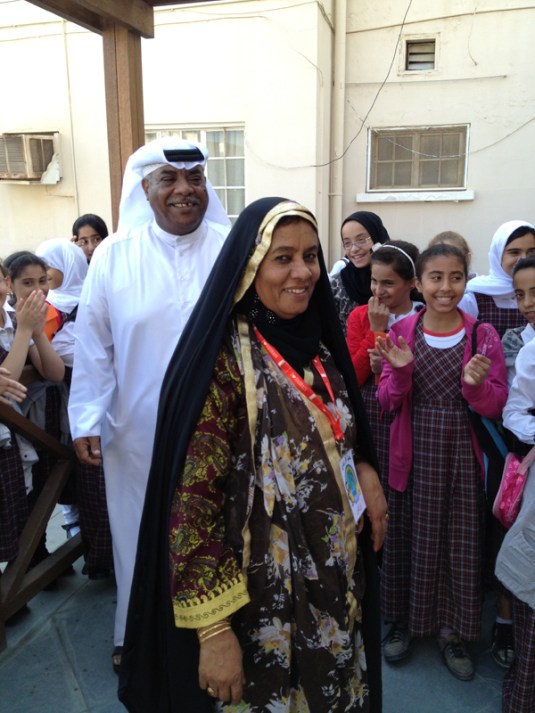
Um Hassan and school girls in Muharraq Bahrain

“Hello, hello,” the girls said to me, practicing their English.

My friend recognized the elderly woman the girls were gathered around.

“Salam alay-kum Um Hassan,” she called out to her, waving.

The woman returned the greeting and waved to us.

“Who is that?” I asked.

“Um Hassan.  The mother of Bahrain,” my friend told me.  “I recognize her from the television.”

“When the teachers started protesting at the Pearl Roundabout, she was the first woman who volunteered to go help in the schools.  She is not educated, but she did not want the schools to be shut down.  They interviewed her and she talked about how Bahrain and all Bahrainis were her children.  Her speech moved many people.  It was repeated over and over again.”

“My Children you are the crown on my head. You are my children and the children of Bahrain … All of us are One and are of one heart. Our flag is red like our hearts. My Child, Bahrain, deserves the best.  It raised us.  Since we were born, all we saw was Bahrain. We are on one track.  We want One heart. Our heart is red like our flag but it’s pure and white and we love everyone and our people are one.”

“Let’s meet her,” I said.

“You want to?” my friend asked.

“Of course.” I said, diving into the girls.

As the Mother of Bahrain held out her arms to embrace me, the abaya-clad women took photos.

Um Hassan The Mother of Bahrain in Muharraq Bahrain

“Our King is the bird and we are the two wings.  A bird can’t fly with one wing and I say, May God guide everyone, all of us, Sunna and Shia.  This land – we will not fail it.”

These revolutions are not just about the youth.  Superman and Um Hassan are carrying messages and lessons learned from all those who have gone, and suffered, before us.

“And please forgive me. I love you and love the land that you walk on. I love you my children. Maybe good will come out of this harm.

The spirit has awoken and you have all awoken and gathered around. May God bless you.”

– Quotes from Um Hassan’s speech to the Second Gathering of National Unity.

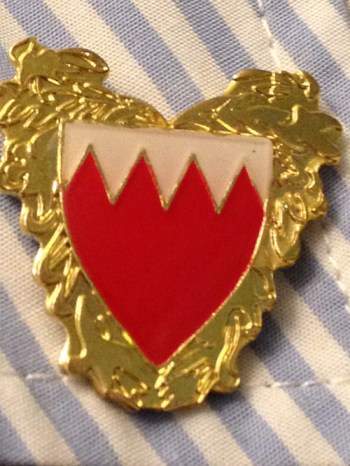
Um Hassan Bahraini Emblem given to me by Um Hassan

Bahrain pin given to me by Um Hassan

It’s Okay to Think about Christmas Now

I enjoy the anticipation of seasonal events: the start of the school year in September, Halloween in October, Thanksgiving in November, and finally, a month of Christmas season celebrations in December.  But that’s not how it works anymore in the USA.

School starts in August while the sun is still hot and the pool is cool.  Spooky/sexy costumes are displayed in Halloween stores in September.

Yesterday, a baseball acquaintance said her family was going “to do” Thanksgiving today.  I am sorry, if you miss Halloween or Thanksgiving, you’ve missed it.  There is no do-over.  The point of a designated holiday is everyone celebrates at the same time, giving the day a special energy.

The only “holiday” Americans seem to agree upon, and that grows in importance every year, is Black Friday, the big shopping day after Thanksgiving.   However even Black Friday’s mayhem has been diluted by Christmas carols echoing through the malls in November.  The early Christmas, shopping virus is spreading faster than H1N1.  Christmas trees and elves have been setting up shop in Bahrain since early November.  It is not right.

I think the stores should close on Wednesday, put out their Christmas merchandise, then re-open on Friday, blaring their Christmas music, hopefully surprising and delighting their customers with their displays.

Wednesday November 28th is the Winter’s Tale Bazaar.  Although winter here means the temperature has dropped to the mid-80s and the bazaar will be held on the floating islands, at least we have put away our kitschy, Thanksgiving decorations.

Messing Around with Bad Deeds

Ad in Thursday’s newspaper

“Haraam” people say here when something bad happens.  Technically, haraam actions are those that violate Islamic prohibitions.

The kiraaman kaatibeen are the angels who sit on our left shoulders and record our haraam or bad deeds.  But, it is not only angels who notice haraam things.  If I tell a sad story, such as a friend having breast cancer, then the listener will say “haraam” to express their agreement that it is a sad situation.

When I first moved to Bahrain I remember chatting with a Bahraini store clerk.  It was clear he was unhappy with his job working in the mall.

“Haraam”, he said without a smile when I told him my family had just moved here.

“You think Bahrain is haraam?” I asked.  “Why haraam?  You have a job.  The government pays for your schooling and health care.  You live with your family.  Bahrain is a nice, peaceful place.”

“The whole Middle East is haraam right now.  I don’t know when things will get better,” he told me.

I walked out feeling bad for him and his hopeless outlook.  Bahrain was his country and he was young.  He was not willing to give up everything and take the risk to start over, as a nobody, somewhere else.

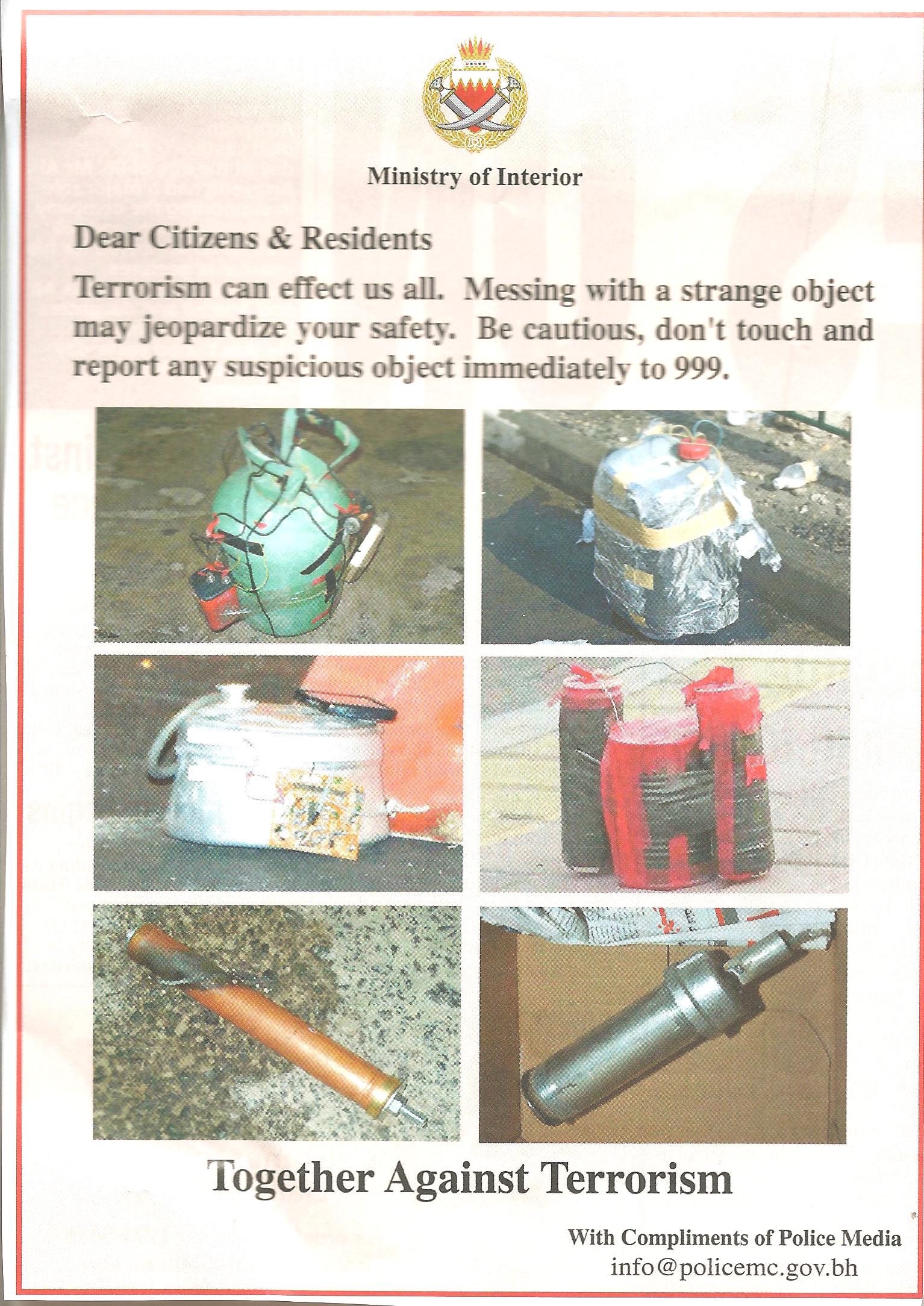
This region is filled with expatriate workers who take a huge risk to come here.  Most laborers are so poor and with little hope for work in their own country, that, for $150 per month, they pay an agent a job-finding fee and leave their families to pick up garbage.  Nine years later, I remembered my conversation with the young man when I read about two Bangladeshi, street cleaners killed by a homemade explosive, hidden in a trash bin.

The angel on my shoulder cringed.

“Haraam,” he said.

Repose After the Summer Heat

للا يوجد شيء إلا بعد المشقة راحة

There is nothing after hardship except repose.

After a storm comes a calm.

from “Apricots Tomorrow” by Primrose Arnander

A Saudi Cocktail

A run into Saudi to renew my visa starts with a tense breakfast.  The tension only diminishes when we see the Bahraini shore.

As my mere black-enveloped presence in the Immigration Office might cause a riot, Mojo drops me off at my place of choice while he takes care of business.

I used to wait at a nearby Starbucks and read, but two trips before a mutawa, a religious “policeman”, knocked on the locked door during prayer.  A lone man, he marched into the family section to berate the Saudi women who were not praying and who allowed their scarves to slide off their hair.  He did not speak to me but he scolded the baristas.  The last visit the staff kicked me out during prayer.  I stood outside sweating after they locked the doors.

Driving in Saudi Arabia is not known to be a relaxing experience.  An everyday commute is more like a NASCAR race than the jammed, but orderly, Los Angeles freeways.  The constant vigil for sober drivers in the right lane deciding to take a left turn in front of you to chase down women on the other side of the three lane highway combined with road construction are the first ingredients for a Saudi Cocktail.

After an hour of sipping that cocktail, even the most agreeable couples explode.

Running late as usual meant we arrived an hour before mid-morning prayer.  The Dhahran/Khobar road was under construction in both directions without any exits or signs.  After driving twenty minutes in a circle that took us no where, Mojo shouted.

“Just drop me off at the Dhahran Mall,” I shouted back unable to stand the tension any longer.

He did only to find his ten-minute drive took seventy-five minutes due to a three car collision.  When I got his first text that he had just arrived I had barely walked halfway around the huge mall.  As I rounded Gate 9, prayer was called and all the businesses shut down.  I sat down and there across the aisle was the newly opened Pottery Barn.  Ah – a taste of home.

After prayer I rushed over to buy picture frames before Mojo showed up.  I was the only woman in a store with ten male salesmen who did not know the merchandise and one old Bangladeshi man who had the unenviable job of dusting the thousands of glass items on display.  I knew exactly what I wanted.  I walked through the store and discovered Thanksgiving turkey dishes I would never find again.  Finally I found the gallery frames way in the back behind the rugs.

Loading my items on the counter, I got another text.

“Eight guys ahead of me.  What are you doing?”

“Pottery Barn opened here.”

“Uh oh” was his response.

I still had time.

I raced to see the king-sized sheets.

Another text.

“Three guys ahead of me.  Officer decided to take a break.”

Still more time.  I circled around again and discovered even more things I never knew we needed.  Thirty-seven items in eight shopping bags later, I got the final text.

“On way, meet you at Gate 3.”

“Sorry,” I texted back, “ you MUST meet me at Gate 9.  I have too much stuff.”

He pulled up and the man with the trolley loaded the trunk.  As Mojo complained about his experience all the way home, we got to the middle of the causeway where immigration and customs met.

Still on the Saudi side, I pointed out the line with only one car but the immigration officer’s window would be on my side, the passenger side.

“You are willing to hand him the passports?” Mojo asked.

“Sure,” I said.  “It doesn’t bother me.”

As I rolled down my window, Mojo reached across me and handed the passports over to the young uniformed man.

“I didn’t want to insult him,” he whispered.

Just breathe, I said to myself.  I omitted the OM in case that might insult someone.

On the Bahrain side, 75% of the customs lanes were closed as they did something to the roads.  Like a herd of cattle being prodded with electric pokers, all the beeping cars funneled into the two open lanes.  Thinking of the trunk full of packages, I decided it was time to lift my sunglasses and wave to the customs officer when he bent over to tell Mojo to pop the trunk.

Mojo got out to review my purchases with the officer.  It did not take any time at all.

“Funny,” Mojo said.  “I remember you saying just this morning before we left how you were not going to buy anything.  You want to be able to walk away from everything we have.  And now you bought all this stuff.”

“That was before you screamed at me.”

“I screamed at you?  I didn’t scream at you.  I was screaming in frustration.”

“But I was the only one in the car….”

And that’s how our outing across the bridge ended – with a Saudi cocktail.

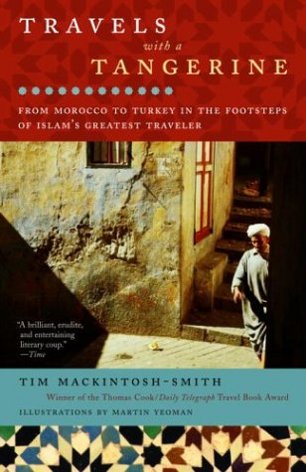
Speaking of Tim Mackintosh-Smith

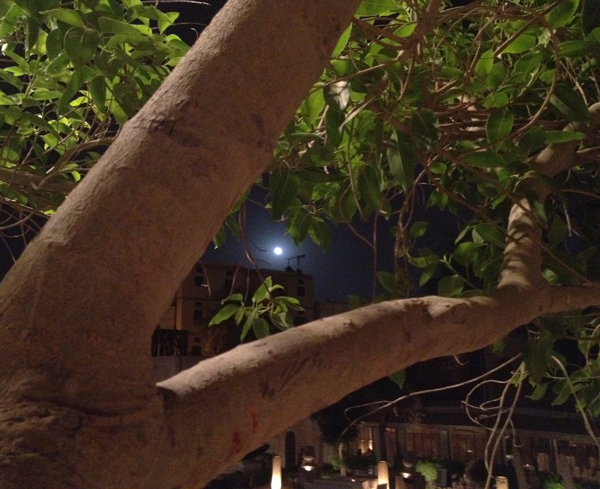
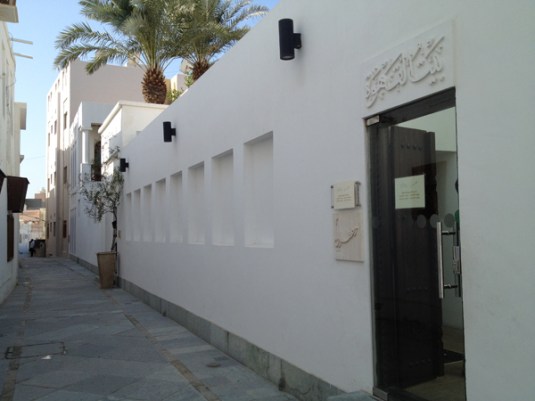
Fatima Ali Raza, the owner of La Fontaine Center for Contemporary Art, invited me for dinner.  As we ate under the moon, she asked me,

“You know Ibn Battuta don’t you,” she began.  Her eyes sparkled.

Ibn Battuta, Ibn Battutua, the name echoed in my brain.  However, no thoughts came to mind.

“No,” I admitted.

“Ibn Battuta was an Arab explorer.  He traveled from Tangier to China and covered more parts of the world than Marco Polo.  So many people do not know who he is.  And do you know who I have coming to La Fontaine?”

“Ibn Battuta’s ghost?”

She paused, “Tim Mackintosh-Smith, the expert on Ibn Battuta.”

Now it registered.

At the 2011 Dubai Literary Festival, my friends, Deborah and Maeve, went to his lecture.  The British Mackintosh-Smith is an Arabist living in Yemen.  He is the go-to man for anything about Yemen – and Ibn Battuta.

Mackintosh-Smith literally re-traced Ibn Battuta’s footsteps around the world.  Then he condensed the 14th century traveler’s thirty years of travel into a trilogy.  Travels with a Tangerine, the first in the series, made it to the best sellers list.

“For three years I have been inviting Mackintosh-Smith to Bahrain.  And he finally accepted.  He will be coming in November.  We are planning to offer several workshops over the three days he is here, both in Arabic and English,” Fatima announced triumphantly.

“That’s fantastic,” I said.  “Now I know what to suggest to my book club.”

“But don’t read all of his books.  I am ordering some for the event.”

I decided to see how well-known Ibn Battuta was.  I posed the question to Mojo who corrects my American history mistakes.

“If I say Ibn Battuta what comes to your mind?” I asked him.

“The Ibn Battuta Mall in Dubai.”

“Have I got a gift for you.”

Get ready for this November event at La Fontaine by reading Tim Mackintosh-Smith’s Travels with a Tangerine.

La Fontaine Center for Contemporary Art is featured in The Best of Bahrain vol. 2 which is being launched this Saturday, September 15th, 2012.

Previous Older Entries Next Newer Entries

Archives

Tales by Chapter